The Hubble Space Telescope captures a distant solar system
Advertisement
In astronomy, a transit is a term describing a situation in which an astronomical body, such as a star or a planet, partially obscures a more distant body. One example of an astronomical transit is the passage of the planet Venus in front of the Sun. The angular size of Venus is much smaller than the Sun’s apparent size in the sky, so it does not cover the Sun completely (as would happen during a solar eclipse, for instance, when the Moon blocks the Sun). Instead, the planet blocks only a small fraction of the Sun’s light.
The universe around us is dynamic; the stars, planets, and galaxies—clusters of hundreds of billions of stars—are constantly moving in different directions. Beyond the surrounding universe, Earth itself is continually orbiting the Sun. Therefore, it should come as no surprise that such astronomical transits occur around us all the time. Recently, the Hubble Space Telescope captured an especially remarkable transit. During this event, a star in our own Milky Way galaxy passed in front of a galaxy much farther away and blocked its light. The star, bearing the catchy name HD 107146, is a Sun-like star located 90 light-years from Earth—about 900 trillion kilometers.
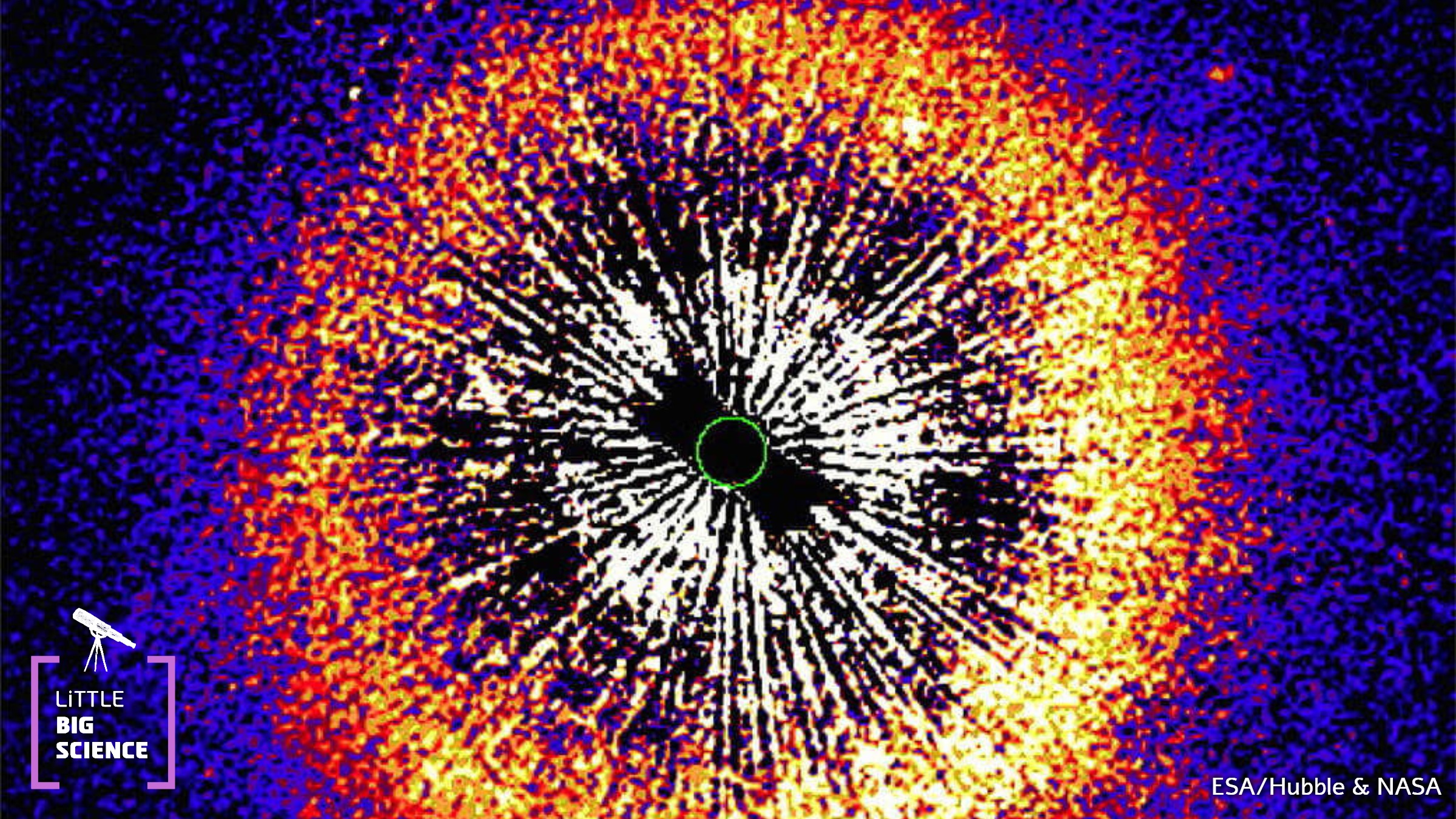
In the image, the star (masked by a black disk edged in green that blocks its light) is surrounded by an orange-highlighted ring. This ring, which probably resembles a three-dimensional bagel, is a reservoir of material orbiting the star that contains gas, dust, and rocks of various sizes, from dwarf planets to asteroids. Scientists suspect that every star, like our Sun, has a similar disk. However, because the objects within it do not emit light, they cannot be observed with an ordinary telescope. During the transit of HD 107146 in front of the distant galaxy, the material disk obscured the galaxy’s light and gave us a fleeting glimpse of the disk’s structure and composition.
Because both objects are extremely far from Earth, the transit lasts a very long time, and the maximum light blockage will occur only three years from now, in 2020. Until then, researchers will gather extensive data on the structure of the material disk encircling the star—its composition, density, and dynamic architecture. This information will help illuminate the processes by which stars and distant solar systems form, and it may also teach us about the formation of our own Solar System.
English editing: Elee Shimshoni