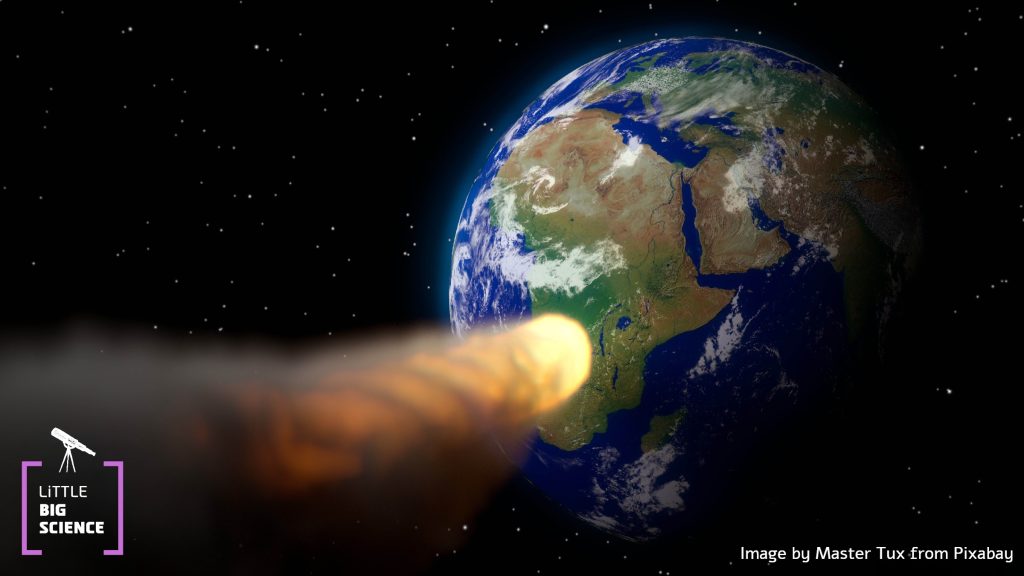
Every few months, news headlines exclaim: “A gigantic asteroid the size of the Empire State Building is on its way to us”; “An asteroid the size of a football field could hit Earth”; “An asteroid like the one that wiped out the dinosaurs is coming at us”; or “Time to panic—an asteroid is about to destroy us.” We will explain where these reports come from and the facts behind them, and find out—do asteroids really pose a danger to us?
Advertisement
Every few months we come across headlines warning us from an asteroid that is getting dangerously close and could wipe us all out [1]. The wording is scary and deliberately alarming (click-bait), yet the panic is unwarranted: although some of us may secretly hope for such drama, the likelihood that an asteroid will exterminate humanity in the near future is very small.
Still, history shows that it can happen: enormous asteroids have struck Earth and caused global catastrophes. One such impact is thought to have wiped out the dinosaurs. To gauge the risk and prepare in advance, various countries and space agencies monitor celestial objects that pass nearby. But what counts as “nearby”? Near what, and how near?
Because distances in space are vast, measuring them in kilometers is inconvenient. Astronomers therefore defined a new unit—the unsurprisingly named astronomical unit (AU). One AU equals the average distance between Earth and the Sun, roughly 151 million kilometers. An object is considered "near" to Earth if its orbit brings it to within 1.3 AU of the Sun [2]. In other words, any object whose path brings it within 196 million kilometers of the Sun is classified as near-Earth, and we keep track of it.
Note that this definition depends only on the object’s distance from the Sun, not on its distance from Earth: we draw a “shell” around the Sun, close (in astronomical terms) to Earth’s orbit, and watch any object that enters this shell, regardless of how far it is from Earth. For example, an asteroid might reach exactly Earth’s distance from the Sun, yet while the asteroid is approaching the Sun, Earth could be on the opposite side of its orbit (see Figure 1). Such an asteroid is still tagged as near-Earth, and we monitor it.
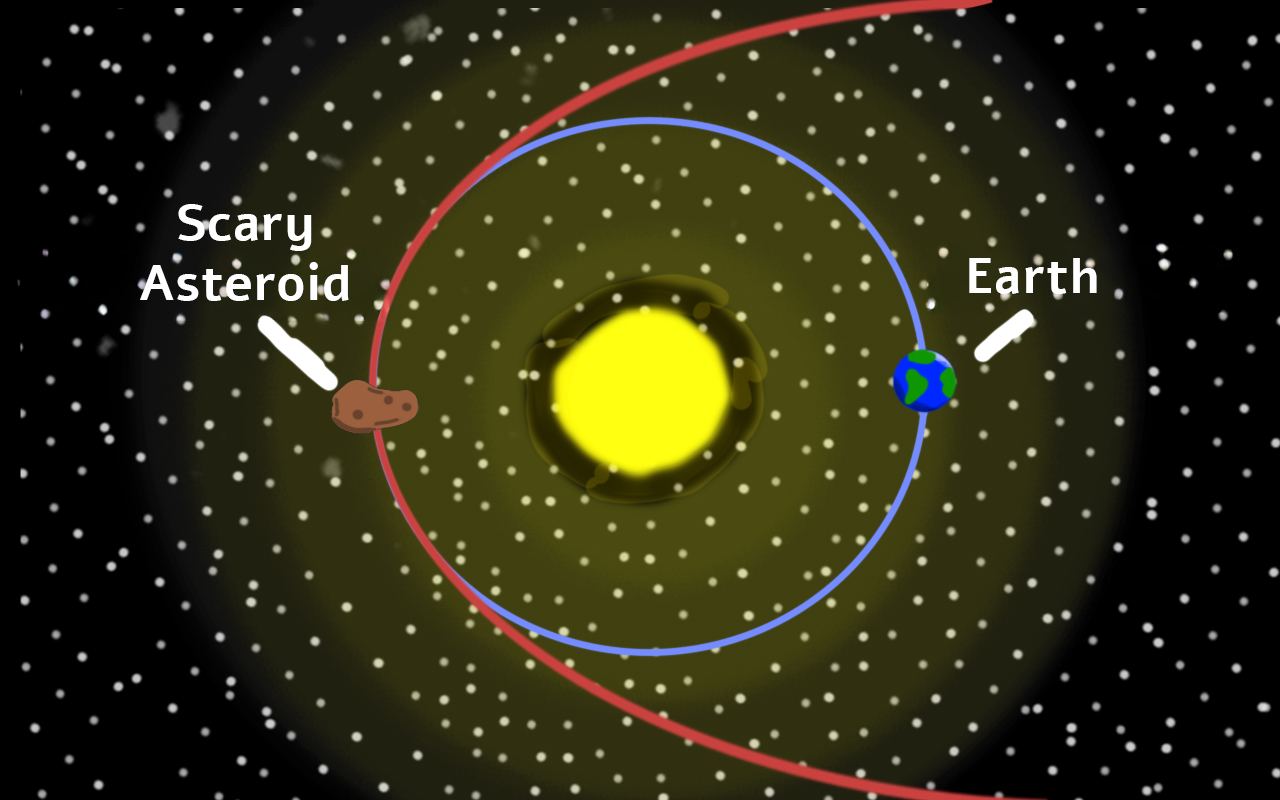
Figure 1
Space agencies currently track about 26,000 objects that meet this definition [3]. Some are only a few meters to a few dozen meters in diameter, others span hundreds of meters, and a few are a kilometer or more (see Figure 2, [3]).
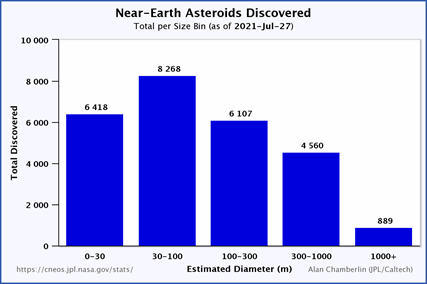
Figure 2
Once we have observed an object, we can plot its past trajectory. Using that path and Kepler’s equations of motion (see more on Kepler’s laws in our articles on orbits [4, 5]), astronomers can project the object’s future orbit, determine how close it will come to Earth, and estimate the probability of impact.
Astronomers define a very close encounter as an approach to within 0.2 AU of Earth—or less. That is, an astronomical “flyby” occurs when an object comes within 30 million kilometers of our planet. Does that sound close? It is roughly 100 times farther than the distance to the Moon! So when a NASA astronomer announces an upcoming encounter with an asteroid, the separation is usually several times the distance between the Earth and the Moon. True, it is not rare for a sizeable object to pass inside the lunar orbit, but even in those cases the chance of collision is still very small.
Although, as we explained herein, the risk of a devastating impact is low, space agencies nevertheless prepare for the possibility that a celestial object might come too close. Contingency plans include several methods for nudging an asteroid off course. These plans do not involve assembling a crack team of oil-drillers led by Bruce Willis, but they do let us sleep soundly without fearing that the sky will fall.
Illustration: Noga Denenberg
Hebrew editing: Smadar Raban
English editing: Elee Shimshoni
Sources and further reading:
- Fox29 An asteroid taller than the Empire State Building may crash into Earth
- UN site: Monitoring near-Earth objects
- NASA: Size distribution of near-Earth objects
- Orbits in Space: Part I
- Orbits in Space, Part B

Elad is a lecturer in the Mechanical Engineering Department at Brauda Academic College of Engineering in Karmiel. He holds a PhD in Autonomous Systems and Robotics and is actively engaged in research in artificial intelligence and optimization.


