
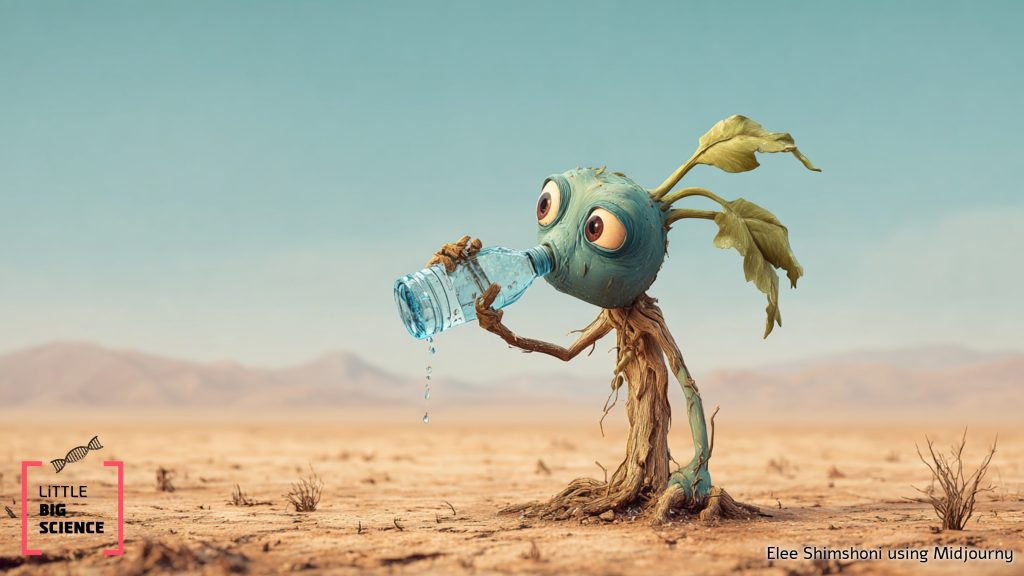
A new study found that when plants recover from drought, they activate an immune response that protects them from disease—even before they resume investing resources in renewed growth.
Advertisement
Drought is one of the environmental conditions that pose the greatest threat to agriculture today. Under drought stress, many plants slow their growth to conserve water, which leads to a significant reduction in yield [1]. Although this field has been investigated for many years and we possess extensive knowledge about how plants cope with drought, researchers still struggle to develop plant varieties that are drought-resistant while meeting agricultural standards—varieties that are robust under field conditions and have at least as much yield as today’s successful commercial crops.
In a study we recently published in the journal Nature Communications, we focused on a less explored phase of a plant’s response to changes in water availability—the phase in which water supply is restored after a drought period [2]. We used the model plant thale cress (Arabidopsis thaliana), the botanical equivalent of the laboratory mouse in biomedical research.
First, we examined whether there are genes that are activated only during recovery from drought. We discovered more than 3,000 genes that are not expressed in response to drought itself but rather in response to re-watering during recovery. This response was monitored at eight time points, from 15 minutes to 48 hours after irrigation was resumed, allowing us to follow gene-expression changes over short and long time frames during recovery.
Next, we wanted to determine whether different cell types in the leaf respond differently to re-watering. To this end, we used single-cell RNA sequencing (scRNA-seq).
What do we mean by “cell types in the leaf”? A leaf contains several tissues, and each tissue contains distinct cell types. For example, in the epidermis, the outer layer of the leaf, there are, among others, “trichomes”—hair-like cells, and “guard cells”—responsible for the opening and closing of stomata, which are small pores in the leaf that allow water evaporation and the entry of carbon dioxide needed for photosynthesis.
After mapping which cells activate which genes in response to drought and to recovery, we used an intriguing method that enabled us to see precisely where these genes are expressed—directly on the leaf tissue. Using MERFISH, we could pinpoint the exact physical location of gene expression in response to drought and during recovery—of not just one gene but a thousand genes simultaneously! (See an example showing three genes in Figure 1.)
A particularly interesting finding was that many of the genes activated in the minutes immediately after re-watering are linked to the plant’s immune system. We were surprised to find that these genes were turned on at the start of recovery from drought, even in the absence of disease-causing microbes in the environment. In other words, the plant initiates a kind of preventive immune response at the beginning of recovery.

Figure 1: Gene expression in a leaf after a seven-day drought period (top) and 15 minutes later, during recovery from drought (bottom). Each dot in the cross-sections represents a transcript, a gene that was expressed. The different colors (purple, green, and blue) represent three genes expressed specifically in the early stage of re-watering. Credit: Natanella Illouz-Eliaz.
But why does the plant invest energy in activating the immune system at this stage? Previous studies have shown that under drought conditions the plant suppresses immune-related genes [3]. The stomata we mentioned earlier are also involved: under optimal conditions, guard cells open and close stomata during the day to maintain proper water balance. During drought, when water is scarce, guard cells close to prevent water loss. After rainfall or irrigation, the plant reopens stomata, allowing renewed water flow from the roots to the aerial parts. However, this opening also creates a vulnerability—disease-causing agents can enter leaf tissues, for example through rain droplets that may contain various microorganisms [4], some harmful to the plant. Thus, the recovery phase is not only a moment of renewed life but also a stage of heightened susceptibility (Figure 2). The hypothesis is that plants have evolved a preventive defense system that protects them from pathogen infection during recovery from drought.
Another important finding: when we followed the plants over time during recovery, we found that genes related to growth and cell elongation are activated only about two hours after re-watering and only after the immune system has been initiated. It appears that the plant first focuses on protection and prevention and only then allocates resources to growth and normal development.

Figure 2. A model illustrating the relationship between water availability and activation of the plant immune system. Under optimal irrigation (left), there is a balance between the plant’s immune system and the biotic factors to which the root and above-ground parts are exposed. During drought (middle), when water availability decreases, the immune system is suppressed and the leaf stomata close. A dry environment is unfavorable for disease-causing microbes, both for infecting the plant and for growth. During recovery from drought—after irrigation resumes (right)—stomata open rapidly while the immune system is weakened due to drought stress, and a range of microbes arrive with the water flow to the recovering leaf tissue. These conditions place the leaf at risk in the earliest moments of recovery. The genes we identified that are activated immediately upon re-watering are likely involved in triggering the immune system at this vulnerable stage. Credit: Rob Soto
Why is all this important? Drought is one of the main threats to agriculture in the era of climate change. Even if a plant survives a dry spell, it can be harmed precisely when irrigation is restored—perhaps due to diseases, or due to general difficulty returning to an optimal, productive growth state, or both. A deep understanding of recovery processes from drought and of how the plant activates the preventive “immune system” described here may enable the development of new crop varieties—such as wheat, rice, and maize—that are not only more drought-tolerant but also more disease-resistant, thereby producing more stable yields under changing environmental conditions.
Natanella Illouz-Eliaz is a postdoctoral researcher at the Salk Institute in California. Her research explores how plants cope with environmental stresses, especially drought, and the lasting impact of such stresses even after they subside. She seeks to uncover mechanisms not yet known to science by which plants recover from stress, with the aim of developing more resilient crops in a world facing extreme climates.
Hebrew editing: Smadar Raban
English editing: Elee Shimshoni
References:


