Advertisement
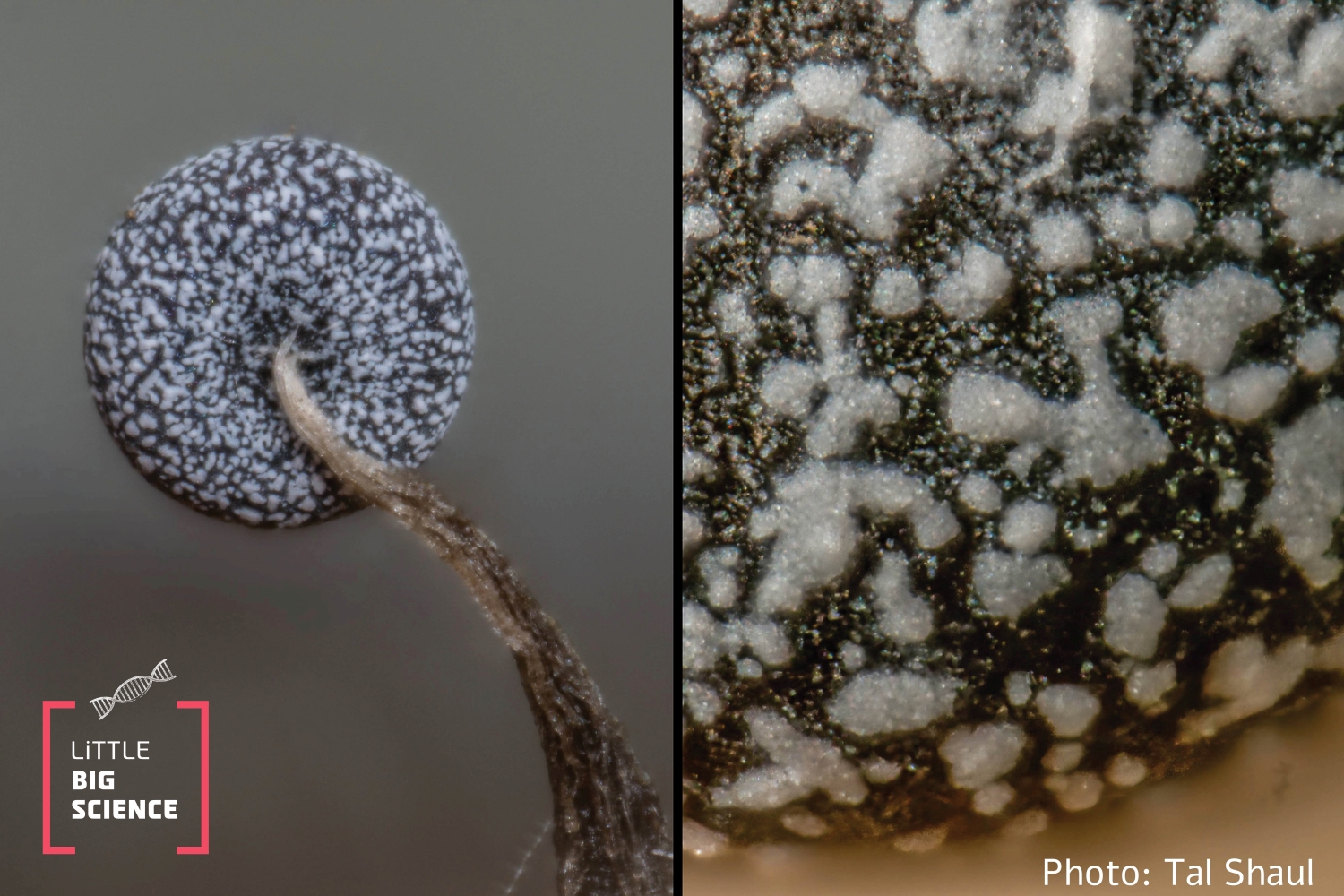
In the image: a slime mold called Physarum album, whose genus name comes from the greek word for "bubble" [1], shown at 10× magnification (left) and 50× magnification (right). Its actual size is about two millimeters.
Slime molds, or myxomycetes [2], are extraordinary organisms: they are neither fungi nor animals, but single-celled amoeboid creatures. These organisms spend much of their lives as a creeping, feeding mass, and later organize into fruiting bodies for spore dispersal. Many slime-mold species (like the one in the image) absorb dissolved calcium from their surroundings and, during the formation of the fruiting body, cause it to precipitate as amorphous calcium carbonate—meaning it lacks an ordered crystalline structure—within an organic network of proteins and polysaccharides. This process creates a calcareous coating, clearly visible in the high-magnification image. The coating primarily envelops the outer wall (the peridium), and in certain species may also appear in other parts of the fruiting body [3]. This mineral-biological layer stiffens the otherwise soft structure, protects the spores from damage and from drying, stabilizes the tiny fruiting body, and allows it to sway gently in the air—thereby aiding efficient spore dispersal [4].
Photo: Tal Shaul
Hebrew editing: Smadar Raban
English editing: Elee Shimshoni
References:
- Physarum album on iNaturalist for crowsourcing nature observations
- Myxomycetes on Encyclopedia Britannica
- Zhang, Jz., Liu, Ln., Fiore-Donno, A.M. et al. Ultrastructural characters of a Physarum melleum on living leaves of Dendrobium candidum in China. J. Zhejiang Univ. – Sci. B 8, 896–899 (2007).
- Garvie, L.A.J., Németh, P. & Trif, L. An exceptionally stable and widespread hydrated amorphous calcium carbonate precipitated by the dog vomit slime mold Fuligo septica (Myxogastria). Sci Rep 12, 3642 (2022).

Noa holds a PhD in Physics from the Technion and is currently a postdoctoral researcher at the Princeton Gravity Initiative at Princeton University. Her research focuses on quantum effects on black hole backgrounds. She also serves as a scientific editor at “Little, Big Science".


