
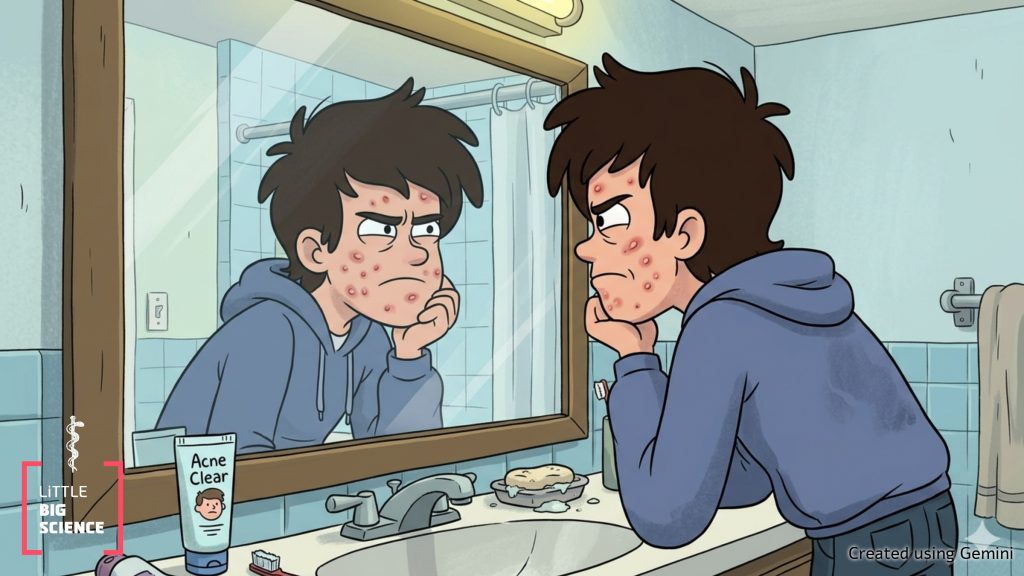
Treatments for acne are generally short-term and local, or they are systemic but come with side effects. New studies are seeking a solution that will be effective in the long term and will eliminate acne entirely. Two new vaccines are currently under development; one aims to familiarize the immune system with the bacteria that exacerbate the condition, and the other with the key enzyme those bacteria secrete.
Advertisement
Acne manifests as the appearance of facial lesions, but can sometimes also appear on other parts of the body. These lesions are colloquially called “pimples” or “zits,” and in medical terminology comedones. They form when sebum and dead skin cells accumulate, clogging pores and hair follicles.
Excess sebum secretion results from hormonal changes, chiefly an increase in the hormone testosterone. There are two types of pimples: blackheads—partially open lesions in which the sebum darkens, and whiteheads, which are closed lesions. This is the mild stage, and the number of pimples can be reduced with salicylic acid or retinoic acid.
At a more advanced stage, the pimples become infected with bacteria called Cutibacterium acnes (formerly called Propionibacterium acne). These bacteria, which live on the skin as part of the normal flora, settle in the sebaceous glands beneath the skin. There they secrete the enzyme hyaluronidase, which breaks down hyaluronic acid—a key component of skin tissue. Degradation of hyaluronic acid triggers local inflammation, which causes deterioration in the condition of these lesions. Picking or scratching the lesions can lead to scars called pockmarks.
Although about 231 million people suffer from acne, and for a long time it was considered merely a cosmetic problem rather than a medical one. This view is now changing, and acne is treated as a medical condition worthy of therapy, chiefly because it usually appears during adolescence—a period when physical appearance is highly important. Acne has been shown to lead to depression and social challenges in adolescents [1]. Nevertheless, acne can also appear later in life.
Sanofi is developing a vaccine intended for people who already suffer from acne [2, 3, 4]. Unlike what we usually call a “vaccine”, in this case it is a treatment for an active disease that works by stimulating the immune system, and there is reason to believe that it could also prevent future recurrences. The company examined two ways to enable the immune system to recognize the bacterial envelope protein that causes the disease. One approach used the proteins themselves; the other used mRNA segments that encode them, similar to the COVID-19 vaccine [5].
In an initial study in rats, the mRNA segments proved more effective at eliciting antibodies that react with the bacteria, so the mRNA vaccine advanced to first-in-human clinical trials: Participants include 400 volunteers with moderate acne in the United States and 200 additional volunteers with mild acne in Singapore. The trials will help determine the number of doses—two or three—and the amount of mRNA required in each dose. Follow-up after vaccine (or placebo) administration will last about 30 months, so the trial is expected to conclude in August 2028.
A second vaccination strategy is being developed as well. A research group led by George Liu at the University of California, San Diego, is focusing on the enzyme hyaluronidase [6]. Liu and colleagues injected mice with protein fragments of the enzyme. Then, they “humanized” the mouse skin by applying sebum to it and infected the mice with the acne bacteria. The vaccine prevented the development of acne in the immunized mice. In this case, the intention appears to be to develop a preventive vaccine. The vaccine is now being developed by Armora Biosciences but is still in preclinical stages.
In summary, Sanofi’s vaccine has been in human clinical trials since April 2024 [6], and they are expected to end in 2028. If the vaccine is approved, many people will likely seek it to eliminate acne, and perhaps even to be vaccinated preventively.
Because the second vaccine has not yet been tested in humans, its development path is longer, and it will have to demonstrate efficacy and safety in people.
We shall wait patiently.
Hebrew editing: Smadar Raban
English editing: Elee Shimshoni
References:
- On the link between acne and depression—review in Journal of the American Academy of Dermatology, August 2020
- Review of the two vaccines—Nature, August 2025
- Article in Life Science about the Sanofi vaccine, April 2025
- Sanofi trial registration, March 2024
- How does an mRNA vaccine work?, National Human Genome Research Institute
- The paper on the anti-hyaluronidase vaccine—from Nature Communications, June 2023

Dror is a member of Little, big Science's board of directors. He holds a PhD in Molecular Biology and has authored textbooks and articles for the general public, primarily in microbiology as well as other biological subjects. Dror taught microbiology and cell biology for more than 30 years at the Open University and other institutions.


