
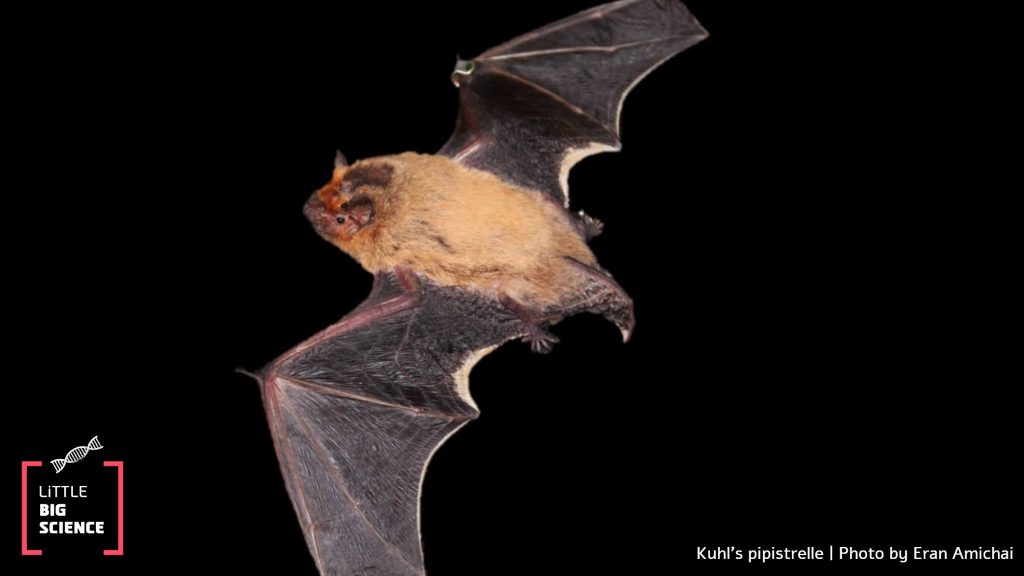
A study conducted at Tel Aviv University showed that in order to navigate along fixed, familiar flight paths, bats rely on prior knowledge of the time it will take them to reach their destination.
Advertisement
One of the most complex tasks animals face is how to navigate efficiently in their surroundings. Bats are particularly notable for their impressive navigational abilities, from daily flights of several kilometers in search of food to seasonal journeys of thousands of kilometers during migration. While, in certain bat species, vision is a primary and useful sense for navigation (contrary to popular belief, bats certainly do see), in others, whose vision is very limited, sonar plays a crucial role. In sonar, also called echolocation, the bat emits sounds and uses the returning echoes to build a three-dimensional image of the world.
So how exactly does echolocation-based navigation work? Several theories have been proposed. According to one, called the “landmark” strategy, the bat navigates by recognizing fixed objects along the route that produce a unique echo, enabling it to identify them. In this way, the bat can determine where it is and in which direction to fly (for example, “at the loquat tree I turn right”). Another theory, named “statistical flow,” proposes that the bat does not recognize specific objects but rather relies on the distance between objects along its flight path. As the bat emits echolocation calls while flying, its position changes from moment to moment, so the echoes it receives with each call also change. In fact, studies show that bees, ants, and even humans use a similar strategy with vision. For example, when we drive a car and see the trees along the road passing slowly, we estimate our speed as low and the distance traveled as shorter, compared with a situation in which the trees pass quickly. A third theory is “analytic flow.” From the time difference between emitting a call and receiving its echo, the bat can calculate its distance from an object. When the bat moves toward the object and calls in sequence, the time gaps between call and echo shorten, and the bat can deduce the distance it has covered. Essentially, the bat can use objects along its flight path to know at all times how far it has traveled toward the goal. Finally, according to the last theory, called “blind navigation,” the bat calculates its current position based solely on internal information, such as the time it has already been flying or its flight speed. Ants, for instance, use this method when little external information is available, and so do humans (for example, by counting steps while navigating).
A new study led by Gal Aharon from Prof. Yossi Yovel's lab at Tel Aviv University examined which of these three strategies bats use while flying. They assessed the navigation of Kuhl’s pipistrelle bats (Pipistrellus kuhlii) along a straight, familiar route, a scenario that mimics bats’ nightly flights to their usual, stationary, feeding sites in nature. In the experiment, bats flew through a 40-meter-long tunnel with poles placed at fixed intervals. For three weeks, a platform with a food reward was positioned at the center of the tunnel. After the three weeks, the researchers removed the platform and discovered that the bats continued to search for it at the spot where it had previously been. Which strategy did the bats use to navigate to the platform—landmark, statistical/analytic flow, or blind navigation?
To test whether the bats used “statistical flow,” the researchers altered the spacing between the poles along the route—changing the rate at which the “trees” passed by the bats’ ears, which should have caused them to misjudge the distance traveled. Even after the change, the bats continued to search for the platform in the same place. To test whether the bats used “analytic flow,” the poles were removed entirely, leaving the bats with no external information about distance traveled. Again, the bats were not confused and searched for the platform in the same location. Thus, it seems they did not use statistical or analytic flow to estimate the distance to the platform.
Next, the researchers examined whether the bats used the “landmark” strategy. For example, the bats might have used protrusions on the tunnel walls as landmarks for navigation. To test this, the entire section of the tunnel in which the bats flew—actually a short, enclosed part of a much longer tunnel—was shifted 10 meters forward. If the bats had relied on landmarks, we would expect them to search for the platform in the wrong place. However, the researchers found that after the change, the distance at which the bats searched for the platform shifted 10 meters forward along with the tunnel. From this, they concluded that the bats did not use the landmark strategy either.
After showing that the bats did not use “acoustic/analytic flow” or “landmark” strategies, the researchers tested whether they used the last strategy, “blind navigation,” and which information they relied on to do so. To that end, they influenced the bats’ flight speed by placing a small weight on their backs (which caused them to increase their flight speed). What happens when the bats are forced to fly faster than usual? The outcome depends on the information they rely on for navigation. One possibility is that the bats rely on the estimated flight time to the goal, based on previous flights. In this case, increasing the speed would cause them to search for the platform farther from its original position, since they would cover more distance in the same amount of time. Another possibility is that the bats rely on their flight speed during navigation. If so, increasing speed would not affect where they search for the goal, because they would take it into account. Finally, if the bats use a strategy of counting wing beats or the amount of energy expended, they would search for the goal closer than it was, because both metrics rise during faster flight.
The researchers found that increasing the bats’ flight speed caused them to search for the platform farther from its original position. These results led them to conclude that the bats relied on “blind navigation,” calculated primarily by the estimated flight time to the goal.
In summary, the results of the study settled the debate among the three different theories of bat navigation and showed that bats use the “blind navigation” strategy to find their destination. The researchers also distinguished among the different forms of blind navigation and showed that the bats use the usual flight time to the goal to gauge distance and locate it again.
English editing: Elee Shimshoni
References:
Original article:
Aharon et al., 2017. Bats Use Path Integration Rather Than Acoustic Flow to Assess Flight Distance along Flyways