
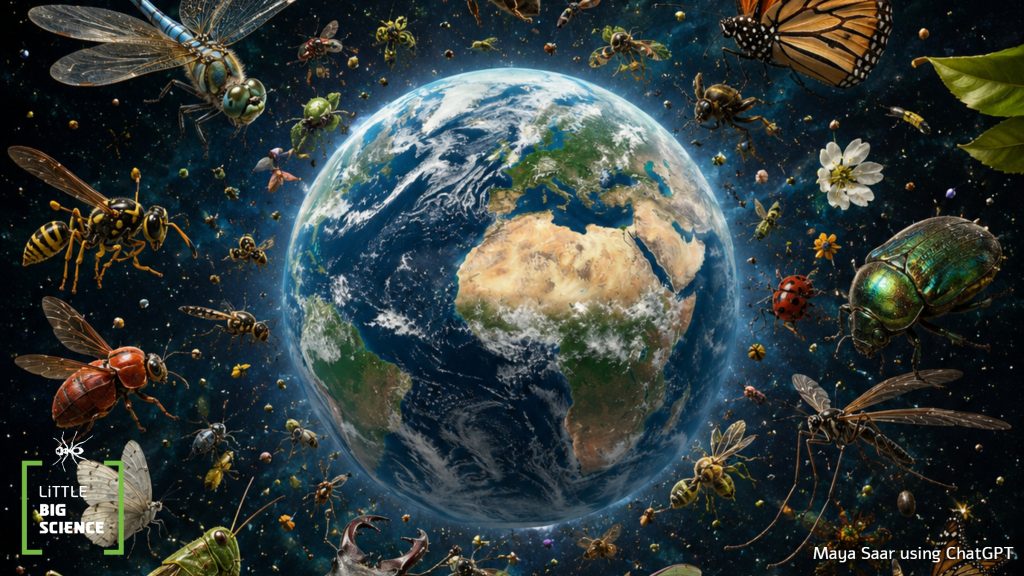
A new study suggests that the biodiversity hidden around us is far greater than we recognize: the number of insect species on Earth may range from 14 to 20 million—two to three times previous estimates. The researchers arrived at this estimate by combining long-term collections of genetically identified insects with statistical methods that make it possible to estimate the number of “hidden species.” At the same time, a new review warns that insect diversity is in ongoing decline due to habitat destruction, climate change, pesticide use, and pollution. This could mean that many insect species may become extinct before we have a chance to discover them.
Advertisement
Insects are found almost everywhere on Earth, and play an essential role in almost all ecosystems. They pollinate plants, break down organic matter, regulate pest populations, and form the basis of entire food webs. A new study now suggests that the actual diversity of insects is far greater than previously thought.
The new study suggests [1, 2] that the world may be home to as many as 20 million distinct insect species. Thit is two to three times higher than the commonly accepted figure of around six million. Moreover, only around one million species have been formally described to date. This suggests that more than 95 percent of species, remain hidden from view.
How can we estimate the number of species that we haven't discovered yet? To answer this question, the researchers employed methods from several fields, including ecology, statistics, and epidemiology, to estimate the number of still undetected insect species.
The study focused on three forest ecosystems in a nature reserve in Guanacaste Province, Costa Rica. Over a period of approximately 17 years, the researchers collected insects from a cloud forest, a dry forest, and a rainforest.
The researchers noticed that many species appeared only once in the study area, suggesting that many more species had simply not been captured. To estimate how many species had been “missed,” they adjusted the number of species found in traps using an “undersampling ratio”. This statistical estimate is based on a comparison between the number of species that had been recorded (just over 1,400) and an estimate of the true number of species, including those not yet detected. Having applied this method to a diverse family of parasitoid wasps, the researchers concluded that there could be as many as 3,400 parasitoid wasp species in the study area - more than twice the number of species that were actually found.
The researchers then combined the parasitoid wasp data with information on millions of other genetically identified insects that were collected in specialised traps in the study area. Using a statistical estimation method also employed in fields such as epidemiology, they estimated that the study area, a relatively small tropical region, contained around 333,000 insect species.
To extend this estimate to a global scale, the researchers examined the relationship between the richness of tree species and the richness of insect species in different regions around the world. Since tree diversity is far better documented and understood than insect diversity, the researchers used the empirical relationship between the two groups. Based on this model, they estimated that there may be as many as 20 million insect species on Earth.
The estimate that millions of insect species remain unknown emerges at a time when researchers are identifying a substantial decline in insect diversity in recent decades. A new review [3] summaries the growing body of evidence indicating that insect populations are shrinking rapidly worldwide.
The problem goes beyond the extinction of entire populations of certain species. Even when the total number of species in an area appears to remain stable, the composition of the community can change dramatically: specialised local species disappear, while more adaptable ones, such as those with broader ecological ranges, or invasive species, spread in their place. For example, forests and agricultural landscapes in Germany experienced a decline of around 34% in the number of specialised insect species over a period of around ten years[4].
The main drivers are well known: habitat destruction, changes in land use, intensive agriculture, the use of pesticides and fertilisers, climate change, and the spread of invasive species. Insects that are specialised for particular environments, or have smaller geographic ranges, are often the first to be affected.
The disappearance of insects can have numerous far-reaching consequences. For example, a decline in pollinator populations would affect both wild plants and agricultural crops, given that around 88% of the world’s flowering plant species rely on animal pollination to some extent [5]. A decline in the number of decomposer insects could alter nutrient cycling in the soil, while the loss of natural predators may lead to increased pest outbreaks.
The researchers emphasise that improving monitoring is essential to understanding the scale of the crisis. This could involve using artificial intelligence to identify insects, taking samples of environmental DNA (eDNA), collecting additional insect data through citizen science projects, and creating global databases that will enable broader and faster monitoring than ever before.
The researchers are calling for a reduction in pesticide use, the restoration of natural habitats, the cutting of greenhouse gas emissions, and the development of more biodiversity-friendly agricultural systems.
If the researchers’ estimates are correct, there are probably millions of undiscovered insect species on Earth. The great challenge now is to ensure that these species do not become extinct, leaving only museum specimens behind.
Hebrew editing: Smadar Raban
English editing: Gloria Volohonsky
References:
- A paper estimating that the world contains as many as 20 million insect species, most of which have not yet been discovered by science
- An article in Scientific American about paper [1]
- A review paper describing the challenges and possible solutions to the global decline in insect diversity
- A paper on the decline of arthropod populations in Germany
- How many flowering plants are pollinated by animals?

Maya serves as Scientific Director at "Little Big Science". Maya is a zoologist and an entomologist with a PhD from Tel-Aviv University, currently working as a postdoctoral researcher in the Florida Museum of Natural History, at the University of Florida. Her research focuses on social insects - especially ants - and covers topics such as ecology and invasive biology.


