
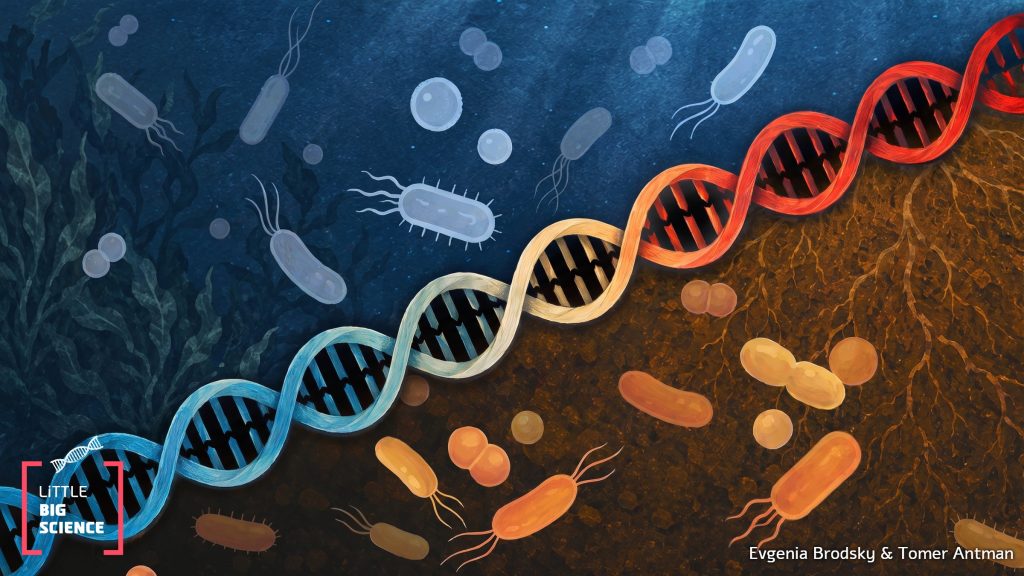
A new study from the Weizmann Institute of Science combined machine learning with the analysis of bacterial samples from diverse environments. It found that the temperature at a particular location, on land or in the ocean, can be inferred from the DNA of the bacteria living there. Surprisingly, in the ocean, the effect of temperature is sometimes masked by an even stronger influence: starvation due to lack of nutrients. The study advances our understanding of how environmental changes may affect bacterial populations.
Advertisement
Bacteria quietly run the world. They are responsible for producing more than 10% of the oxygen we breathe [1, 2] and play an important role in every food web. This summer we saw just how tangible bacteria’s impact on our lives can be: an unusual bloom of blue-green bacteria (cyanobacteria) has caused high turbidity in seawater and disrupted the operation of desalination plants in Israel. Nearly every gram of soil and every milliliter of ocean water is home to thousands of bacterial species. Given their central role, it is important to understand how disruptions such as climate change and pollution affect bacterial communities, i.e., the composition of bacterial populations in a particular region.
A new study conducted in the Department of Plant and Environmental Sciences at the Weizmann Institute of Science, recently published in Nature Microbiology, found that environmental effects are remarkably strong: the composition of the DNA of a bacterial community at a given location can reveal how hot or cold it was there, without measuring the temperature or determining exactly which species in the sample [3].
The computational study, led by Tomer Antman and Dr. Ohad Lewin-Epstein from Dr. David Zeevi’s laboratory, used machine learning to analyze DNA sequencing data from more than 1,200 samples in public databases. The samples were collected and sequenced in previous environmental surveys worldwide, from soils and oceans, in regions ranging from freezing cold to intensely hot. The samples are metagenomic, meaning they contain all the DNA collected from the environment, without separation according to different bacterial strains. Each sample was accompanied by a temperature measurement taken in the field at the time of collection: the lowest, −1.6 degrees Celsius, was measured at sea, while the highest, about 44 degrees, was measured on land.
So how can a computer be taught to infer temperature from DNA sequences? The genetic material of bacteria, like our own, consists of four building blocks linked in a chain to form DNA: adenine (A), thymine (T), guanine (G), and cytosine (C). The researchers computationally divided the DNA into segments of four building blocks, called tetramers (from the Greek: tetra—four, meros—unit). For example, the sequence AATTCGG is broken down into the segments AATT, ATTC, TTCG, and TCGG. The researchers trained a model to infer a sample’s temperature from the pattern of tetramers it contained, then tested the model on sites that had not been included in the training data. The model was able to infer temperatures with an average deviation of only about two degrees—solely on the basis of the bacterial DNA composition in the sample.
But the researchers encountered a paradox: bacteria in warm environments are known to tend toward genomes richer in the building blocks G and C, because this pair of building blocks is linked by a stronger chemical bond than the bond between A and T, making DNA more stable in heat [4]. Indeed, this is what was observed in bacteria originating on land. But among bacteria originating in the ocean, the relationship was reversed—as the water became warmer, the GC percentage declined. It turns out that the explanation lies in a broader story. In ocean waters, warm water is mainly on the surface, since the upper layer of the ocean is warmed by the sun. This layer is poor in nutrients such as nitrogen. Since producing guanine and cytosine requires more nitrogen atoms than producing adenine and thymine, bacteria facing nitrogen scarcity tend to “save” by using fewer of these “expensive” building blocks [5]. In other words, what appeared to be an effect of heat was, in the ocean, primarily an effect of starvation.
The study’s strength lies in the scale of its data: samples painstakingly collected by numerous research groups around the world, now publicly available, made it possible to obtain a broad picture of the relationship between bacterial DNA composition and environmental conditions. However, because the samples were collected at natural sites rather than under controlled laboratory conditions, and because the study did not follow a single bacterial community as it warmed over time, it can identify an association between temperature and DNA composition but cannot establish that heat is the direct cause. Other factors to which the bacteria are exposed and which vary with temperature, such as sunlight and oxygen levels, may also affect DNA composition.
The researchers showed that the overall genetic composition of an entire bacterial community carries a complex fingerprint of the temperature and nutrients available to it. In the future, bacterial community DNA composition may serve as a way to understand how rising temperatures affect the smallest, yet among the most important, organisms on Earth.
Tomer Antman is one of the article’s authors and a doctoral student in Dr. David Zeevi’s laboratory in the Department of Plant and Environmental Sciences at the Weizmann Institute of Science.
Hebrew editing: Galia Halevy Sadeh
English editing: Elee Shimshoni
References:
- A study showing that blue-green bacteria produce oxygen and dominate all aquatic habitats worldwide
- An information page from the U.S. National Oceanic and Atmospheric Administration: How much of the oxygen we breathe comes from the ocean?
- The study discussed here: DNA signatures of temperature and nutrient limitation in bacterial communities worldwide
- A large-scale genomic study found that bacteria growing at higher temperatures have a higher GC percentage
- An article presenting the streamlining theory: in nutrient-poor regions, smaller, GC-poor genomes that require less nitrogen are selected for

PhD student at the Department of Plant & Environmental Sciences at Weizmann Institute of Science


