
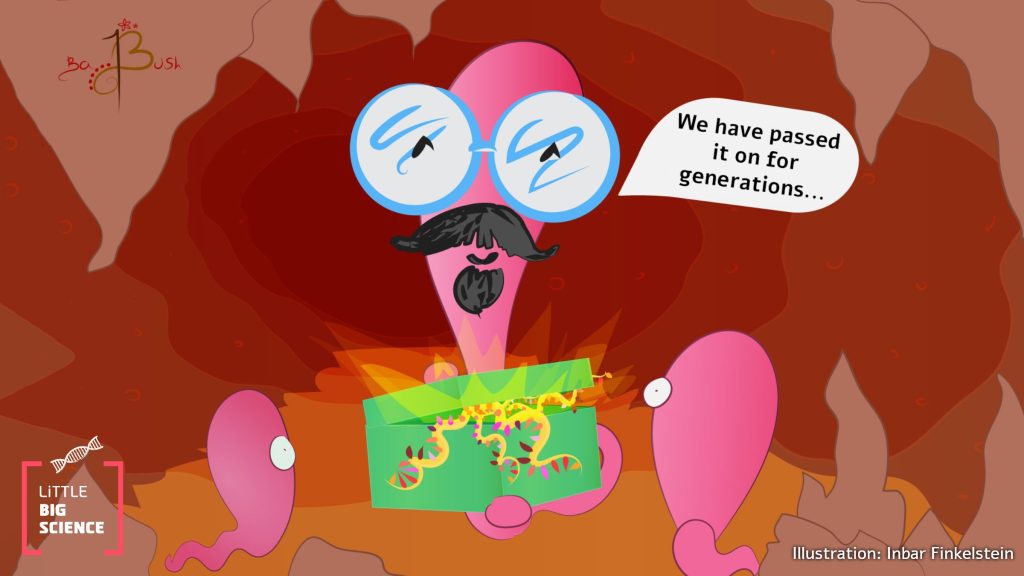
A new study from Tel Aviv University on nematodes (C. elegans) found that small molecules produced in the worms' brains can be inherited by their offspring and influence their behavior. The parent-derived molecules affect how the offspring's genetic material is expressed in a process known as epigenetic inheritance.
Advertisement
From the moment a sperm cell and an egg meet, their combined genetic material dictates a person’s eye color, height, intellect, and health. Yet the genetic material (DNA) is only a set of instructions, and anyone who has ever baked a cake knows that even a recipe can be interpreted in several ways, depending on the reader.
In the various cells of the body there are many factors that can influence how DNA is expressed—which genes will be expressed, in which body part, and when—but they do not alter the DNA’s content or sequence. For example, every cell contains identical DNA, yet the diverse molecules in the cell define each cell’s unique identity and whether it will become a heart cell or a liver cell. Some of these molecules are present in the germ cells, the sperm and the egg, and therefore can be passed on to the next generation and influence DNA expression in the offspring as well. Just as DNA itself is inherited by the next generation, so can the various players that affect it be inherited. This mode of inheritance is called epigenetic inheritance, meaning “above the genes.”
DNA contains many genes that encode proteins, as well as DNA segments whose role is to regulate protein production. One of the factors that can, for instance, influence the type and amount of proteins produced according to the DNA instructions is a group of small molecules called short interfering RNA (siRNA). Their role in the cell is, well, to interfere with processes (in biological jargon—to silence). They hinder the expression of specific genes, and therefore they are part of what is called the RNA interference (RNAi) system. If these siRNAs are present in germ cells, they can be inherited by the next generation and interfere with gene expression there as well.
Findings from recent years show that the environment also affects DNA expression. Diet or stress, for example, can influence siRNAs and, through them, the way DNA is expressed. These siRNAs can likewise be inherited—so essentially the parent’s environment can cause changes in the offspring too. A scientific version of "The Ancestral Sin".
In a new study published in the prestigious journal Cell, a research group from Tel Aviv University led by Prof. Oded Rechavi proved that not everything that happens in the brain stays in the brain—some of it affects the germ cells and is passed on to future generations [1].
Their research was conducted on nematodes (C. elegans), the model organism in which the interference system was first discovered—a discovery that led to a Nobel Prize after it was found that the process exists in humans as well [2]. Today these worms are widely used in epigenetics research.
For the experiment, the researchers genetically engineered one group of worms that completely lacked a protein called RDE-4 and a second group that expressed the protein, but only in their brains. This protein is essential for producing a specific family of siRNAs. As expected, siRNA was indeed produced in the brains of worms expressing RDE-4 there, but to the researchers’ surprise it appeared not only in the brain but also in the germ cells. Its presence in the germ cells could result from siRNA migrating from the brain to the germ cells or from communication between the brain and germ cells that stimulates their own production of siRNA.
Who does this siRNA affect? The researchers found that worms unable to produce RDE-4 at all lost the ability to respond to chemical cues in their environment and move toward them (a behavior called chemotaxis; you can read more about it in our previous article [3]). In worms that expressed RDE-4 in the brain, movement improved significantly, and the researchers discovered that siRNA activity specifically in the germ cells was critical for improving movement. In other words, communication between brain cells and germ cells, mediated by siRNA, influenced the worms’ behavior.
As mentioned, germ cells contain the genetic and epigenetic information passed to the next generations, so it begs the question: what about the offspring? Among all offspring of worms that expressed RDE-4 in the brain, the researchers isolated only those offspring that did not produce RDE-4 at all, so they could not generate siRNA themselves to restore movement. They found that movement was normal for up to three generations of descendants. That is, the parents’ siRNA was inherited across generations and restored movement even in the great-grandchildren. In effect, the brain communicated with the germ cells via siRNA and impacted the behavior of succeeding generations. This is the first time a mechanism has been identified that can convey information from a parent’s brain and influence the offspring’s behavior.
Although the RNA interference system is studied mainly in nematodes because they are easy to work with, it is conserved throughout evolution and likely existed in the earliest eukaryotes (cells with a nucleus). Therefore, it can be found in a very wide range of animals and plants. It is entirely plausible that in the not-too-distant future we will discover similar processes occurring in other, more complex animals and perhaps even influencing more complex behaviors.
English editing: Elee Shimshoni
References: