Social isolation is a negative emotional state that exerts a profound impact on a person’s physical and mental health. During a global pandemic, in which the primary protective measure against infection is social distancing, loneliness surges. This phenomenon affects us all, yet it strikes high-risk groups more profoundly. Recent studies have demonstrated the biological effects of social isolation on the brain and the body, in animal models and in humans. It is therefore crucial to understand the danger posed by social isolation and to look after ourselves and those around us.
Advertisement
Social isolation is a state in which a person feels alone, cut off from social life and support. Even someone who is in a house full of people, but feels isolated and as if they do not belong can experience loneliness. In contrast, a person who withdraws to write a book or for spiritual seclusion, and does not feel the absence of others, is not lonely. Most of the time, loneliness is both an objective and a subjective feeling of lack of companionship and support.
For almost a year we have been experiencing major social changes due to COVID-19 and the social distancing imposed on us. Loneliness affects us all, but hits high-risk groups harder: older adults, people coping with mental illness or those treated with drugs that weaken the immune system, as well as people who live alone. Epidemiological studies show that long-term social isolation harms health and has been compared to other risk factors such as smoking, hypertension, and obesity [1].
How does short-term isolation affect us? A new study [2] published in the prestigious journal Nature Neuroscience examined what happens when people are forced to separate from others—i.e., does social deprivation change the brain? A group of 40 men and women were asked to undergo either ten hours of fasting or ten hours of complete social isolation (including social media!). Participants reported their levels of loneliness and their craving for company or for food. Using functional scans—functional magnetic resonance imaging (fMRI, [3])—the researchers measured which brain regions were activated when participants were shown images of their favorite social activities, or images of preferred foods for the fasting group. The scans showed that similar midbrain areas were activated to a comparable degree in those craving food and those craving social contact, and a strong correlation was found between self-reported loneliness and activation of these regions. This study illustrates that the need for social interaction is a basic, vital human need, similar to fundamental needs such as food and water.
Long-term loneliness has been studied extensively in animals. For example, in a study where rats were isolated for six weeks, they exhibited depressive-like behavior, increased pro-inflammatory proteins, and structural damage in the brain [4]. In another study, researchers examined the effect of loneliness on cancer development in rats and showed that rats that lived alone for months developed more breast-cancer tumors, and these were more aggressive [5].
Human studies conducted at UCLA that explored the link between loneliness and the immune system found altered gene expression in white blood cells (leukocytes) of people who reported high loneliness [6]. This genetic change impairs cell function and reduces the efficiency of the immune response (see figure). In a paper recently published in Cancer, a study of women with ovarian cancer found that patients who reported high social isolation displayed increased metastatic markers within the tumor, whereas patients who reported high social support did not show these changes. These molecular alterations worsen prognosis and lower chances of recovery [7].
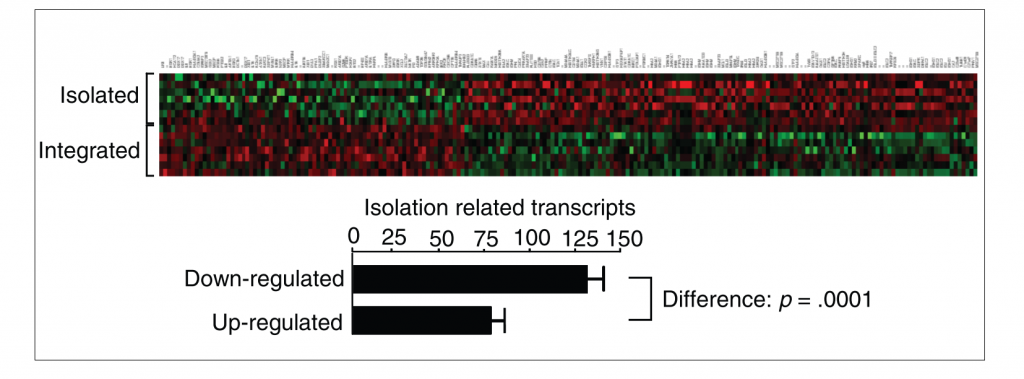
Expression of different genes related to white blood cells in lonely versus non-lonely individuals (from [6]).
The studies described above present some of the evidence science has gathered on how the social environment of a person or an animal affects their body and brain. Several mechanisms have been proposed to explain how isolation and the feeling of loneliness damage various bodily systems—for example, by increasing stress hormones such as cortisol and adrenaline. From an evolutionary perspective we can also explain it: we are social creatures, and as a species we survive better as a group than as individuals.
These new studies also show how science is advancing our understanding of the mind-body connection—the link between biology, behavior, and emotions. The field focusing on these aspects is called “Psychoneuroimmunology.” This scientific discipline investigates the relationships between emotions, the brain, and the immune system, and it is rapidly evolving thanks to innovative tools. In the not-too-distant future we will know more about how feelings, thoughts, and biology interact, and we will be able to help humanity overcome psychological difficulties that adversely affect the body.
Because the coronavirus is still here, as are the lockdown(s), hugs are a bit distant and so are parties. If you feel alone and need a kind word or encouragement, do not hesitate to reach out to friends, volunteer, go out for a chat with someone—do not stay alone with painful feelings [8 – 988 mental health crisis hotline]. Let us keep an eye out and see how we can ease loneliness, even a little, for those around us—call grandma or a friend who lives alone, provide them with a bit of light, support, and health. May we soon be able to return to hugging both strangers and loved ones freely.
English editing: Elee Shimshoni
References:
- Metanalysis—social environment and health risk
- Acute Social Isolation—Nature Neuroscience
- fMRI, from Cleveland Clinic
- Study about neuroinflammation and social isolation in rats
- Study about social isolation and breast cancer risk in rats
- Social isolation and leukocyte gene expression
- Loneliness in ovarian cancer patients
- 988 mental health crisis hotline

A postdoctoral researcher in neuroscience at the University of Cambridge. She studies how the social environment, and in particular social connections, affects brain function, the immune system and overall health. She completed her PhD in neuroscience at Tel Aviv University.


