Advertisement
From time to time we publish articles that sound the alarm about the danger of one species or another becoming extinct. Almost every time, these questions appear in the comments: “Why should I even care?”, “Why is this important?”, or “So what will really happen? We can live without a tiger/elephant/orangutan…”.
Personally, I believe that every creature on our planet has an intrinsic right to exist simply because it is here. It is our duty as humans to prevent—or at least reduce—the damage we cause to the world. Unfortunately, most of today’s arguments for preserving biodiversity are human-centric: They try to persuade us why it is in our own interest, as humans, to protect nature, and how doing so will ultimately save us as well.
There is no doubt that we cannot survive in an ecological vacuum. The human-centric arguments are entirely valid. So, for everyone asking the above questions, this post will demonstrate the delicate, complex fabric of ecological systems and what happens when you pull on one thread and start to unravel it…
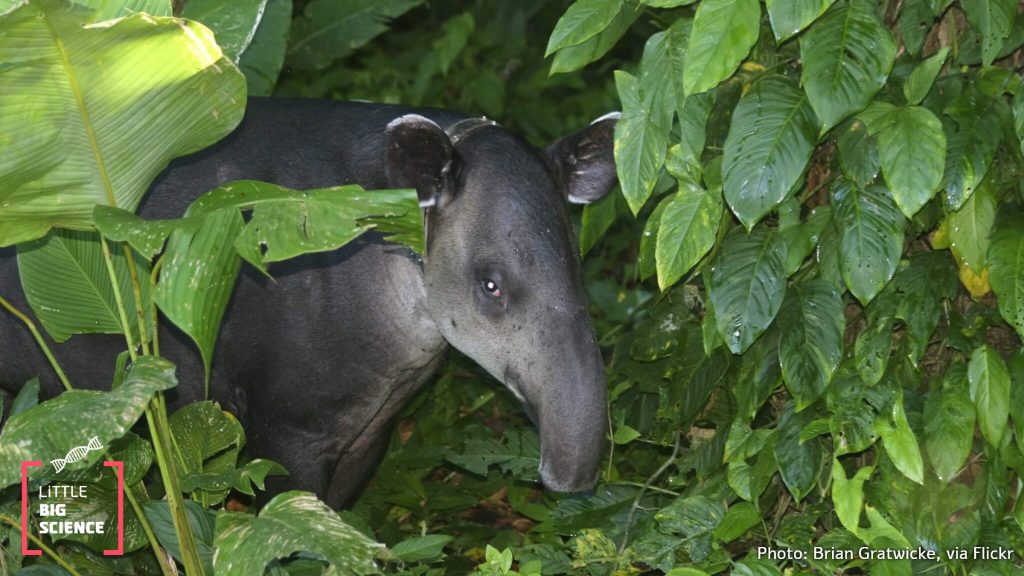
Our example concerns the tapir, specifically Baird’s tapir (Tapirus bairdii), which lives in the rainforests of Central America [1]. The tapir is a large member of the order Perissodactyla (odd-toed ungulates). It is herbivorous and weighs up to about 400 kg. The tapir forages on the forest floor, rooting with its elongated snout, and in the lower forest layer (up to about 1.5 m high) where it eats fallen fruit, leaves, twigs, and more.
Esteban Brenes-Mora, a biologist who has been obsessed with tapirs since childhood, realized his dream with funding from the Zoological Society of London and founded the tapir conservation and research organization in Costa Rica—Nai Conservation. He noticed that in Costa Rica the tapir is almost forgotten. It has no significant role in local culture, and if you visit tourist souvenir shops you will hardly find anything related to tapirs.
Brenes-Mora chose to highlight the need to conserve tapirs by emphasizing the crucial role played by large frugivores and seed dispersers in the rainforest ecosystem. He investigated the link between large herbivores and the forest’s capacity to store carbon.
Let us talk about rainforests for a moment.
In figurative language, rainforests are a kind of living, breathing “organism”—immensely complex. In scientific terms, they are an intricate ecosystem composed of thousands of living, growing, and non-living elements. Each element has its own role, however small, that is essential to the health of the whole system. The system exists thanks to all those participants whose lives are intertwined into a marvelous tapestry that creates this rich and magical forest.
In fact, not only the rainforest is a “living, breathing organism”. We can take this holistic view and apply it to the entire planet we live on. Every creature, every ecosystem, has a role in maintaining the health and vitality of our Earth, and like all other organisms on it, we depend on its health for our own existence—even though, at the moment, we seem to be making great efforts to ruin and damage it, with considerable success.
So what is the role of rainforests in the intricate system called “life on this planet”?
Plants of all sizes and in all places on Earth—on land and in the sea—have one decisive function that actually enables life on this planet: they sequester carbon from the atmosphere and store it in their tissues. They “invented” this trick almost 350 million years ago. They do it through a process called photosynthesis, in which they absorb carbon dioxide (CO2) from the air and turn it into simple sugars and then into more complex carbohydrates such as cellulose, while releasing oxygen [2]. In fact, most of a tree trunk is dead material made of cellulose. In addition, carbon makes up about half the dry weight of wood, so forests store enormous amounts of carbon above ground and below—in roots and in the soil itself. The larger and taller the tree, and the wider the trunk, the more carbon it holds. It is therefore clear that forests are an immense and very important carbon reservoir.
Why is this so important, especially today?
In light of ongoing climate change and the increased carbon emissions that accelerate the process, the preservation of forests, which are constantly busy fixing atmospheric CO2 and removing it from the air, is extremely important. Tropical forests store about 40 percent of the carbon on Earth’s land surface. Deforestation accounts for 7–17 percent of carbon emissions to the atmosphere. The tropical forests are among the largest carbon stores and play a critical role in regulating the global climate.
How are tapirs connected to all this?
The large trees, which have the central role in carbon sequestration, usually bear large fruit with large seeds and rely on large fruit and seed eaters to spread those seeds. One such frugivore is.. you guessed it—the tapir. In addition, various monkeys and large birds share the task. All of them eat the fruit, move long distances through the forest, and then do what they do (yes, poop…), dispersing undamaged seeds (often passage through the gut actually promotes germination) that find themselves surrounded by a heap of fertilizer. In this way, the animals help the tree to spread.
While looking for ways to raise awareness of tapir conservation, Brenes-Mora came across theoretical studies examining what would happen if the forests were emptied of tapirs and other large fruit and seed eaters. The experiments are theoretical (based on computer simulations) but the idea, unfortunately, is very real. Many forest-dwelling animals are endangered. Baird’s tapir, for example, is listed on the IUCN Red List of Threatened Species as EN—“Endangered” [3].
Studies have shown that poaching of wildlife in forests worldwide, known as bushmeat hunting, occurs at unsustainable levels [4]. This means that if current rates continue, hunting will drive populations to extinction. Poaching threatens 19 percent of forest vertebrates, and because it is for food, larger animals are hit harder.
In the theoretical studies, entire series of computer simulations were conducted to examine what happens if the population of large fruit and seed eaters in the ecosystem is reduced or removed entirely. Both studies found that removing these animals significantly changes the species composition of trees in the tropical forest. The decline in dispersal of large-seeded trees now gives an advantage to the recruitment (germination and growth) of small-seeded trees, dispersed by smaller animals or by abiotic factors such as wind. According to the simulations, a drop in the density of large frugivores can lead to about a 60 percent reduction in the abundance of tree species that depend on them, and to a 25 percent—or even 33 percent—decrease in the average seed size of mature trees in the forest.
Such studies provide a new way to bring the importance of conserving tapirs (and other large herbivores) to public attention. The experiments Brenes-Mora encountered were conducted by Carolina Bello, an ecologist at the University of São Paulo in Brazil [5], and by Anand Osuri, an ecologist at the Tata Institute of Fundamental Research in Bangalore, India [6].
From the explanation about carbon storage in forests, one can infer that changing the composition of trees in the forest—and in particular the disappearance of large trees—may have far-reaching effects on the forest’s capacity to store carbon. Indeed, Osuri found in his simulations that the disappearance of seed eaters could cause forests to lose about 12 percent of their carbon storage capacity—a significant drop, given that forests account for 40 percent of global carbon storage.
In fact, tropical forests that rely on animal seed dispersers exist only in certain regions of the globe. In Osuri’s study, which ran simulations on ten tropical forests worldwide, the results differed across regions, depending on the trees’ dispersal methods. His simulations indicated that the reduction in carbon storage is likely to be more pronounced in the rainforests of the Americas, Africa, and South Asia, where the tree population is dominated by species that depend on animals for dispersal. In contrast, the forests of Southeast Asia and Australia, which rely on wind and gravity rather than fruit and seed eaters, are less exposed to change following the disappearance of animals.
The shift in tree composition in the tropical forest can be very deceptive and elusive. Tropical forests are vast, and research on them is sometimes on a large scale—for example, studies that use remote sensing and satellite imagery (similar to research on ocean plankton). In such satellite images everything can look fine—the forest remains green and the change in tree composition—the disappearance of large trees—will not be apparent, even if the forest no longer fulfills its ecological role in the same way. Essentially, it is like cutting down the forest without actually cutting it down—you do not have to lose the entire forest to lose its carbon-storage capacity.
Today, 88 percent of tropical forests are at risk of losing their fauna because of a combination of factors such as hunting, habitat fragmentation, selective logging, and other human disruptions. Large animals are at the greatest risk, both because they are often direct targets of poaching and because they need very large home ranges and territories.
The forests of the Americas, Africa, and South Asia make up 75 percent of the world’s tropical forests, and the studies we described clearly demonstrate the need to preserve the vitality and natural composition of these forests in every respect. Yes, the disappearance of a single species—or a few species—can indeed have far-reaching effects. So far-reaching, in fact, that they ultimately reach us, sitting (to some of our regret) far, far away from the rainforests.
English editing: Elee Shimshoni
References:
- https://www.climatecentral.org/news/surprising-link-between-tapirs-and-climate-change-20687
- Video about photosynthesis
- https://www.iucnredlist.org/species/21471/45173340
- Bushmeat, Wikipedia
- http://advances.sciencemag.org/content/advances/1/11/e1501105.full.pdf
- https://www.nature.com/articles/ncomms11351

Keren is the Chief Financial Officer and Science Editor at the NGO "Little, big Science". In addition, she works as a zoologist at the Ramat Gan Safari and serves as an independent zoological consultant. Keren holds a Master’s degree in Ecology from Ben-Gurion University.


