
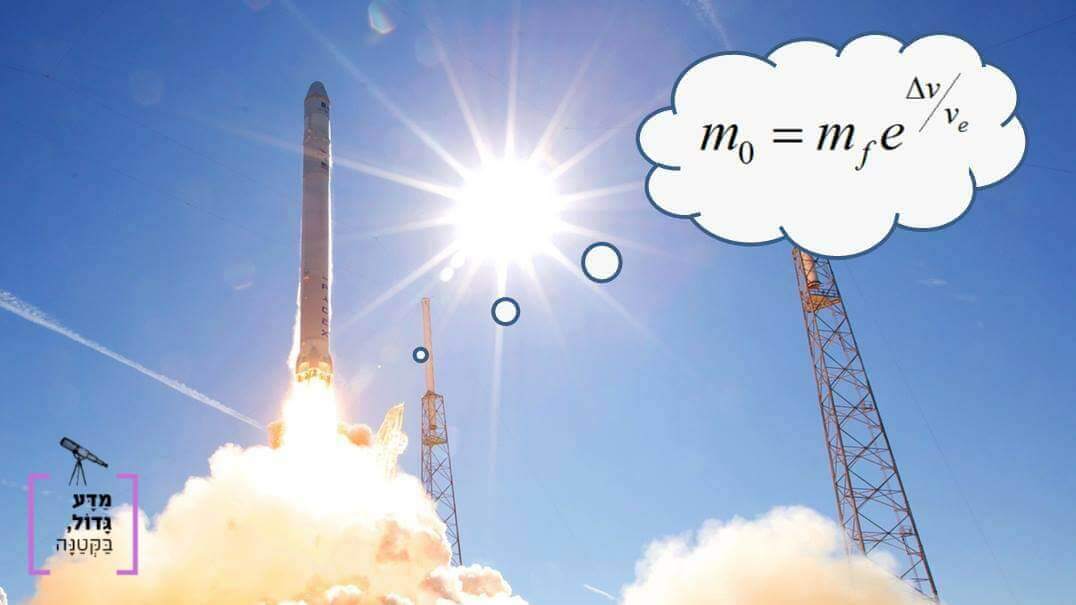
We were all excited to see Elon Musk share with us his vision for a multi-planetary future of the human species. His plans are grandiose and ambitious, and at their core lies a simple fact—reaching space is complicated. But why is that the case?
Advertisement
As Cooper said in “Interstellar,” to move forward you have to leave something behind. In spaceflight, we leave a great deal of “something” behind.
To reach space we need a propulsion method. Propulsion is based on Newton’s Third Law [1]: “for every action there is an equal and opposite reaction.” This is how our cars move: friction between the tires and the road causes the road to exert a force on the car, and the car moves forward. In space there is no road, and today the only way to lift off from Earth is with a rocket.
How does a rocket work?
Take a balloon—inflate it, and release it—and you have just launched the simplest rocket in the world. The principle behind rockets is identical: take a tank, fill it with propellant, supply energy to the propellant, and let it exit through an opening called a “nozzle.” In the case of the balloon, the propellant is the air you blow into it, and you raise its energy by increasing the pressure while inflating. In rockets launching from Earth the propellants are combustible, and burning them raises both the pressure and temperature of the exhaust gases.
So how much propellant is needed?
An approximate answer was given independently by two scientists: William Moore [3] in 1813 and Konstantin Tsiolkovsky [4] in 1903. We will skip the mathematical derivation, but it is important to understand the logic behind the equation. Suppose we want to apply a certain force to the rocket. The rocket has a specific weight, and to lift it and reach the target we must apply a force greater than its weight for a certain duration. The only way to exert this force is by throwing propellant backward. We must carry that propellant with us. But carrying propellant increases the rocket’s mass. The rocket is now heavier, requiring a stronger engine and additional propellant to lift off. Adding more propellant to compensate again increases the rocket’s mass, and so on.
Moore and Tsiolkovsky expressed this relation mathematically and obtained the following equation:

Here m0 is the rocket’s initial mass, mf its final mass, ∆v is the velocity the rocket must achieve, and ve is the exhaust velocity of the gases leaving the engine. This equation is called the “ideal rocket equation” because it neglects other factors that affect the rocket’s motion and structure.
The key takeaway is that the required ∆v plays a critical role—it appears in the exponent, so small changes in ∆v may cause large changes in the rocket’s initial mass.
Let’s talk numbers
Suppose we want to deliver 1 kg of payload to space (that is, mf = 1 kg). What must the rocket’s initial mass be? To reach low-Earth orbit we need ∆v ≈ 10 km/s. The exhaust velocity of the gases in the Merlin engine (nine of which power SpaceX’s Falcon 9) is about ve = 2.9 km/s. Hence the initial mass must be m0 ≈ 31.45 kg. To reach Mars we need ∆v ≈ 19 km/s, giving m0 ≈ 700 kg. And if we also want to return from Mars, we get m0 ≈ 18,600 kg (assuming the return to Earth is braked by the atmosphere).
These numbers are only estimates. Atmospheric drag increases the rocket’s initial mass, but staging (discarding empty sections so as not to carry dead weight) reduces it. For example, in the latest version of Falcon 9 the initial mass is m0 ≈ 24.08 kg. In any case, we see that the final mass we can deliver to the desired destination constitutes at best only a few percent of the rocket’s total mass.
What can we do to improve this?
At present there is no solution on the horizon. The obvious route is to increase the exhaust velocity ve. Such engines exist (electric propulsion) [5], but they generate thrust that is far too low to lift off from Earth. Launching from Earth is the most energetically demanding phase of any space journey, so another alternative is required.
One option is some future technology, say, an anti-gravity engine would help immensely. As of today, though, this is nothing more than science fiction. Until physicists discover new ways to overcome Earth’s gravity, we will have to leave something behind in order to move forward, and spaceflight will remain expensive and complex.
English editing: Elee Shimshoni
References:
Victor is a senior lecturer in the Department of Mechanical Engineering at Braude Academic College of Engineering in Karmiel. He holds a PhD in Aeronautical and Space Engineering, specializing in combustion, engines, fluid dynamics, and simulations. He also serves as a scientific editor at “Little, Big Science.”


