The main component of air, nitrogen, liquefies at a temperature of −196 degrees Celsius, i.e., 77 degrees above absolute zero (77 Kelvin). At this temperature, nitrogen turns from a gas into a liquid (or from a liquid into a gas, depending on whether you heat or cool it). Can we get closer to absolute zero than 77 Kelvin? The answer is yes! And the person who took this giant step led to an important scientific discovery.
Advertisement
In 1913, the Nobel Prize was awarded to the Dutch physicist Heike Kamerlingh Onnes for his research on the properties of matter at low temperatures, and in particular—for liquefying helium [1]. Although Onnes “beat” Sir James Dewar in the race to liquefy helium [2], the vessels used to hold helium, essentially giant thermoses, are still called “Dewars” in his honor.
To liquefy helium, pre-cooling with liquid nitrogen is required, along with the application of very high pressures. All of this makes Onnes’s technological achievement especially impressive—all the more so because every piece of apparatus was made of glass (fragile!) rather than metal, like we would have today. Is it Nobel-worthy? How close does it get to absolute zero? Well, the temperature of liquid helium at atmospheric pressure is 4 kelvin [3], only four degrees above absolute zero (and by lowering the pressure you can get to less than 2 degrees). Now this new capability could be harnessed for research.
One open question that could be addressed after helium was liquefied in 1911 was what happens to the conductivity of metals when they are cooled to absolute zero (or at least close to it). A known property of metals, already understood at the time, is that when they are cooled their electrical conductivity increases: for the same voltage (the same “battery”) one obtains a stronger electric current. The reason is that the atoms of the metal have less thermal energy and therefore move less. The reduced atomic motion allows the electrons, whose movement constitutes the electric current, to flow more freely without colliding with atoms and losing energy. Figuratively speaking, you can think of the electrons as “rubbing” against the atoms, causing them to lose kinetic energy in the form of heat.
What will happen if we cool the metal to absolute zero? As in most cases, we can envision three scenarios: at some point the electrons too might lose their thermal energy, translating into a lack of kinetic energy—causing the electrical conductivity to drop; it is possible that as we cool the atoms, the electrons will remain unaffected and the conductivity will continue to rise indefinitely; and the third possibility is, of course, that the conductivity will reach a certain value and stay constant.
Onnes and his colleagues chose to cool mercury and observe what happened. To their surprise, when they reached a temperature of 4.2 kelvin, the resistance—which until that point had fallen gradually—suddenly plummeted to the lower limit of what could be measured [4], effectively to zero. At first the scientists tried to find some source of an short circuit that might mean they were not actually measuring the voltage drop and current in the right place, but when none was found they had no choice but to celebrate—a new state of matter had been discovered! (And that really does merit a Nobel Prize...).
In this new state, obtained as a sharp phase transition when the material is cooled below a certain critical temperature, the material exhibits zero electrical resistance and is therefore called a “superconductor.”
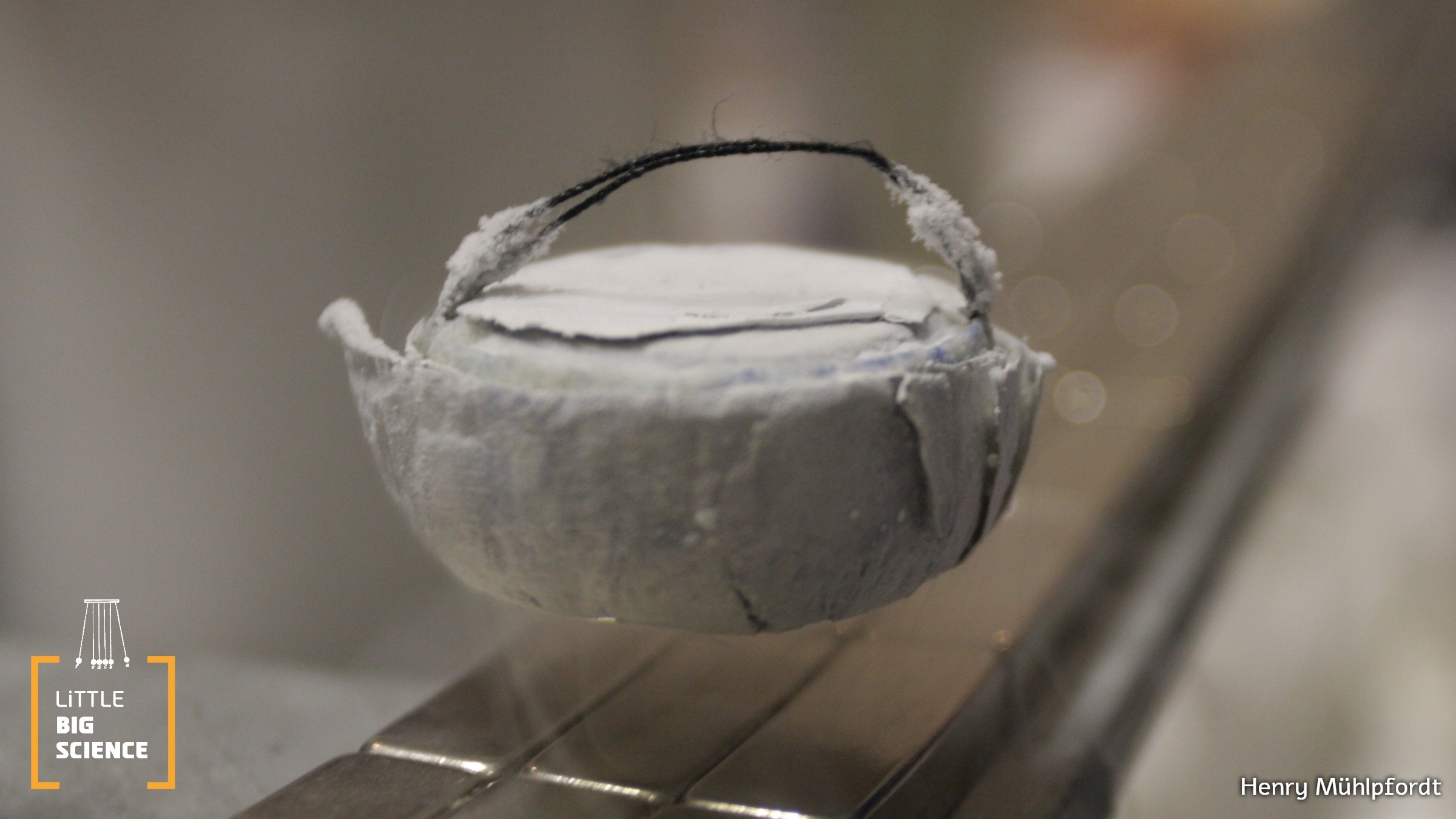
In addition to zero resistance, superconductors are also perfect diamagnets: they repel any magnetic field whatsoever. This may sound similar to Faraday’s law, which says that conductors resist a change in the magnetic flux passing through them, but for superconductors the resistance is not to the change—it is to the field itself: inside a superconductor, the magnetic field is zero. This expulsion, also called the “Meissner effect,” leads to the fascinating phenomenon of “quantum levitation” [5]. In the next post we will continue the story of the discovery and discuss applications of superconductors.
Hebrew editing: Shlomi Jemo
English editing: Elee Shimshoni
References: