
In the previous post we described the historical background of the discovery of superconductivity and the experiment conducted by Kamerlingh Onnes and his group that led to the surprising discovery in 1911. What has happened since then?
Advertisement
In the years that have passed since 1911, additional superconductors with various critical temperatures have been discovered: aluminum (1.2°K), lead (7.2°K), niobium (9.3°K), and more. Nevertheless, it took more than half a century before a theory emerged that could explain the intriguing physics behind the phenomenon.
The theory is called BCS after the three physicists who devised it: Bardeen, Cooper, Schrieffer. This theory employs quantum mechanics to explain exactly what happens in the material, turning superconductivity into macroscopic evidence for quantum mechanics (which usually manifests on a microscopic scale). In 1972, Bardeen, Cooper, and Schrieffer received the Nobel Prize for developing the theory [1], and Bardeen became a two-time laureate after his 1956 award for the invention of the transistor [2].
Trying to describe BCS theory in just a few sentences would not do it justice, so we are planning an entire post that explains the theory. In the meantime, let us tell you about historical and contemporary uses for superconductors.
The rapid discovery of new superconductors, together with the theory that explained them in the 1970s, led many to dream of the day when every power cable would be replaced by wires that do not lose electrical energy as heat [3]. This can happen only when room-temperature superconductors are found, and as you know, that has not yet occurred. In fact, the field of superconductivity entered a “slumber” of more than a decade and awoke only in 1986, when superconductivity was discovered in materials that are not conductors at all—layered ceramic compounds such as La2BaCuO4 and YBa2Cu3O7, all sharing copper-oxygen planes [4]. Superconductivity in these new materials is not explained by the BCS theory, and to this day open questions remain about their superconductivity. Beyond the surprise that non-conductive materials can become superconductors, the scientific community was astonished by their critical temperature—the highest observed until then: 30°K.
This discovery rekindled activity in the field, yielding superconductors with critical temperatures above 100°K. One hundred Kelvin is an excellent temperature because it can be reached easily using liquid nitrogen: nitrogen is abundant in the air and easier to liquefy than helium. Today, superconductors are used wherever exceptionally high electric currents are required—both because efficiency increases when no electrical energy is lost as heat, and because the intense heat generated by the current can sometimes damage the conductor itself (for example, by melting the insulation between wires).
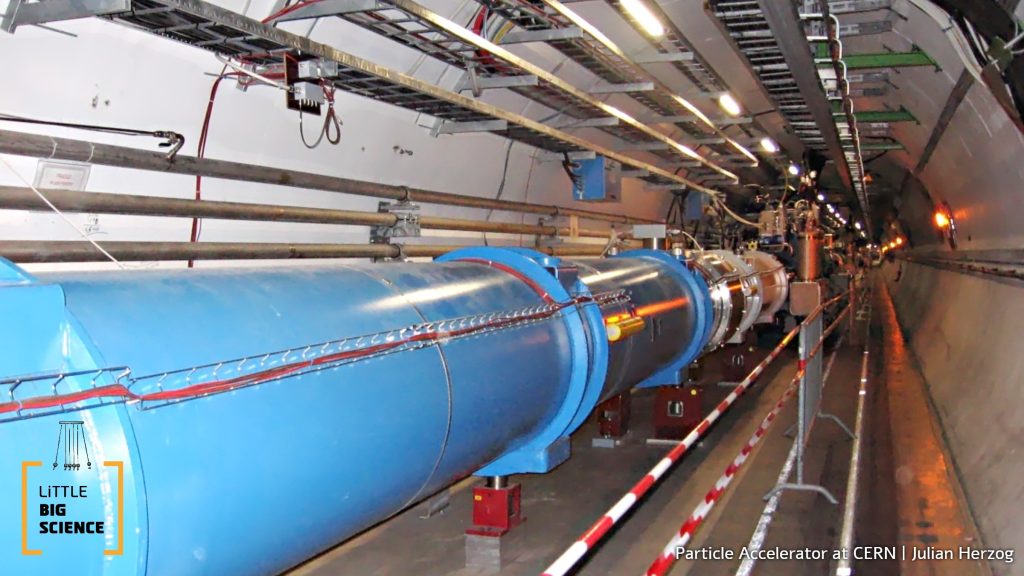
Among the devices we owe to superconductors are the MRI for medical imaging, whose strong magnetic fields are enabled by a coil made of superconducting wires; CERN’s particle accelerator (again, magnetic fields); and a certain type of levitating train (for example in Japan [5]), one of which broke the ground-speed record thanks to its frictionless ride on the track.
English editing: Elee Shimshoni
<< To the previous post To the next post >>
References: