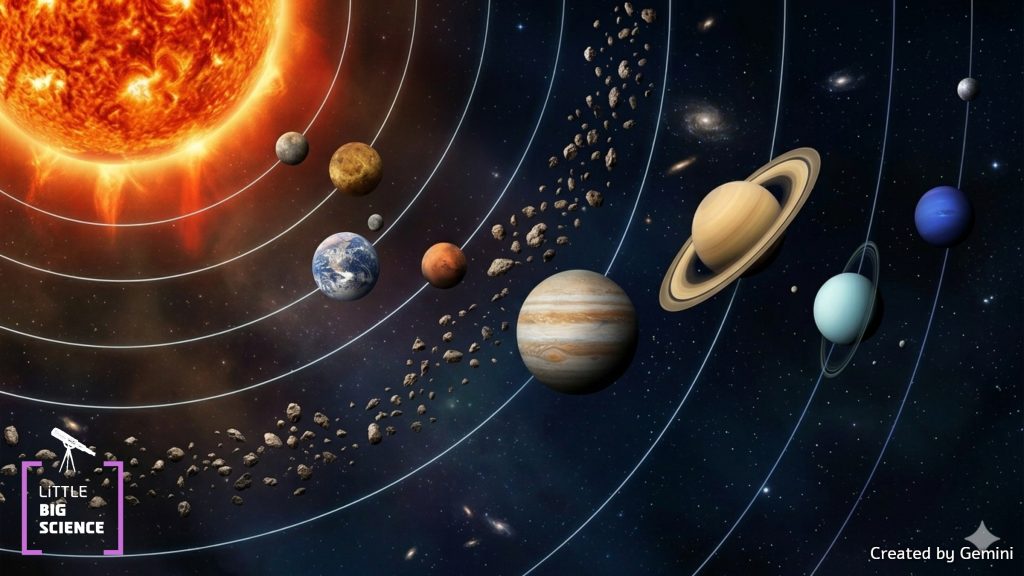
Since the dawn of history, humans have wondered if the Earth on which we live is the center of the universe. As early as antiquity, the Greeks proposed that the Earth revolves around the Sun. What do we know today, and how do we know it?
Advertisement
Through historical works and religious writings we know that people have always wondered about humanity’s place in the universe and the position of Earth. They were inclined to believe that the Earth was at the center, because they saw the Sun, Moon, and the stars moving around it.
The ancient Greek astronomer Aristarchus of Samos determined from his observations that the Sun is very far away [1]. Despite its extreme distance from Earth, the Sun appears to be the same size as the Moon during a solar eclipse. Therefore, the Sun must be much larger than either the Earth or the Moon. Over 2,200 years ago, Aristarchus concluded that Earth orbits the Sun. Although he did not know Newtonian mechanics, which was formulated much later, Aristarchus intuitively assumed that smaller bodies orbit larger ones. Today we know that bodies revolve around their common center of mass. In our solar system this center is very close to the Sun’s center.
Despite Aristarchus’s insights, most people continued to believe that Earth is the center of the universe and that the Sun and stars revolve around it. The reasons were varied, one of them being Aristotle’s philosophy, which placed Earth at the universe’s center. Models that put Earth at the center are called geocentric models.
The key figure in our story is Nicolaus Copernicus [2]. In the early 16th century, Copernicus made observations and calculations inspired by Aristarchus, and presented a heliocentric model in which the Earth and the other planets orbit the Sun. He realized that calculations of celestial motion would be simpler if the planets were assumed to move in circles around the Sun. Alternatively, one could choose a reference frame describing the motion of the Sun and planets from the viewpoint of a stationary observer on Earth. In this sense, the Earth is at the center. However, as we will see later, this reference frame is very inconvenient and “unnatural” frame, because it requires the addition of fictitious forces.
Johannes Kepler [3] took the next major step in the early 17th century. Kepler painstakingly gathered data on planetary motion, particularly that of Mars. He concluded that the planets move in elliptical orbits around the Sun, which is located at one of the ellipse’s two foci.
The great mathematician and physicist Galileo Galilei [4] followed in Kepler’s footsteps refining his observations with precise telescopes that he built himself. Galileo supported the heliocentric model and declaring that the Earth’s revolution around the Sun was not just a mathematically convenient model but reality. This angered the Catholic Church, which sentenced him to house arrest in a small village near Florence. I had the privilege of visiting his home a few years ago. Galileo did not submit to the Church proclaiming, "And yet it moves", meaning, of course, that the Earth moves and is not the center of the universe.
The scientific foundation for Kepler’s theory was established by the most important physicist in history, namely Isaac Newton [5]. Newton’s theory forms the basis of modern physics and is grounded in on solid mathematical foundations. He formulated his laws using differential calculus, a new branch of mathematics that he developed. According to Newton’s law of gravitation, every pair of masses exerts an attractive force on each other that depends on the distance between them, and decreases with the square of that distance. Newton demonstrated that solving the relevant differential equation reveals that celestial bodies orbit the Sun in elliptical paths with the Sun at one focus. Thus, Newton confirmed Kepler’s laws through a comprehensive physical theory. The question of which model correctly describes the structure of the universe, geocentric or heliocentric, was settled when Newtonian physics, verified by countless experiments, ruled in favor of the heliocentric model.
Until the early 20th century Newton’s theory of gravity was almost unchallenged. However, tiny cracks began to appear when the motion of Mercury became difficult to explain, and questions arose regarding the very origin of the gravitational force.
In 1915 Albert Einstein astonished the world by publishing the general theory of relativity [6]. One implication of this theory is that, although the planets orbit the Sun in ellipses, the major axis of these ellipses slowly rotates. This phenomenon has been observed in Mercury’s orbit. Thus, Einstein’s theory supports the heliocentric model, but makes a minor adjustment.
Some claim that according to the principle of relativity, it is impossible to determine whether the Earth orbits the Sun or vice versa. In fact, since Newton, we have been able to describe motion in any reference frame, including one centered on Earth. However, this is not a new concept. Humans have always observed the stars and described their motion relative to Earth. Does this mean that motion is purely relative and therefore rendering the question “Who orbits whom?” meaningless?
Imagine a child spinning on a carousel. Any sensible observer would see that it is the child who is rotating, while the carousel’s axis is stationary. However, the spinning child can describe everything he sees as if he, the child, is the center of the world. In physics, we would say that the motion can be described using a coordinate system with the child as the origin. So who revolves around whom? Does the child revolve around the carousel’s axis, or does the axis revolve around the child? The answer is simple. When the child circles the axis, he feels dizzy due to the centrifugal acceleration created by the rotation. No centrifugal acceleration acts on the carousel’s axis. Therefore, a clear, measurable effect determines who revolves around whom. The child revolves around the axis because he experiences the acceleration caused by rotation.
The same is true for the Earth and the Sun. The Earth moves in an elliptical orbit around the Sun because it is accelerating. Since the Sun experiences no acceleration (or, more precisely, only a negligible acceleration), we can conclude that it does not orbit the Earth. Although it is possible to describe the entire solar system in a reference frame in which the Earth is stationary at the center, such a frame would be extremely cumbersome and unnatural. It would be akin to describing the carousel’s axis as revolving around the child. While it is mathematically possible, it requires introducing complicated fictitious forces.
The Earth orbits the Sun. But that is not the end of the story. The Sun resides in a galaxy that is part of a cluster of galaxies in our universe, which may be infinite. We are not at the center of the universe, we just live on one of its many planets, perhaps one of infinitely many in the cosmos.
Hebrew editing: Smadar Raban
English editing: Gloria Volohonsky
Sources and further reading:

Adi is a professor of theoretical particle physics at Swansea University. His research focuses on quantum chromodynamics and string theory.


