
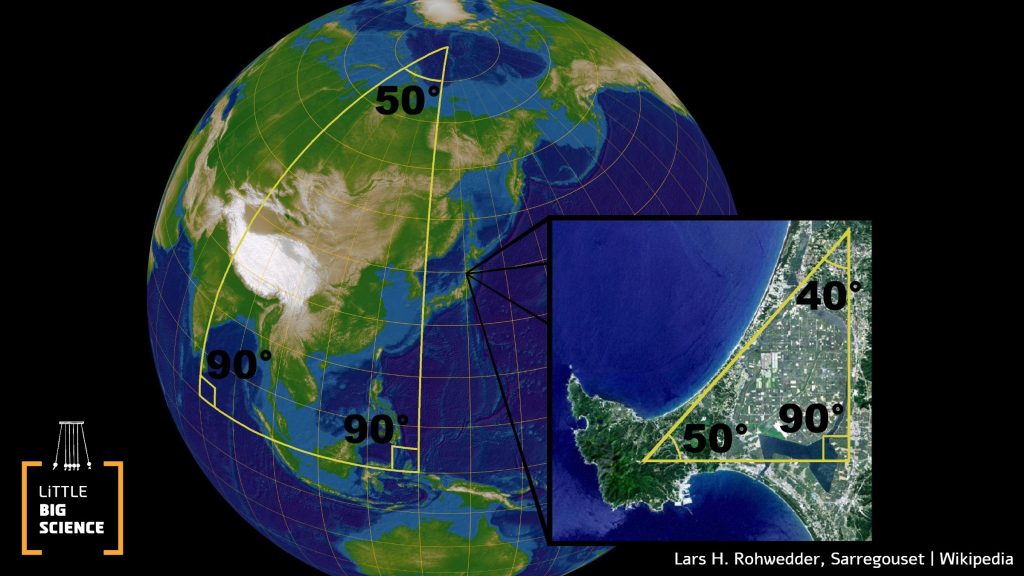
In school geometry classes we are taught that parallel lines do not meet, that the sum of the angles in a triangle is 180 degrees, the Pythagorean theorem, and that the circumference of a circle is the diameter times pi. All of this holds in ״Euclidean geometry״, yet Einstein’s general theory of relativity is based on the idea that the geometry of the universe is different—a ״non-Euclidean״ geometry in which different mathematical laws apply.
Advertisement
After Albert Einstein completed his work on the special theory of relativity in 1905 [1], he began working on the general theory of relativity. He completed the project and published it in 1915.
At the heart of special relativity lies the principle that the laws of nature must appear the same to observers moving at constant velocity with respect to one another. General relativity is a far more ambitious undertaking: It addresses the question of how to formulate the laws of nature when observers are accelerating [2]. Einstein was especially interested in the connection between gravity and acceleration, leading him to formulate the “equivalence principle”, rooted in insights dating back to Galileo Galilei: When a body accelerates, one can view the phenomenon as the action of a gravitational force on that body. In Einstein’s view there is no distinction between acceleration and gravity.
It also turns out that to address the problem of formulating the laws of nature in the presence of acceleration or gravity, we must employ “non-Euclidean” geometry.
What is non-Euclidean geometry? We will start by describing Euclidean geometry [3].
Euclidean geometry is named after Euclid, who compiled it in his book “Elements” about 2,300 years ago [4]. It is based on several axioms (basic assumptions that cannot be refuted); the most relevant here is the “parallel postulate”, which defines parallel lines: “If a straight line crossing two straight lines forms interior angles on the same side whose sum is less than 180 degrees, those two lines, if extended infinitely, will meet on that side”.
Up through the 18th and 19th centuries the parallel postulate was considered so logical and natural that mathematicians believed it might be superfluous, derivable from Euclid’s other axioms. Their attempts failed. The great mathematician Gauss and his student Riemann dared to ask whether one could replace the parallel postulate with a different axiom, thus constructing a geometry in which Euclid’s parallel postulate does not hold.
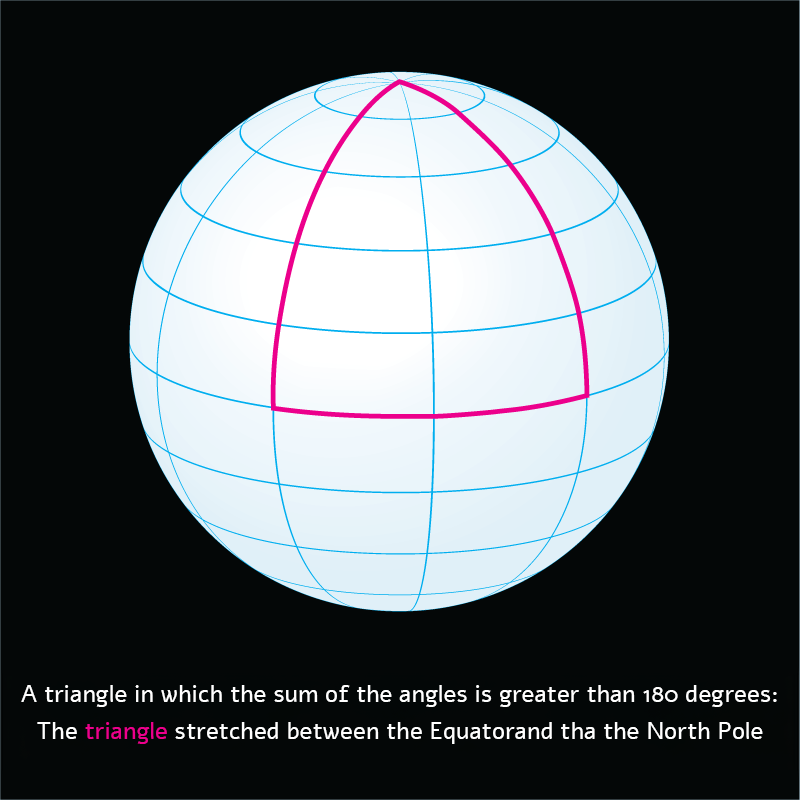
Consider an example of non-Euclidean geometry: imagine a person walking on Earth from the equator straight toward the North Pole along the shortest path, always moving due north. Now picture his companion, initially two meters to his left on the equator, who also heads straight north toward the North Pole along the shortest path. Seemingly they travel parallel to each other, yet they will meet at the pole. This is an example of (apparently) parallel lines that intersect, without contradicting Euclid’s parallel postulate because the surface they walk on is not Euclidean—the Earth is not flat. Note that the lines the pair follow and the additional line joining them along the equator form a triangle in which the sum of the angles exceeds 180 degrees; see illustration:
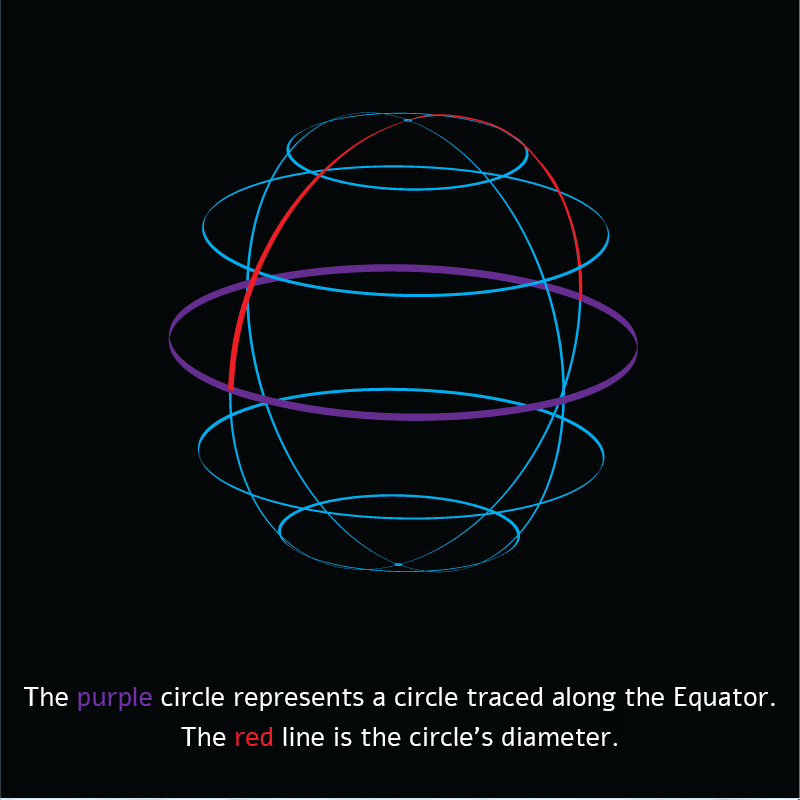
An amusing anecdote is that the circumference of the equator is twice its diameter rather than π times the diameter, when the diameter is defined as a straight line connecting two points on the equator that are maximally distant from each other; see illustration:
More than two millennia after Euclid, Riemann devised his own geometry, now called “Riemannian geometry” [5]. At its core lies the idea that space is not flat but curved, like the surface of Earth. In Riemannian geometry the amount of curvature is a property that can vary from point to point. Initially this geometry was regarded as a purely mathematical theory, irrelevant to our world.
In the twentieth century it became clear that Einstein’s general theory of relativity is built on Riemannian geometry. According to the theory we live in a four-dimensional space-time: Three spatial dimensions and one time dimension. The curvature of four-dimensional space at each point is determined by the energy density at that point; the higher the energy density, the greater the curvature.
An intuitive illustration of the idea underlying relativity and geometry is as follows: Imagine a tightly stretched sheet—initially flat. Place a heavy object at its center. The sheet will sag so that near the object the curvature is large, and as we move away the sheet becomes progressively less curved.
The assertion that the space in which we live is non-Euclidean has far-reaching empirical consequences. Important phenomena such as the deflection of light near massive bodies, the expansion of the universe, and the existence of black holes are all explained using Riemannian geometry. An interesting aside is that if we measured the circumference of a large circle around the Sun, it would not be exactly π times the diameter—slightly different from what we were taught in school geometry.
In this short article we learned that the geometry of our universe is not Euclidean. The effects of general relativity become significant near extremely dense masses, for example inside a black hole. Those wishing to experience life in a Riemannian geometry are invited to dive into a black hole.
English editing: Elee Shimshoni

Adi is a professor of theoretical particle physics at Swansea University. His research focuses on quantum chromodynamics and string theory.


