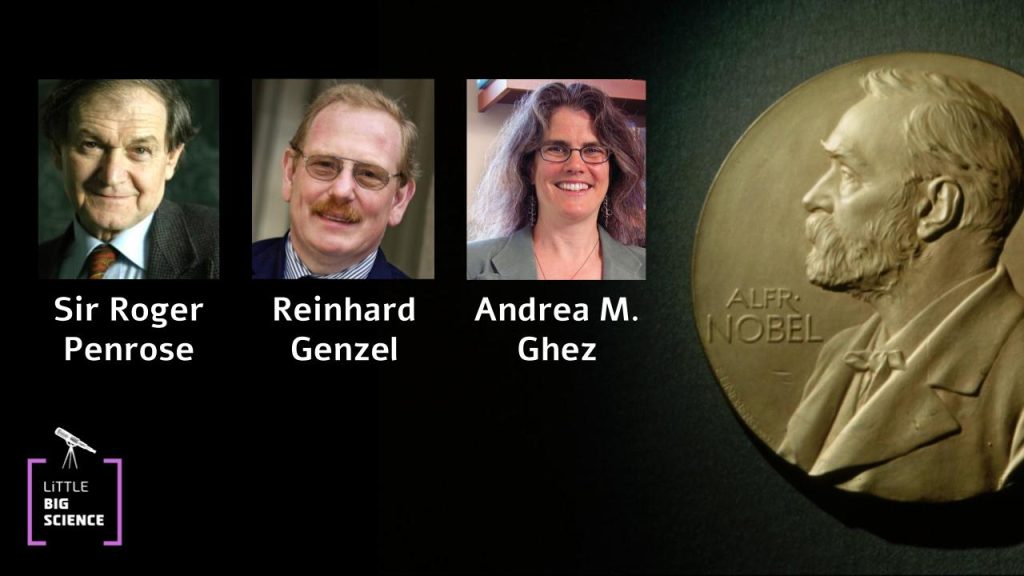
The Nobel Prize in Physics this year was awarded to Roger Penrose, Andrea Ghez and Reinhard Genzel, for their discoveries related to black holes [1]. Penrose received half of the prize for his contribution to the theoretical understanding of black hole formation, and Genzel and Ghez share the other half for the discovery of the supermassive black hole at the center of our galaxy.
Advertisement
Einstein’s General Theory of Relativity predicts the existence of objects with such high density that not even light could escape them, thus earning them the name “black holes.” [2] Einstein himself found it difficult to accept the existence of such objects in nature, and regarded the idea as a mere mathematical curiosity. This year’s Nobel Prize in Physics was awarded for the theoretical and observational discoveries indicating the existence of black holes, suggesting that even Einstein can be wrong.
The initial reservations regarding the existence of black holes are not without foundation. Initially, researchers were only able to investigate these objects under the assumption of perfect spherical symmetry—namely, assuming that the gravitationally collapsing matter retains the shape of a perfect sphere during the formation of a black hole. However, this assumption is not realistic - in the natural world, perfect spherical symmetry is highly unlikely. Can a black hole, whose core harbors a singularity (a single point of infinite density), form once this assumption is removed? In other words, does black hole formation fundamentally rely on perfect spherical symmetry? This would imply that such idealized objects may never actually form in our universe.
In 1964, Penrose untangled the conceptual knots that had tied researchers up until then. In his work [3], Penrose demonstrated that a deviation from spherical symmetry would still result in the formation of a black hole and the subsequent collapse to a singularity. Penrose's work removed unnecessary assumptions and showed that the formation of black holes is possible under very general conditions. By doing so, Penrose took black holes out of the pages of theory and placed them on the doorstep of observational astrophysics.
To substantiate his claim, Penrose developed and refined a series of innovative mathematical tools that have since been incorporated in contemporary research methodologies.
Just a few months following the publication of Penrose’s groundbreaking 1964 paper, Stephen Hawking made a substantial contribution to the research endeavor by extending Penrose’s theory. In the subsequent decade, the two scientists contributed to the maturation of the Theory of General Relativity and advanced the mathematical understanding of black holes and the origin of the universe by a giant leap.
Three decades following the publication of Penrose’s seminal paper on the potential existence of black holes, two different research groups, led by Andrea Ghez and Reinhard Genzel, employed precise astronomical observations to measure the movements of stars at the center of our galaxy [4,5].
Based on these measurements, the researchers concluded that the stars are orbiting an object of an exceptional mass relative to its size—a potential black-hole candidate. They calculated that the invisible object residing at the galactic center is four million times heavier than our sun, yet only about as large as our solar system [6]. The presence of such an immense mass concentrated within a relatively small region at the galactic center matches the anticipated characteristics of a supermassive black hole. Consequently, the research conducted by Ghez and Genzel offers the most compelling evidence to date for the existence of a supermassive black hole at the core of the Milky Way.
These breakthroughs, which earned their discoverers the 2020 Nobel Prize in Physics, are milestones in a field where mysteries still outweigh what we know. Black holes, so it seems, will continue to fascinate physicists for years to come.
English editing: Gloria Volohonsky
References:
- Nobel Prize announcement
- Little, big science post on black holes
- The paper that earned Penrose the Nobel: gravitational collapse and singularities
- Measurements of stars at the galactic center
- Measurement of stellar accelerations at the galactic center
- Estimating the mass of the galactic-center black hole

Noa holds a PhD in Physics from the Technion and is currently a postdoctoral researcher at the Princeton Gravity Initiative at Princeton University. Her research focuses on quantum effects on black hole backgrounds. She also serves as a scientific editor at “Little, Big Science".

Adi is a professor of theoretical particle physics at Swansea University. His research focuses on quantum chromodynamics and string theory.