
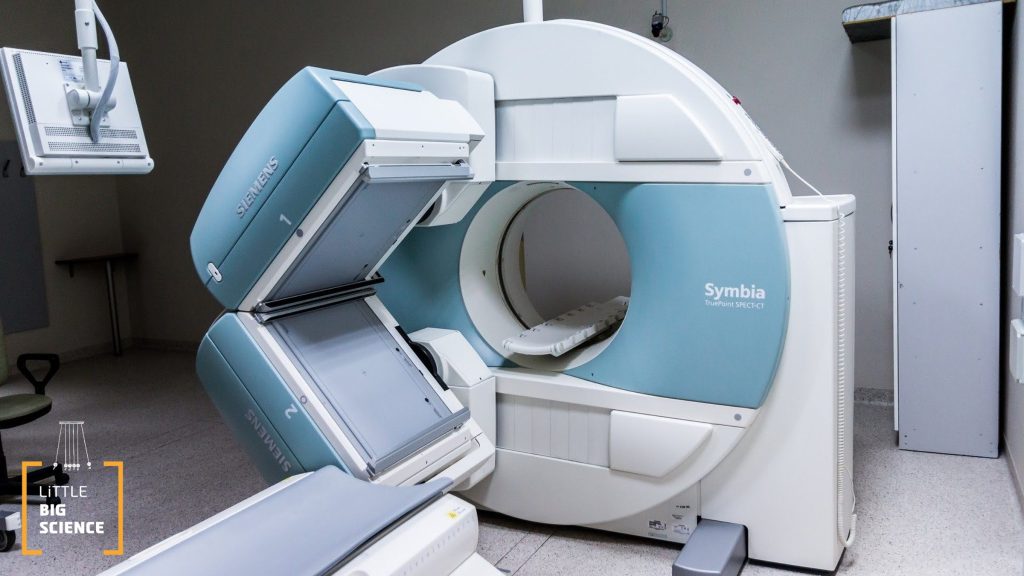
Magnetic Resonance Imaging (MRI), is a common and safe imaging method used in medicine and research, allowing us to visualize internal organs non-invasively and painlessly, by using radio-frequency radiation and a powerful magnet [1,2]. The invention of the MRI device is considered revolutionary, as it enabled physicians to replace a host of invasive procedures with a safe, high-quality examination, and therefore earned its inventor the Nobel Prize in Physiology or Medicine in 2003 [3].
Advertisement
Most of us have probably heard more than once that the MRI device is safe to use—and rightly so—but for the popular reason that the device does not use radiation in its operation. The truth, as you will see in the in a minute, is that the MRI device does indeed use electromagnetic radiation, but it is non-ionizing. Moreover, even devices that emit ionizing radiation are safe to use, as long as the exposure is in measured doses that do not endanger us.
Radiation is energy that propagates through space in the form of waves. Such waves can be characterized, among other things, by their frequency (or their energy)—the number of cycles the wave completes per unit time. This enables us to divide the radiation spectrum into different types: if we look at wave types by frequency, from low to high, we find, for example, radio waves, visible light, X-rays, and gamma rays. Ionizing radiation, such as X-rays and gamma rays, is so energetic that it can “break” molecules into individual atoms and free electrons, essentially turning materials into “ions,” in a process called ionization. The World Health Organization has defined ionizing radiation as a carcinogen; the greater the exposure, the higher the risk of cancer. Non-ionizing radiation, such as the radio-frequency radiation used in an MRI scanner, is not energetic enough to ionize molecules and therefore cannot cause the health damages associated with ionizing radiation.
So, what does radiation have to do with the powerful magnet at the heart of the MRI device?
Simply put, to perform magnetic resonance imaging, we need a magnet large enough to scan the human body and metal coils wound around the magnet that can transmit and receive radio waves.
The MRI image relies on the presence of hydrogen nuclei, an atom that is one of the components of the water molecules making up about 70% of our body. Under normal conditions, hydrogen nuclei spin around their own axis randomly and without a specific orientation. In the presence of a strong magnetic field, such as that produced by the MRI magnet, the hydrogen nuclei in our body become magnetized and align uniformly either with or against the direction of the magnetic field, in a process that is harmless to our body.
If we irradiate the hydrogen nuclei under the magnetic field with radio waves, some of the nuclei will flip their spin direction to be opposite to the magnetic field. When we stop transmitting radio waves, the system returns to its initial state: the hydrogen nuclei that flipped during the radio-frequency irradiation return to spin in the direction of the magnetic field. This return of the hydrogen nuclei to their original state is called “relaxation.” The metal coils wound around the magnet can measure the relaxation process—this is essentially what the MRI device measures.
Different tissues in our body contain different concentrations of water molecules composed of hydrogen nuclei, so their relaxation times will differ. Irradiating radio waves at varying rates and decoding the different relaxation signals produce an image that allows us to distinguish between the various body tissues and differentiate bone, muscle, nerves, fluids, and more [4,5].
While the MRI device does not use ionizing radiation, it does create a strong magnetic environment and emits radio waves. The powerful magnetic field attracts magnetic metallic objects, so it is recommended to arrive for the scan without such objects. It is also necessary to inform the medical staff about the presence of metals in the body, such as a pacemaker, various implants, and so on. In addition, the radio waves emitted during the MRI scan may cause the scanned area to heat up [6].
Thanks to its powerful magnet and radio-frequency radiation, MRI enables us to image the human body, even in three dimensions. The fact that the MRI device does not use ionizing radiation encourages researchers to develop improvements that allow us today not only to view structural images of our body but also to image brain activity in real time and determine the chemical composition of various substances in the body—all, of course, non-invasively. We can expect that in the not-too-distant future MRI scanners will become more available and accessible. The development of even more powerful magnets will allow us to image the human body with unprecedented accuracy and quality. For example, only recently the best MRI scans in history were published, enabling us to view the human brain at an unprecedented resolution [7].
English editing: Elee Shimshoni
References:
- About MRI from Mayo Clinic
- About MRI from the National Institute of Biomedical Imaging and Bioengineering
- The inventors of the MRI device win the Nobel Prize
- On how the MRI device works
- On the physics behind MRI operation
- MRI benefits and risks according to the U.S. Food and Drug Administration
- The best MRI scans in history

Daniel is a physician (M.D.) specializing in neurology at the Tel Aviv Medical Center, and he holds a PhD in the physiology and pharmacology of the nervous system from Tel Aviv University.


