
Advertisement
Water is a fascinating substance with many remarkable properties. The main reason for this is the unique structure of the water molecule. Although electrically neutral, its structure and charge distribution are asymmetrical, creating an electric dipole—that is, a structure whose one end carries a positive charge and the other a negative charge.
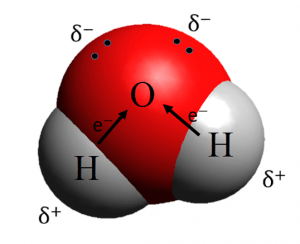
In the image: a water molecule with its dipole markings (credit: Drago Karlo CC-BY)
Molecules that possess an electric dipole are called polar molecules. Non-polar molecules, in contrast, have both a symmetric structure and a symmetric charge distribution, meaning the charge is evenly dispersed in space. Polarity strongly influences molecular behavior. In polar molecules, the positively charged side is repelled by positive regions of neighboring molecules and attracted to negative regions. In polar liquids such as water, this produces a strong electric attraction between molecules, on average. Consequently, a molecule located at a free interface (for example, the boundary between a liquid and a gas) feels an inward pull from the molecules within the liquid but no attraction from the air above. This creates an inward force. Because no molecule “wants” to sit at the interface, energy must be invested to create a free surface (or an interface between two liquids). The ratio between the energy stored in the surface and the surface area defines the liquid’s surface tension.
Neglecting gravity, a water droplet adopts a perfect spherical shape, because a sphere has the smallest possible surface area for a given volume [1]. This shape therefore minimizes the droplet’s surface-tension energy. But what happens if we bring a solid surface close to a droplet floating in space? It turns out that this depends on how polar the molecules making up the surface are. The more polar the surface, the stronger its attraction to the water molecules, and the more the surface would become wet.
One widely used method for quantifying how much a surface would become wet was proposed in 1805 by Thomas Young [2]. It relies on the contact angle between a small droplet and the surface (for small droplets gravity can be neglected). A contact angle of 0° represents perfect wetting, and an angle of 180° represents complete non-wetting. Generally, materials with a contact angle smaller than 90° are called hydrophilic (“water-loving”), or super-hydrophilic if the angle is below 10°. Materials with a contact angle larger than 90° are called hydrophobic (“water-repelling”), or super-hydrophobic if the angle exceeds 140°.
Oil is a familiar example of a hydrophobic substance. If oil is added to a container of water, water molecules attract one another and push away the non-polar oil molecules. The oil molecules prefer to stick together to minimize the interface area between themselves and the surroundings, forming small oil droplets inside the water. Because oil usually has a lower density than water, the droplets float to the surface and merge into a continuous oil layer above the water. This phenomenon is called “phase separation.”
Most hydrophobic materials are also lipophilic (oil-loving), so water-repellent surfaces can be used to attract oily substances. The beetle Hemisphaerota cyanea has tiny hairs on its underside that grant it hydrophobic properties. When a predator approaches, the beetle secretes oil that glues its abdomen to the surface through an effect known as a “capillary bridge,” preventing the predator from lifting it [3]. Experiments have shown that in this way the beetle can resist forces up to 60 times its own weight.
Despite many attempts by researchers worldwide, super-hydrophobic surfaces cannot be obtained by surface chemistry alone. To achieve contact angles greater than 140°, one must design sophisticated surfaces with special micro- and nanostructures.
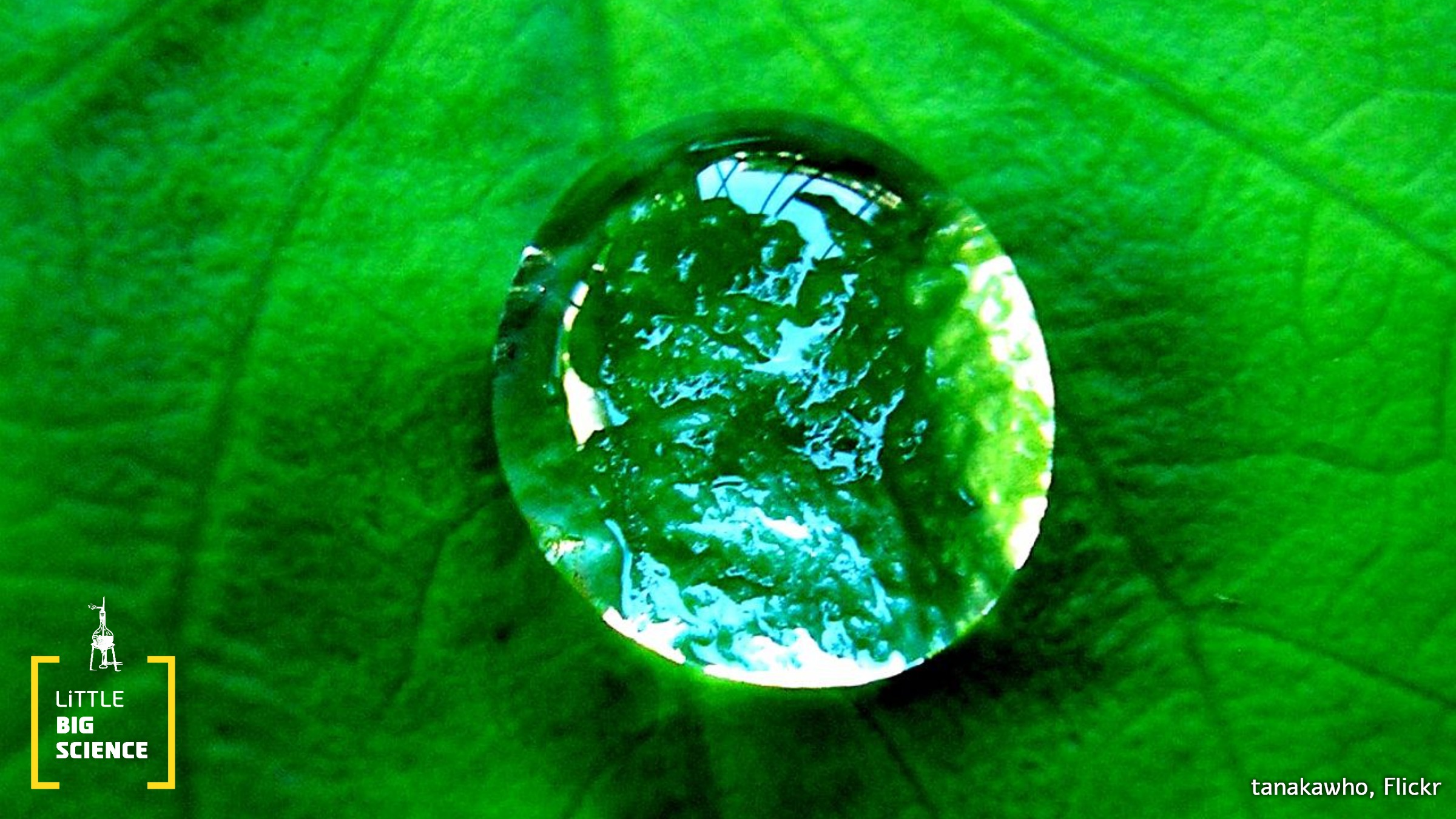
Main image: The world in a waterdrop, tanakawho, Flickr
English editing: Elee Shimshoni
References:

Valeri is an assistant professor at Boston University. His lab focuses interfacial phenomena and physics of fluids, with applications to microfluidics, optics, additive manufacturing, and in-space manufacturing. He is also interested in the field of Hydrodynamic Quantum Analogs, which explores fluid-mechanical systems that exhibit quantum-like behavior.


