In 1962, Brian Josephson, then a doctoral student, published a paper showing that electron pairs in superconductors can tunnel through an insulating layer. A year later, experiments validated his calculations and demonstrated that Cooper pairs can indeed tunnel through an insulating barrier. The "sandwich" of superconductor—insulator—superconductor, was named after Josephson as the "Josephson junction", and he received the Nobel Prize in Physics for this discovery in 1973. But the story is only beginning.
Advertisement
As noted in part I, just as in a superconductor, a Josephson junction can sustain an electric current with no electric voltage. This current can increase up to a maximum value called the “critical current.” The critical current of a Josephson junction is lower than the critical current of the superconductor that composes it, and depends, among other things, on the thickness of the insulating layer and on its cross-sectional area.
By analogy with the superconductors that form the junction, applying a magnetic field also affects the junction’s critical current. The magnetic flux i.e., the amount of magnetic field passing through the insulating region, either increases or decreases the maximum supercurrent the junction can carry. The change is periodic: Increasing the field reduces the critical current up to a certain level and then raises it again. Remarkably, the critical current changes with the magnetic field in the same way that light intensity changes with position on the screen in a single-slit interference experiment [1]. Hence, a Josephson junction is the electrical analogue of single-slit interference!
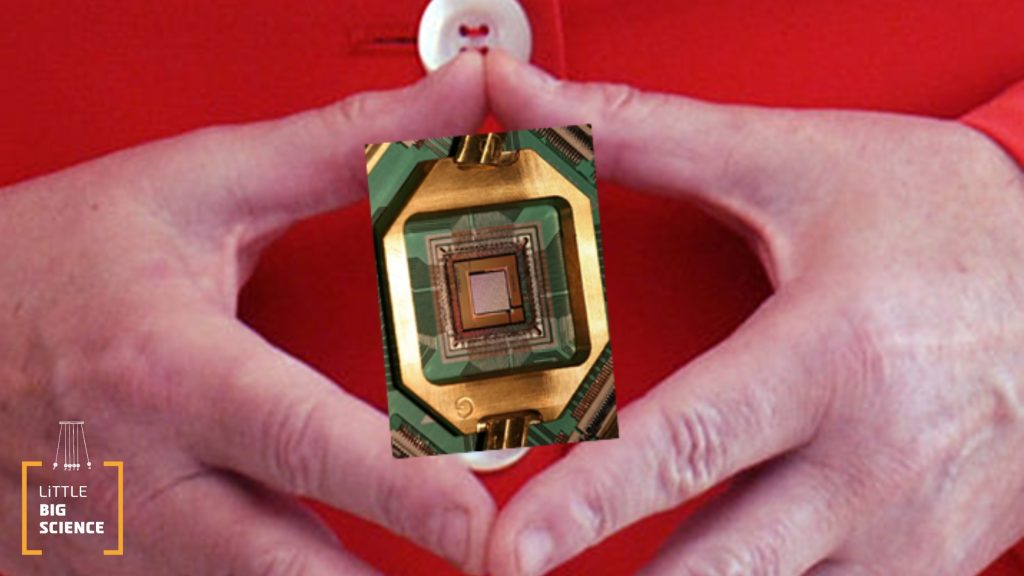
This fact alone is enough to make the Josephson junction an especially common device in basic research, but what about two-slit interference—the famous Young experiment [2]? If one junction is one slit, then two junctions are two slits, and now we only need to figure out how to arrange them. The way to place the two junctions is to connect two superconductors, each of which splits into two paths. Imagine Angela Merkel’s hands (yes, I misled you in the teaser for part II). There’s also a picture below if it’s hard for you to picture Angela Merkel’s hands forming her well-known diamond.

Her hands are the superconductors; between the two thumbs there is one junction, and between the other fingers a second junction. If you still can’t picture Angela Merkel, imagine two half-circles glued together to form a ring. The glue spots are where the junctions sit. Two wires are attached to the ring so that a current can be sent through the whole setup.
A current arriving from one wire into the ring now has to “choose” whether to flow through one half of the ring and meet junction A or through the other half and meet junction B. This “choice” corresponds to the photon’s choice of which slit to pass through in Young’s experiment. As expected with a quantum device, there is no real choice: The current flows through both halves of the ring and through both Josephson junctions. When the current completes the loop and reaches the second wire, the two paths merge, and the total current is determined by the interference result—constructive interference gives the maximum current, destructive interference the minimum.
This is a “Superconducting QUantum Interference Device,” better known by the cool initials SQUID. Here is what it looks like:
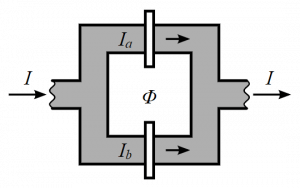
In this loop with two superconductors attached, one can think of two kinds of supercurrents. The first type is the current through the SQUID: It flows from one superconductor, splits into the two halves of the loop (each containing a junction), and exits through the other superconductor. The second type is the current that circulates inside the loop and stays within the SQUID. Because this current is also a supercurrent, it can flow without resistance in the circuit that includes both junctions.
The critical current of a SQUID—the highest supercurrent that can flow through the SQUID, or through Angela Merkel’s two arms—depends on the magnetic flux passing through the loop bounded by her fingers. In our glued ring, the magnetic flux is the magnetic field threading the ring, and because the ring’s size is fixed, the field strength in which the ring sits determines the critical current. This property makes SQUIDs particularly useful for measuring magnetic fields, and they are employed for this purpose in research and industry [3].
Very basically, one can explain the dependence of a SQUID’s critical current on an external magnetic field by noting that a superconductor always adjusts the flux through the loop to an integer multiple of a fundamental unit (a “quantum”) of magnetic flux, using a magnetic field created by the current circulating inside the loop. If the external magnetic field gives a flux through the SQUID loop that is one quantum minus “a bit”, a supercurrent will flow in the loop, producing an opposite magnetic field that supplies that “bit”. This flux adds to the external field’s flux so that the total flux becomes an integer multiple of the magnetic-flux quantum (in this case, one quantum). Recall that the “compensating” current circulating in the loop also passes through the junctions and therefore “uses up” some of the supercurrent that can flow through the SQUID between the two arms.
The highest critical current naturally occurs when there is no flux at all, or when the flux is an integer multiple of the magnetic-flux quantum. In that case, all the supercurrent can be dedicated to flowing through the SQUID. The lowest critical current occurs when the largest compensating supercurrent is required in the SQUID loop. This happens when the flux is an integer plus one-half. In that case, a loop current must create half a flux quantum. But should it add half or subtract half?
Because in both cases the result is an integer multiple of the flux quantum, and because there is no preference for either current direction, the two states have equal energy and can exist in quantum superposition [4]. Two energy-degenerate states that can be distinguished experimentally, e.g., by measuring the current direction, are excellent candidates for use as quantum bits. Such qubits are called “flux qubits.” There are additional types of qubits based on Josephson junctions (not necessarily on SQUIDs); they rely on other aspects of Josephson-junction behavior and on the fact that superconductivity in general is a quantum state of many particles. This is the place to recall that superconductivity arises from the Bose-Einstein condensation of electron pairs [5].
Superconductor-based qubits and Josephson-junction qubits are considered highly promising in quantum computing, and they form the basis of the quantum computers built by companies such as Google [6] and Rigetti [7].
All of this stems from one curious graduate student’s doctoral work that later won a Nobel Prize, and from the strange and astonishing properties of superconductors in particular and of quantum theory in general.
English editing: Elee Shimshoni
<<<To the previous post in the series
Sources and further reading:
- Wave Interference
- On the double-slit experiment, Wikipedia
- On a magnetic microscope that uses a SQUID to study material magnetism
- Superposition, the paper by Einstein, Podolsky, and Rosen
- The post series at Little, Big Science on superconductivity
- Paper on Google’s quantum-computing technology, another one, and yet another
- Rigetti’s homepage