
There is an old joke about a dairy farmer who asks an engineer to help him calculate how much milk his cows produce per day. The engineer immediately replies, “Of course I can calculate it, but first we need to assume the cows are spherical and frictionless”. This joke, illustrates one of engineers’ most despised enemies: friction. While friction between rigid surfaces is relatively easy to describe, friction between fluids and surfaces is much more complicated, giving rise to the “boundary layer”—a special region within the fluid whose accurate physical description is critical to many engineering and scientific applications.
Advertisement
Friction is a force that acts between two bodies that are in contact and moving relative to one another, and it causes resistance to that motion [1]. Friction is the force that keeps you, and everything else, from sliding endlessly across the floor; it effectively “anchors” us in place (if you want to torment a physicist, tell them that and watch the response). But why does friction arise between bodies at all? In simple terms, if we examine the surface of any object under a microscope, we find that it is rough, even when it feels and appears smooth. When two surfaces move relative to each other, the roughness of each one collides with the other, producing a force opposite to the direction of motion.
Some of you might immediately ask, “Fine, that explains solids, but how does friction work with water or air?” For example, when we swim or play with a ball [2]. Excellent question—give yourself a pat on the back. The mechanism of friction with water or air differs from the one that exists between solid objects. First, note that both water and air are fluids [3]: A fluid is a substance that takes the shape of its container, whether it is a liquid or a gas. Therefore, what we really need to explain is: “What is the mechanism of friction with a fluid”? Any body moving through a fluid [3] experiences a force opposing it, called drag. In broad terms, drag arises from two main causes: (1) the body must push aside fluid particles that are in its path while those particles push back, according to Newton’s second and third laws (this is called pressure drag); and (2) friction with the fluid, which will be our focus here. The more viscous the fluid, e.g., honey compared with water, the more dominant the frictional component becomes relative to pressure drag.
Imagine some fluid (say, water) flowing peacefully alongside a flat surface, for example, water moving over a plate. If we look at the layer of water closest to the surface, down at the level of individual molecules, we see that they do not move; instead, they “stick” to the fixed surface. In fact, the fluid molecules that are right next to the surface get caught on the solid’s microscopic roughness due to electrical forces such as van der Waals interactions between the fluid and the surface, and they stop. The molecules in the layer just above this thin layer collide with it and slow down, and in turn the molecules above them do the same, and so on. The result is many layers colliding with and slowing each other because each exerts friction on the layer above it—this is how friction between the water and the surface arises. The same thing happens between any fluid and a solid body [4].
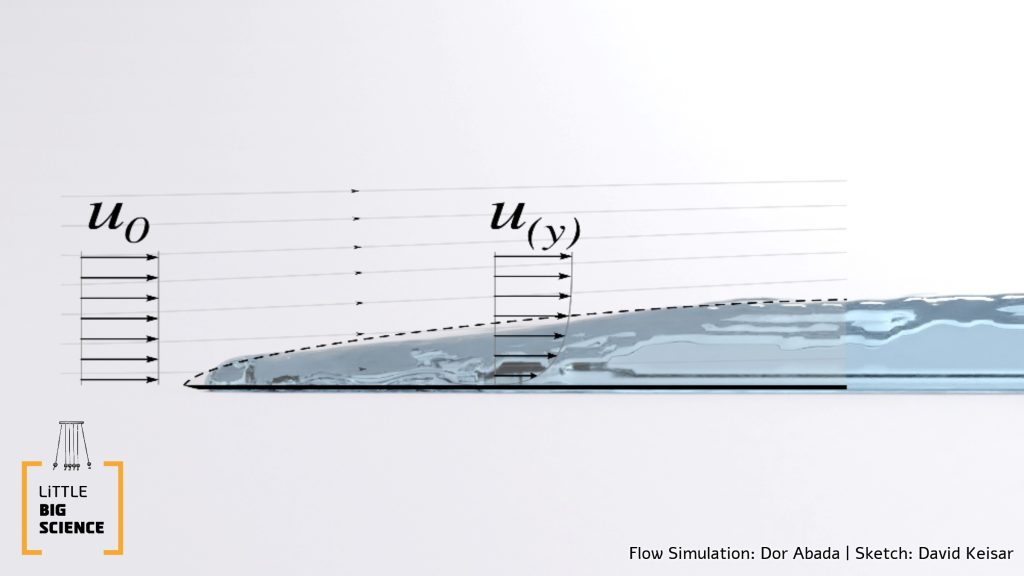
The outcome is a speed that varies with distance from the surface: Right next to the plate the velocity is zero, and far away it equals the undisturbed flow speed, as though the fluid never met the surface. This gradual change between the layer that is "stuck" and the free stream can be calculated by solving the Navier–Stokes equations and estimating the frictional force [3] (see the MIT video—slightly old but excellent [5]).
This region adjacent to the plate, where the fluid velocity changes, is called the boundary layer, because it is a layer right at the boundary of the plate (engineers are not very creative with names). A computer visualization appears in the image at the top of the article: the blue fluid is the boundary layer, while the unimpeded fluid above it is omitted. The arrows show how velocity changes with distance from the lower surface, and the long lines behind indicate how the flow direction changes (streamlines).
Its outer edge is defined as the point where the velocity is slowed by only 1 % compared with the free-stream speed [6]. The boundary layer exists wherever there is flow—inside arteries, in the wind over aircraft wings and automobiles, in heat transfer by airflow, and in the winds that blow near the ground. This is why wind speed right at the ground is lower than the wind speed near our heads, which in turn is markedly lower than the wind speed near the tops of skyscrapers [7]. That variation matters especially when designing wind-turbine farms or tall buildings, because the change in wind speed with height dramatically affects the amount of electricity the turbines can generate or the building’s stability in strong winds, respectively.
In summary, the boundary layer is the phenomenon by which a fluid generates friction with rigid bodies such as plates, wings, or even the ground, through a mechanism different from the friction between two solid surfaces. The friction between each fluid layer and the layer above it creates a velocity profile in which speed increases with distance from the solid. The boundary-layer effect influences numerous engineering and physical applications, from reducing friction in water pipes and controlling heating and cooling by airflow, to the efficiency of wind-energy harvesting and even the formation and movement of clouds in the atmosphere [8].
English editing: Elee Shimshoni
References:

David holds a PhD in Energy Engineering and is currently a postdoctoral researcher at MIT, focusing on thermochemical energy storage, battery recycling and heat and mass transfer phenomenon. David also serves as the scientific editor at “Little, Big Science.”


