
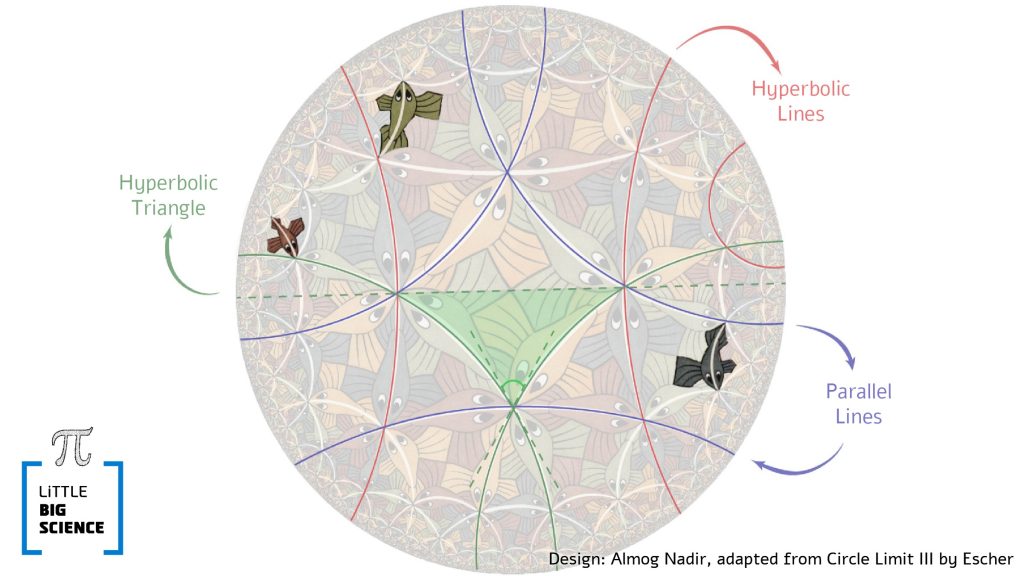
Let us acquaint ourselves with hyperbolic geometry, a peculiar geometry in which lines do not appear straight and the sum of the angles in a triangle is not 180 degrees. This geometry has applications in applied physics and in the theory of relativity, and it even shows up in nature—for example, in the shapes of lettuce leaves and coral reefs. This time we will not discuss the applications or the lettuce; instead, we will present the historical background and the mathematical foundations, illustrated with Escher’s famous and delightful woodcut.
Advertisement
Let's acquaint ourselves with hyperbolic geometry, a peculiar geometry in which lines do not appear straight and the sum of the angles in a triangle is not 180°. Hyperbolic geometry has applications in applied physics and the theory of relativity. It even appears in nature, for example, in the shapes of lettuce leaves and coral reefs. Today, we will not discuss these applications or lettuce. Instead, we will present the historical background and mathematical foundations of hyperbolic geometry, illustrated with M. C. Escher’s famous and delightful woodcut.
The geometry we learn in school is Euclidean geometry. It is based on just five axioms that were established in Euclid's times, around 300 BCE. Axioms are foundational assumptions from which numerous conclusions about triangles, circles, and more can be derived. Interestingly, Euclid’s book "The Elements", remained the primary geometry textbook until the end of the 19th century [1, 2, 3].
The fifth of Euclid’s axioms, the “parallel postulate,” has long been the subject of both suspicion and interest. In a modern formulation it states:
Given a straight line and a point outside it, there is exactly one straight line passing through the point that does not intersect the given line, that is, it is parallel to the given line.
Compared to the other axioms, the fifth is the most complicated one. Mathematicians therefore thought it might be possible to prove it using the other axioms, which would leave only four axioms. However, all attempts failed. It is not only impossible to derive the fifth axiom from the others, but assuming it is false and replacing it with different postulates, yields different geometries.
Before we continue, let’s clarify what “different geometries” means. A geometry establishes the relationships between points and lines by selecting the axioms that dictate the rules of the game. We are familiar with how Euclidean geometry deals with points and lines. As we will soon see, it is possible to replace the fifth axiom with an alternative one. The result is a geometry, where the relationships between points and lines are different. However, the other four axioms still need to be satisfied. For example, we want any two points to be connected by exactly one line segment, and for there to be only one way to extend a given line segment into an infinite line, just as in Euclidean geometry.
In the 19th century, two mathematicians, the Russian Lobachevsky and the Hungarian Bolyai, independently discovered (or invented!) non-Euclidean geometry. They demonstrated that a different geometry results when Euclid’s fifth axiom is replaced with the following:
“Given a straight line and a point outside it, there exist at least two distinct lines passing through the point that do not intersect the given line.” In fact, in such a case, there are infinitely many such lines. This geometry is called hyperbolic geometry.
But how can we be sure that a structure exists that satisfies the first four axioms and this alternative fifth one? Or did we invent an axiom out of thin air? To show that such a different geometry exists, we present an explicit construction that satisfies all the necessary axioms: the Poincaré disk model [4, 5]. Instead of using the entire plane, we use a disk as the setting for everything that happens. “Points” are ordinary points inside the disk, excluding its boundary. “Straight lines” come in two types: (a) ordinary Euclidean straight lines passing through the center of the disk, and (b) arcs of circles intersecting the boundary of the disk at right angles.
Wait, what is the angle between two circular arcs? Look at the tangents to the arcs at their intersection point. The angle between the arcs is defined as the angle between those tangents. Thus, a “straight line” of type (b) is an arc whose tangent at each boundary intersection is perpendicular to the tangent of the boundary circle itself (see Figure 1).
Look at the white curves in Escher’s print Circle Limit III in the post’s image, they are “straight lines”!
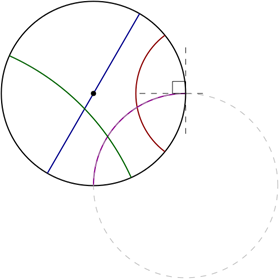
Figure 1: Example of “straight lines”
Returning to the fifth axiom of hyperbolic geometry: Figure 2 shows a blue “line” and an external point. According to this geometry's definition, the many black lines passing through the point are "straight lines", and none of them intersect the blue “line.” Can you find a similar configuration in Escher’s print?
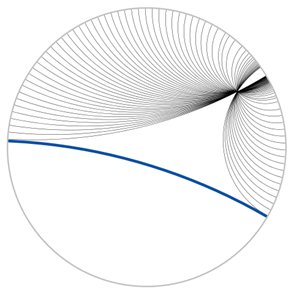
Figure 2: All the black “straight lines” passing through one point are parallel to the blue “straight line”.
To better understand hyperbolic geometry, let's examine what triangles look like. We will discover that the sum of the angles in a triangle is not 180 degrees!
A triangle is three points pairwise connected by “straight lines.” What are the angles of a triangle? If the sides are true straight lines, then the angles are measured in the usual way. The angle between two circular arcs is measured by the angle between their tangents at the point of intersection. Figure 3 shows an example of a hyperbolic triangle. Look for triangles and angles in Escher’s print.
.
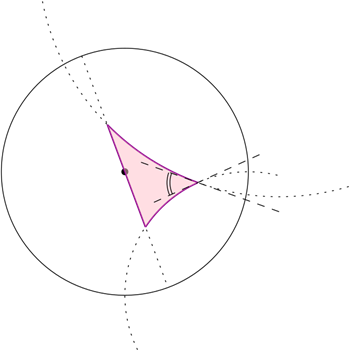
Figure 3: A hyperbolic triangle
Now we add the possibility of triangles with one or more vertices lie on the boundary of the disk. These generalized triangles are called ideal if all three vertices are on the boundary (see Figure 4).
.
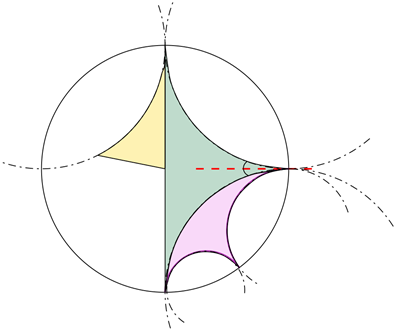
Figure 4: Generalized and ideal triangles
What is the angle at a triangle vertex on the boundary? Since each side that meets at such a vertex is a "straight line", each side forms a 90-degree angle with the boundary. Therefore, the two triangle sides share the same tangent, which is perpendicular to the boundary at their intersection. Thus, the angle between the two sides is zero. If all the vertices of a triangle lie on the boundary, then all of its angles are zero!
(The red line in the Figure 4 is tangent to both “straight lines.” In the green and pink triangles all angles are zero.)
In summary, we have learned about a strange geometry in which infinitely many parallels can pass through a point outside a given line, and in which the sum of the angles of a triangle is less than 180 degrees. This sum is not fixed, and can even be zero in generalized triangles. Note that distances on our disk are not ordinary either. For instance, the distance from the center of the disk to any boundary point is defined as infinite. Escher mentions this property in his description of the print, in which fish shoot out perpendicular to the boundary from infinity and return to where they came from [6, 7]:
"As all these strings of fish shoot up like rockets
from infinitely far away, perpendicularly from the
boundary, and fall back again whence they came,
not one single component ever reaches the edge."
The post image is based on Circle Limit III by M. C. Escher (1959), via mcescher.com.
Hebrew editing: Smadar Raban
English editing: Gloria Volohonsky
References:
- Euclid's Elements, Wikipedia
- A modern online edition of Elements
- The Poincaré disk model, Wikipedia
- A textbook on non-Euclidean geometry
- On non-Euclidean symmetry in Circle Limit III
- About the artist M. C. Escher, Wikipedia
- On non-Euclidean geometry and general relativity – a post on Little, big science

Holds a BSc and an MSc degree in Mathematics from Tel Aviv University, and works as a data scientist. She has a broad interest in science, a passion for music, and a love for proverbs in various languages. She also serves as a scientific editor at “Little, Big Science.”

Almog is a graphic designer and an enthusiastic illustrator. She holds a Master’s degree in Biology from Ben-Gurion University.


