
Measurements taken from the depths of the oceans, at sea level, from continental glaciers, and from the atmosphere all show that Earth is accumulating energy, meaning it is getting warmer. This conclusion is based on direct observations and basic physics, not on sophisticated, intricate climate models,
Advertisement
The Earth is warming due to the increasing concentration of greenhouse gases in the atmosphere. While the temperature increase is attributed to human activity, in this post we will focus solely on the evidence that the Earth is indeed warming.
The amount of heat energy on Earth is equal to the total energy received from the Sun minus the energy radiated into space. If these amounts are equal, the Earth's temperature remains stable and the planet does not warm up. However, if the amount of heat radiated outward is smaller than the amount received, the planet warms up. The question is: how can we measure this warming directly, without using models? Just as you can use a thermometer to determine whether you have a fever (elevated body temperature), we can use various instruments to measure changes in the Earth’s temperature and estimate how much it is warming.
The oceans can be viewed as a natural thermometer for the Earth. Since most of the planet's surface is covered by water, if the Earth is indeed warming, the temperature of the oceans will rise. Water has a relatively high heat capacity, meaning that raising or lowering its temperature requires a large amount of heat energy to be added or removed. This makes changes in ocean temperature a particularly stable and reliable indicator of the planet's energy balance, since small or temporary fluctuations in the balance will not produce significant changes in water temperature.
The first sea-surface temperature measurements were carried out by sailors on ships as early as the mid-19th century. Since the 1980s, sea-surface temperatures have also been measured using satellites equipped with infrared and microwave sensors. Since infrared radiation is quickly absorbed by water, infrared sensors can only measure the thermal radiation emitted by the uppermost layer of the ocean surface — a layer ranging from a few microns to a few millimeters in thickness — and thus measure its temperature. Microwave sensors, on the other hand, detect radiation at lower frequencies that can penetrate certain types of clouds. These sensors enable sea-surface temperatures to be measured even when infrared sensors are ineffective. Sea-surface temperatures are measured millions of times each year, at almost every point in the oceans. These measurements show that the global average sea-surface temperature has risen by about 0.9 °C since the mid-20th century, with the rate of increase has accelerating since the 1990s [1-4].
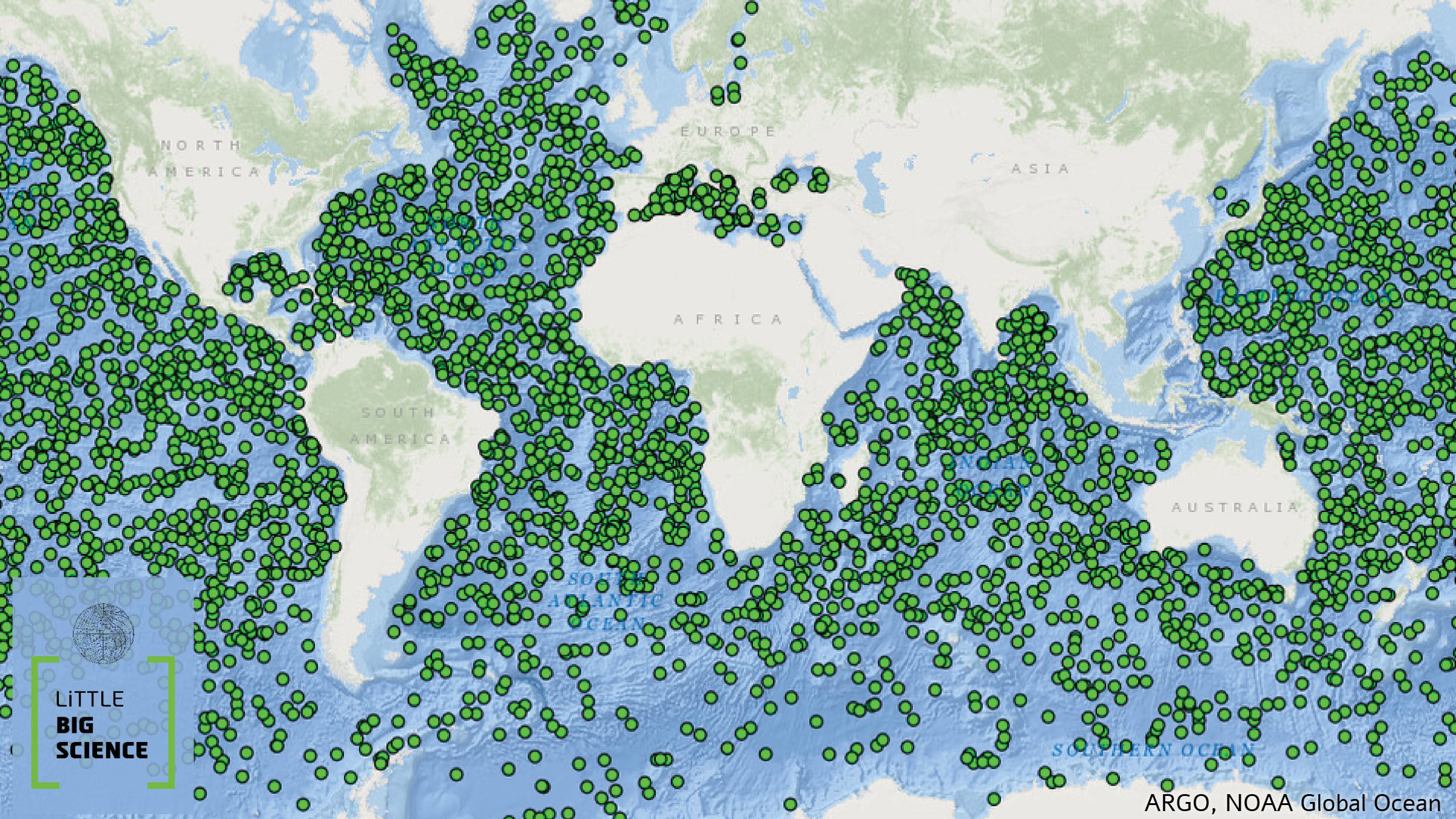
Although measuring ocean temperature with satellites provides extensive information, this method is limited to the surface. Since the temperature of the ocean varies with depth, estimating the ocean’s total heat content requires measurements at depth as well. The ARGO program (Array for Real-time Geostrophic Oceanography) is an international initiative comprising a fleet of almost 4,000 robotic floats that measure temperature and salinity throughout the oceans. ARGO floats drift with ocean currents, and their horizontal position is not controlled. However, each float is equipped with an accurate depth gauge and a buoyancy bladder that enables depth control. The floats dive, take measurements, surface, and transmit the data via satellites [5]. This system provides hundreds of millions of measurements worldwide each year, enabling the estimation of changes in the thermal energy of the entire ocean, not just the surface [6]. ARGO data show that the ocean’s heat content has increased at an average rate of 1021 joules per year since 2000 [7, 8]. This amount of energy is equivalent to more than one hundred million atomic bombs like the one dropped on Hiroshima in World War II! This is s particularly powerful evidence for three reasons: (i) the oceans are vast, (ii) water has a high heat capacity, and (iii), the measurements rely on basic physics and simple, reliable instruments (thermometers).

ARGO float. Source: https://globalocean.noaa.gov/research/argo-program
The energy balance also affects the temperature of the atmosphere. Since the 19th century, hundreds of thousands of meteorological stations worldwide have been measuring air temperature [9]. Since the 1950s, hundreds of weather balloons have been launched daily, to collect data from the ground level up to altitudes of tens of kilometers. These measurements demonstrate warming in the troposphere (the lowest atmospheric layer, at altitudes between 0 and 12 km) and cooling in the stratosphere (at altitudes between 12 and 50 km) [10]. Since the early 1980s, satellite measurements have also been used [11]. These satellites carry temperature sensors based on microwaves across a broad frequency range, with each frequency being sensitive to a different altitude layer. This enables a high-resolution vertical temperature profile of the atmosphere to be assembled on a global scale [12]. Millions of measurements are collected daily around the world, and the data clearly show significant warming of the troposphere and cooling of the upper layers.
The fact that energy accumulates in the lower layers and declines in the upper layers indicates that the warming results from a reduction in the energy radiated from the Earth into space rather than an increase in the energy arriving from the Sun. Energy leaves the Earth’s surface in the form of infrared radiation. When a larger proportion of this radiation is absorbed by the atmosphere, less energy escapes into space, and more energy remains in the lower layers. This state is known as the “greenhouse effect,” in which the troposphere is expected to warm, while the stratosphere, receiving less heat from below, is expected to cool. If the Earth’s warming were caused by an increase in solar energy, we would not observe this pattern, since solar energy heats the upper layers first. The fact that the two atmospheric layers respond in opposite ways confirms that the rise in Earth’s thermal energy results from a reduction in energy loss to space [13].
There are also indirect measurements of the increase in the Earth’s thermal energy that do not rely on temperature readings. For example, measurements of the major land glaciers in Greenland and Antarctica show that they are losing hundreds of billions of tons of ice each year [15]. Together with the fact that water expands as its temperature rises, this is causing the sea level to rise. Measurements of the sea level taken worldwide for more than a century also show that the Earth is warming [14].
We know that the Earth is warming because we have measured the excess energy resulting from a change in its energy balance. This excess energy raises ocean temperatures, alters the atmospheric temperature profile, raises the sea level, and melts glaciers. Each piece of evidence is compelling in its own right, and collectively they point to one clear physical conclusion. The Earth’s heat energy content is increasing, meaning there is global warming.
Featured image: Locations of Argo floats on 1 Dec 25, 21:30 IST. Source: https://globalocean.noaa.gov/research/argo-program
Hebrew editing: Smadar Raban
English editing: Gloria Volohonsky
Sources and Further Reading
- Sea-surface temperature data set from 1854 to the present
- Chapter 2 of the 2021 IPCC report with sea-surface temperature data and changes
- European Environment Agency global sea-surface temperature data set
- Paper analyzing temperature data to calculate the rate of increase
- The ARGO website
- Technical explanation of ARGO measurements, data availability, and applications
- Historical review of ARGO data usage
- Article on ocean heat content
- Meteorological station data set
- Weather-balloon data set with links to relevant papers
- Atmospheric temperature measurement by satellites
- Paper explaining construction of vertical atmospheric temperature profiles from satellite data
- Chapter 3 of the 2021 IPCC report, explaining why tropospheric warming combined with stratospheric cooling is a unique signature of reduced heat emission to space
- Paper on the trend in sea-level rise
- Paper on Antarctic and Greenland glaciers

Yuval is a marine biologist with a PhD from the Technion, and is currently a postdoc at MIT. He studies sea bacteria and enjoys doing field work, via scuba diving or on-board research ships. Yuval believes in the power of second chances. He is a father, partner, nature lover and foodie.


