
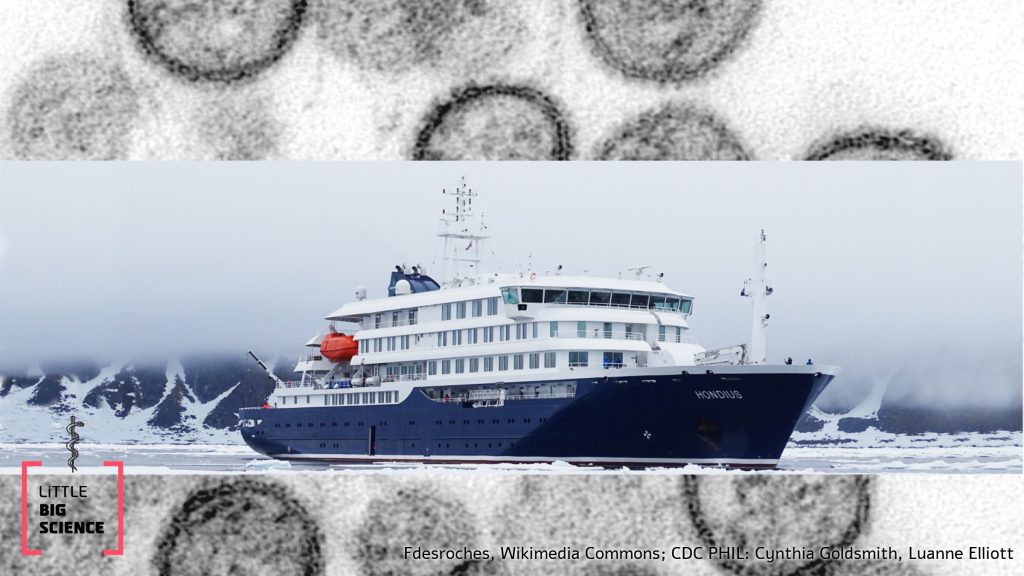
Eleven people who were on board a cruise ship came down with a viral illness. Three of the passengers died and one is currently hospitalized in an intensive care unit. What is the hantavirus? What disease does it cause? And why is this likely not the start of a new pandemic?
Advertisement
Eleven passengers who were on board the Dutch cruise ship “MV Hondius” came down with hantavirus-associated illness. Three of them have died, and one is in critical condition and hospitalized in an intensive care unit. The remaining patients are in stable condition and are being kept in isolation in different countries [1, 2]. The ship docked in Tenerife in the Canary Islands, and the passengers are on their way back to their home countries for further quarantine, after they were not allowed to disembark once the outbreak investigation began.
This outbreak is currently making headlines worldwide. In this article we will explain what the hantavirus is, how likely it is that additional cases will be detected, and what is the risk that this will become a new pandemic (as noted, this scenario is unlikely).
What is hantavirus disease?
Hantaviruses are RNA viruses from the Hantaviridae family. They are naturally found in rodents, and transmission to humans usually occurs after exposure to the animals’ excretions—urine, feces, or saliva—for example, through a bite or by inhaling contaminated particles. Each viral strain has a characteristic rodent host and a defined geographic distribution [3]. Dozens of hantavirus strains are known, yet not all of them cause disease in humans, and only one is capable of spreading from person to person [3]. According to World Health Organization (WHO) estimates, between 10,000 and 100,000 people worldwide contract hantavirus disease each year [4].
After an incubation period of one to eight weeks (typically 2–4 weeks), hantaviruses can cause two main diseases: Hantavirus Pulmonary Syndrome, which is common in the Americas, or Hemorrhagic Fever with Renal Syndrome, which is common in Europe and Asia [1]. The pulmonary syndrome is the more severe one, with fatality rates of up to 50 % [1]. The illness usually begins with nonspecific symptoms such as fever, muscle aches, and digestive symptoms, but it can rapidly deteriorate into acute respiratory distress and multi-organ failure. There is currently no specific treatment or approved vaccine; patients receive mainly intensive supportive care, such as respiratory support [5].
The current outbreak on the cruise ship
On May 2nd, 2026, the WHO was notified of an unusual cluster of people on a ship suffering from severe respiratory illness. At that time the vessel carried 147 passengers and crew members from 23 countries.
Patient zero was a 70-year-old man who developed symptoms on April 6th while on board and died a few days later. He had boarded the ship on April 1st in Ushuaia, Argentina, after he and his wife had spent several months bird-watching in South America. His wife later became ill and also passed away. Another passenger has died, and another one is currently hospitalized in intensive care.
There was also concern that a flight attendant had been infected after accompanying a patient evacuated for medical treatment, but this was ruled out by laboratory testing. According to the latest update from the European Centre for Disease Prevention and Control (ECDC, 12 May 2025), a total of eleven cases have been reported, three of whom have died; nine of the cases have been laboratory-confirmed [2].
Health authorities believe that the initial infection occurred off the ship during the bird-watching trip, most likely after exposure to infected rodents. However, the fact that several people who were in close contact to one another on the ship (for example, patient zero and his wife) became infected—a setting where the typical rodent hosts for the virus are unlikely to be present—raises suspicion of person-to-person transmission, an exceedingly rare phenomenon that has previously been documented mainly with the Andes strain of the virus (Orthohantavirus andesense). Genetic sequencing confirmed that this is indeed the strain found in all confirmed patients [1].
Is there cause for concern?
The WHO estimates that some of the ship’s passengers are at real risk of contracting the disease. In contrast, the risk to the global population is low, even in the places to which passengers from the ship have traveled, and the WHO does not recommend any measures beyond those already in place: i.e., keeping the ship in quarantine and isolating the patients. From what is known from previous infections, person-to-person transmission of the Andes hantavirus usually requires close contact with someone who is exhibiting characteristic symptoms, so a mass outbreak is not expected [1]. This is a different situation than COVID-19, which spreads easily from person to person through the air and is contagious even before symptoms appear, when an individual still seems healthy.
In summary, this is an unusual outbreak of an uncommon, yet lethal, disease under conditions not typically associated with it. Although the worldwide risk is low, the event is drawing considerable attention from the scientific community, chiefly because of the rare occurrence of human-to-human transmission. We will continue to monitor the outbreak and, of course, will update if significant developments occur.
Hebrew editing: Smadar Raban
English editing: Elee Shimshoni
References:

Dror is a member of Little, big Science's board of directors. He holds a PhD in Molecular Biology and has authored textbooks and articles for the general public, primarily in microbiology as well as other biological subjects. Dror taught microbiology and cell biology for more than 30 years at the Open University and other institutions.

Microbiologist, insect and photography enthusiast.


