
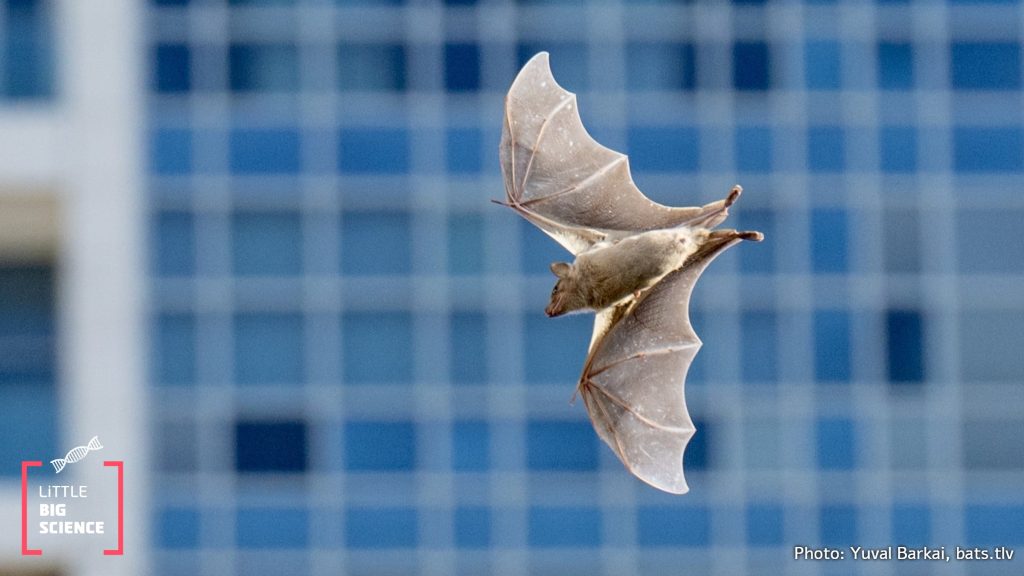
If you wander around Tel Aviv at night, you’re unlikely to miss an encounter with the Egyptian fruit bat, as it is one of the most familiar and widespread urban wild mammals in Israel. A new Israeli study suggests that these bats may not only live in the city, but also evolve alongside it.
Advertisement
Urbanization is one of the most significant processes through which humans reshape the world. For many organisms, urbanization changes the availability of food and shelter, lighting regimes, noise levels, local temperatures, and the landscape itself. Many species are harmed when their natural habitats undergo urban development and become covered with roads and buildings. Yet some species manage to thrive in built-up areas. One such species is the Egyptian fruit bat (Rousettus aegyptiacus), which thrives in Israel both in cities and in the countryside. These bats feed on fruit from wild vegetation, agricultural crops, and urban ornamental trees. This makes the species especially interesting to researchers because they can directly compare urban and rural populations.
Previous studies from the lab of Prof. Yossi Yovel’s at Tel Aviv University have shown that urban and rural fruit bats of the same species exhibit different behaviors and physiologies from a young age [1, 2]. For example, urban bat pups are bolder and learn faster than their rural counterparts. Urban mothers have higher levels of cortisol, a hormone linked to stress and metabolism, in their milk. Urban mothers give birth about two and a half weeks earlier than rural mothers in spring. This allows some of them to complete a second reproductive cycle later in the year. In addition, the urban bats’ diet is more varied and includes fruit from many tree species planted in the city.
These differences raise a fundamental evolutionary question about the bats: Do city bats merely adjust to their environment, or has urban life begun to shape their genes?
A new study on the topic, published in Evolutionary Applications, was conducted jointly by the labs of Prof. Yossi Yovel (Tel Aviv University), Dr. Eyal Privman (University of Haifa), and Dr. Orly Razgour (University of Exeter, UK) [3]. The researchers sampled fruit bats from ten colonies in Israel: five urban colonies in the Tel Aviv metropolitan area and five rural colonies in the Beit Guvrin National Park region. The researchers collected a small piece of wing skin from each bat and used a method called ddRAD-seq, to scan thousands of genetic markers across the genome. Genetic markers are DNA sequences at defined positions in the genome that can contain tens to hundreds of different genes. Studies of this kind focus on known markers, thus avoiding the sequencing of the entire genome, most of which is non-coding. The researchers examined a total of 185 samples, and analyzed the sequences of more than 20,000 genetic markers.
The first result was clear: urban and rural bats are not distinct genetic populations. The researchers found no significant genetic differences between city and country bats. This finding was expected, since the populations belong to the same species. Moreover, because bats are highly mobile and can fly long distances in a single night to reach distant feeding sites and mate with individuals from other populations, the potential for genetic mixing is increased.
However, the story is not so simple. While most of the genomes of urban and rural bats are very similar, the researchers identified 59 genetic variants that differ between city and country bats. These differences are found in markers containing genes whose function correlates with the level of urbanization around the colonies (as determined using satellite imagery). In other words, the bats are not splitting into two distinct genetic groups—urban and rural—but rather, certain parts of the urban bats’ genomes are responding to the urban environment. This is microevolution, or evolutionary change that creates differences between populations of the same species over relatively short periods of time.
At first, this may seem contradictory. If urban and rural bats intermix, how can the urban bats adapt locally? The answer lies in the balance between gene flow and natural selection. Gene flow, or the movement of genetic variants between populations through reproduction, tends to blur genetic differences among colonies. However, if natural selection is strong enough, it can still maintain differences in specific genomic regions. Thus, while most of the genome may remain similar between urban and rural bats, while certain variants that help cope with city conditions may become more or less common, depending on the environment.
As part of the study, the team conducted landscape analysis using satellite images of the bats’ colony areas. Surprisingly, the researchers discovered that cities do not constitute a barrier to gene flow. Urban areas, plantations, and forests actually promote connectivity among colonies. Conversely, open areas such as bare ground, grasslands, and agricultural fields act as quasi-barriers. While cities often fragment habitats for many animals, urban areas rich in trees can serve as corridors for fruit bats, offering abundant food and navigation landmarks. A city dotted with fig trees, palms, gardens, and parks is more than just concrete. For the Egyptian fruit bats it is an open buffet.
Which genes were found in the analysis? It is important to note that the researchers didn't prove that a variant in a specific gene causes a bat to become more urban, bolder, or better adapted to the city. Rather, they identified genetic variants whose frequency changed according to the level of urbanization around the colonies. The team mapped the location of these variants in the genome and discovered that some lie in genes involved in neural transmission and synaptic function, which are systems that mediate communication between nerve cells. While this finding does not prove that these genes “create an urban bat,” it is intriguing because previous studies have shown behavioral differences between urban and rural bats, such as differences in boldness and learning rates. Therefore, this finding suggest that evolutionary responses to city life may involve nervous-system activity. Additional candidate variants were located in genomic regions of genes involved in sensory perception, metabolism, reproduction, hormonal signaling, stress response, immune function, and gene expression regulation. These are broad categories, so over-interpretation should be avoided. Nevertheless, they may be relevant to well-known urban challenges such as navigating in complex, lit environments, exploiting a more diverse food supplies, adjusting breeding times, and coping with environmental conditions different from those in caves and rural areas. In other words, the study does not point to a single “urban gene,” but rather to several biological systems that may be involved in adapting to an urban environment.
One of the study's most striking results was the location of most of these variants in the genome. Of the 59 candidate variants, 51 were found in introns, which are regions within genes that do not code for proteins. This may not seem significant, but introns can influence when, where, and how strongly genes are expressed. Therefore, adaptation to urban environments likely occurs primarily through changes in gene expression regulation rather than through alterations in protein structure itself. In other words, city life may not replace the bats’ biological machinery, but rather fine-tune its settings.
Naturally, this type of study has its limitations. The method sampled only a tiny fraction of the genome. While the candidate variants are associated with urbanization, statistical association does not prove causation. Some variants may simply be located next to the genes that drive the change. Future studies will need to perform full genome sequencing, gene expression analysis, functional experiments and long-term sampling across generations to confirm the role of these variants in urban adaptation. Nevertheless, the pattern uncovered is striking. Although the bats do not exhibit a significant urban-rural genetic divide, certain genes potentially linked to urbanization stand out. These genes are not random: they cluster in systems related to neural signaling, metabolism, gene regulation, stress response, and reproduction. Together, they suggest that urbanization may shape several interconnected biological systems simultaneously.
The next time you hear fruit bats squabbling over a fig tree in Tel Aviv, remember that they are more than just city residents. They are participants in an evolutionary experiment that humans have unwittingly set in motion. The streets, gardens, fruit trees, buildings, and lights are all part of the landscape of natural selection.
Yomiran is the lead researcher in the study.
Hebrew editing: Smadar Raban
English editing: Gloria Volohonsky
References:

Yomiran is the General Manager of the NGO "Little, big Science". He is a doctoral candidate in the Department of Zoology at Tel Aviv University, where he researches bats' genetics, he holds a master's degree in Biology from the Technion.


