
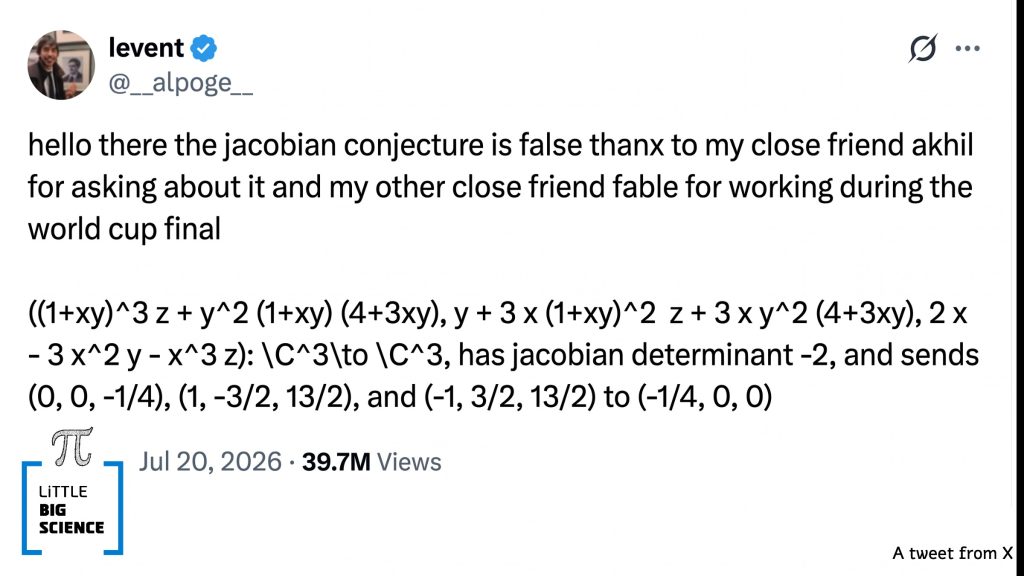
While the mathematical community is digesting the disproof of the Erdős conjecture [1], another model, Fable 5 by Anthropic, has found a counterexample to another unresolved conjecture. Unlike last time, where verifying the disproof required deep mathematical understanding, the current example can be verified with a fairly simple calculation. The result was published quite casually by mathematician Levent Alpöge in a post on X, as shown in the image of the post [2].
Advertisement
Before we turn to the conjecture and its disproof, we need to understand what a function is—a concept familiar to us from high school.
A function is like a creature that eats things of a certain kind and returns something in exchange. We can think of a function as a machine that knows how to accept an input of a particular type, e.g., a number, and return a defined output according to some rule, e.g., the square of that number, as in the function f(x) = x^2.
Functions do not have to accept a single number and return a single number: here is an example of a function that can accept two numbers and also return two numbers: for instance, the first number and the sum of the two inputs: f(x,y) = (x, x+y).
Unlike the one-variable functions familiar to us from high school, this is a function of two variables, and its output also consists of a pair of numbers. The function could just as well return a single number or three numbers, according to some rule. Functions can also accept and return other kinds of objects.
One important property a function can have is invertibility: a function is called invertible if one can find another function—its “inverse”—that performs exactly the opposite operation and restores everything to its original state (and this must work in the other direction as well, that is, mutually). This may sound too abstract, so let us look at a few examples.
Let's say we have a function that takes a number and adds 1 to it: f(x) = x+1. This operation has an opposite operation, and therefore an inverse function: the operation that takes a number and subtracts 1 from it, namely g(x) = x-1.
If we take any variable and first apply f to it (add 1), and then apply g (subtract 1), we return to the same initial value. In other words, the operation of g cancels out the operation of f (this also works in the opposite order: if we first apply g and then f, we return to the original input). These functions are inverses of one another!
In contrast, the function f(x) = x^2, if we consider every x on the number line, cannot be invertible. Why? Both 2 and −2 are mapped by the function to the number 4. This means that if we try to find an inverse function, it will not know what to do with that 4: which number should it output to restore everything to its original state: 2 or −2? Therefore, f has no inverse function unless we restrict our attention to nonnegative inputs only, or to nonpositive inputs only.
More generally, if a given function “merges” two inputs into the same output, it cannot have an inverse (a function that does not “merge” multiple inputs into the same output is called one-to-one; see Illustration 1).
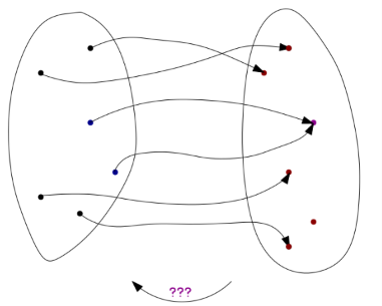
Illustration 1: A function that is not one-to-one—it has no inverse, because two inputs lead to the same output.
It is interesting to note the derivative of f(x) = x^2: it is equal to 2x and vanishes at 0, which is also the “transition” between the two regions in each of which inverse functions do exist.
Back to the conjecture that was disproved. The conjecture concerns functions that accept several numbers as inputs or variables, and return the same number of outputs, and that are additionally composed of polynomials, i.e., combinations of multiplication and addition of powers of the inputs. The conjecture assumes that the function’s “Jacobian” does not vanish and is equal to a constant number. The Jacobian is an object that combines, in a particular way, all the derivatives of the function with respect to all of its variables, and can be regarded as a certain multidimensional generalization of the derivative.
The conjecture states that under the assumption that the function’s Jacobian does not vanish and is equal to a constant number, the function must be invertible.
For a function of one variable, it is easy to see why the conjecture is true: If a function has a constant, nonzero derivative, then it is in fact a linear function (of the form f(x) = mx+n), whose graph is not parallel to the x-axis, and such a function always has an inverse (for example, we saw the inverse of f(x) = x+1. Similarly, one can derive a general formula for the inverse of a function of this type).
The assumption that the Jacobian does not vanish at any point is, in a sense, analogous to the one-variable assumption that the derivative does not vanish. But when there are several variables, matters become more complicated, and conclusions from one variable cannot simply be extended to the multidimensional case.
With one variable, if the derivative does not vanish at a particular point, this means that the function tends to increase or decrease there (that is, it does not get stuck in place), which means that near a point where the derivative is nonzero, the function is invertible, because points will not be “merged” into the same input. This is called “local invertibility”, meaning invertibility only in the vicinity of the point where the derivative does not vanish. For example, the function x squared is locally invertible at every point other than 0 (in contrast, there is no local invertibility at 0, because in every neighborhood of zero we will always encounter the phenomenon of “merging” two inputs into an identical output).
With the addition of a few more considerations [3], the conjecture can be formulated differently: If a function of the type described above is locally invertible, then it must be also globally invertible.
And this is precisely where the language model provided a counterexample: It generated an example of a function of three variables that does not satisfy this claim. Simple calculations of its various derivatives show that its Jacobian is a nonzero constant (meaning that it is locally invertible). But a simple substitution immediately reveals that the function maps three distinct points to exactly the same point, and as we have learned—this means that it cannot be invertible!
It is worth noting that the AI disproved the conjecture for three or more variables, but the conjecture remains open in the case of two variables. Can you settle it?
Thanks to Dr. Yaniv Ganor for his professional comments and assistance in preparing this post.
Hebrew editing: Shir Rosenblum-Man
English editing: Elee Shimshoni
Further reading:
- A post about an Erdős conjecture, the first major conjecture to be refuted by an artificial intelligence model.
- The post by mathematician Levent Alpöge, who published the refutation of the present conjecture.
- A blog post by mathematician Terence Tao concerning the refutation of the Jacobian conjecture, on which this post is based.

Holds a BSc and an MSc degree in Mathematics from Tel Aviv University, and works as a data scientist. She has a broad interest in science, a passion for music, and a love for proverbs in various languages. She also serves as a scientific editor at “Little, Big Science.”


