
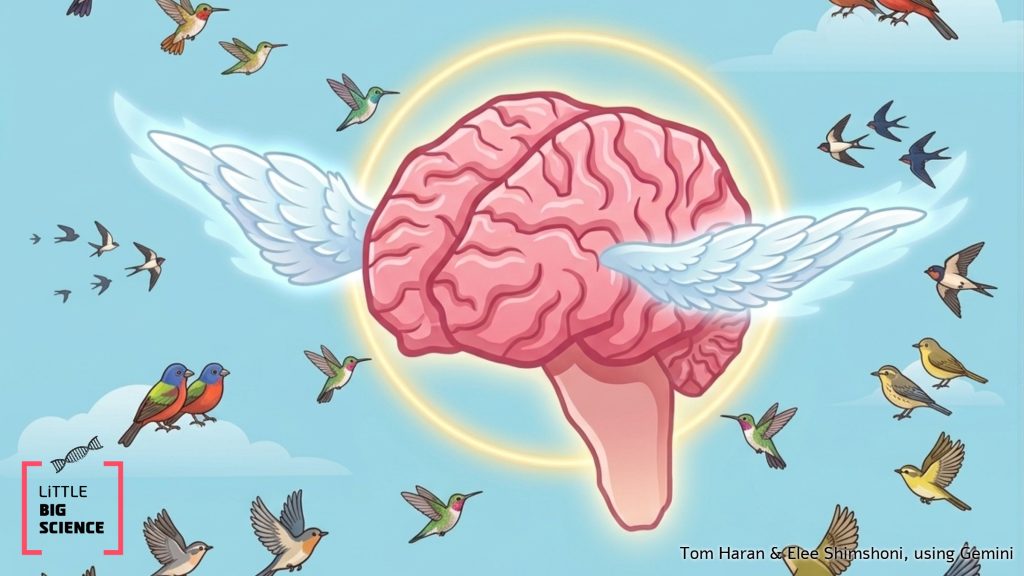
Human beings are remarkably interesting creatures, especially when it comes to what we do with our brains. We can communicate and express complex, abstract ideas, learn to control our bodies in extraordinary ways, and devise creative solutions to any problem. What makes our brains so special? Do they have a unique structure that enables the cognitive abilities distinctive to our species? The answer may come from a surprising source: birds.
Advertisement
In humans, the main brain region responsible for “higher” cognitive function is the cerebral cortex. This part of the brain is unique to mammals, and in humans it is enormous and highly folded—a structure that gives the human brain its iconic appearance. The cerebral cortex contains centers for receiving and processing sensory input, integrating this information with information from other brain regions, planning actions, and carrying them out voluntarily.
The cerebral cortex’s distinctive feature is its internal structure: its neurons are arranged in layers, usually six, and each layer contains different types of neurons at different densities. In addition, the neurons are organized into column-like structures. This arrangement enables complex communication between neurons, both horizontally, across different regions of the cerebral cortex, and vertically, between the layers. This network of extensive connections between neurons is the key to the advanced cognitive abilities of mammals in general, and humans in particular.
Most neuroscience research is conducted in mammals, primarily mice, rats, and macaque monkeys. These animals are evolutionarily close enough to humans that every part of their brain has a counterpart in the human brain, making it easier to compare findings from these animals with the functioning of our own brains.
However, in the context of comparative research, it is especially interesting to look aside to our more distant relatives on the tree of life: birds. Our feathered companions possess considerable cognitive abilities. Some species can navigate across immense distances, identify prey and pursue it mid flight, while others can maintain complex social relationships. On the other hand, the common ancestor of mammals and birds lived about 320 million years ago [1], and was most likely a lizard-like creature with a small, fairly basic brain. In other words, mammalian and avian brains have evolved separately for a very long time, so their cognitive abilities may be supported by entirely different structures. This makes birds a fascinating model for studying the neural basis required to perform complex mental tasks.
How different are mammalian and avian brains? When anatomists began dissecting and examining bird brains, sometime in the late nineteenth century, they discovered that the main difference lay in the upper part of the avian brain, known as the pallium. Unlike the mammalian cerebral cortex, the bird pallium does not have a layered structure. Instead, it contains clusters of neurons organized into “nuclei” [2].
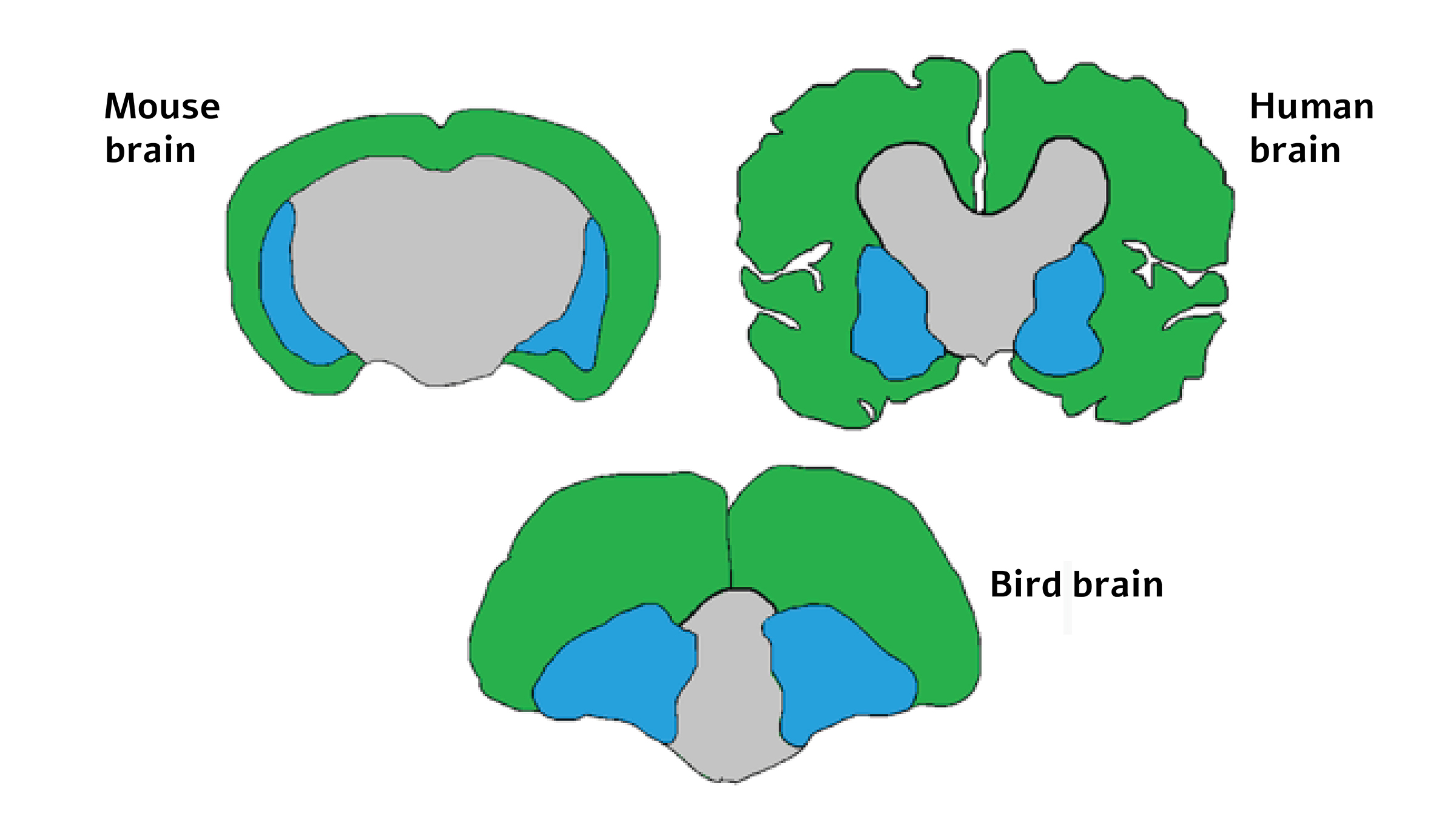
Illustration: Tom Haran
Such nuclei are characteristic of the striatum, a brain region located beneath the mammalian cerebral cortex and shared by mammals, birds, and reptiles. The nuclei in the striatum are responsible for carrying out simple, repetitive behaviors, such as walking or running. Researchers therefore concluded that, over the course of bird evolution, the striatum had thickened and become larger and more developed, allowing birds to develop improved cognitive abilities compared to reptiles.
However, because the avian pallium is not layered but organized into nuclei, neuroscientists assumed that birds lacked the neural infrastructure required for higher cognitive functions such as learning, planning, or consciousness. They even concluded that birds’ enhanced cognitive abilities were essentially automatic actions preprogrammed by the brain’s structure.
Birds were once considered inferior creatures compared to mammals—hence the expression “bird brain”—so this explanation seemed satisfactory. It also fit well with the idea that what distinguishes humans from other animals is our especially highly developed cerebral cortex. But in science, as in science, new discoveries challenged this view.
First, research into animal behavior demonstrated birds’ remarkable abilities, fundamentally changing the outdated perception of birds as primitive creatures with limited cognitive capacities. Experiments in certain bird species, especially members of the crow family, showed that these birds possess excellent spatial memory, can solve complex problems [3], and can even make tools. In some cases, these abilities are no less impressive than those of mammals, including great apes.
Moreover, closer examination of the avian pallium showed that it resembles the mammalian cerebral cortex more than previously thought. For example, researchers demonstrated that despite its nuclear structure, the pallium contains horizontal and vertical connectivity between neurons, similar to the connectivity between layers of the mammalian cerebral cortex [4]. Other researchers showed that the auditory region of finches, a group of songbirds, contains neurons that are biochemically and functionally similar to their mammalian counterparts, and that they communicate with one another in similar ways [5]. In addition, researchers identified a region in the crow pallium involved in planning actions in advance based on sensory input. This region closely resembles the corresponding region in the mammalian brain—the prefrontal cortex—and may even support consciousness [6].
Thus, although the overall structure of the avian brain evolved in a different direction from that of the mammalian brain, at the microscopic level mammalian and avian brains do not appear to be so different, at least with regard to the neural infrastructure that supports higher cognition.
Much more research is needed to gain a deeper understanding of how the avian brain functions and in what ways it resembles or differs from our own. What is certain is that birds are a classic example of a group of organisms that forces biologists and neuroscientists to broaden their perspective and reconsider their fundamental assumptions about what intelligence is, what is required to sustain it, and, more broadly, humanity’s place in the living world.
Hebrew editing: Smadar Raban
English editing: Elee Shimshoni
References:
- Article on the evolution of mammalian and avian ancestors
- A brief review article on the avian brain
- A crow solves a multi-step puzzle (video)
- A layer-like structure in the avian brain
- Similar neurons in the auditory systems of birds and mammals
- A region in the crow brain responsible for action planning

Tom is responsible for short-form content. He is a doctoral student in medical sciences at the Faculty of Medicine at the Technion. His research focuses on how neural activity shapes the function of the immune system. Tom holds a bachelor's degree in Life Sciences and Earth Sciences from the Hebrew University of Jerusalem.


