
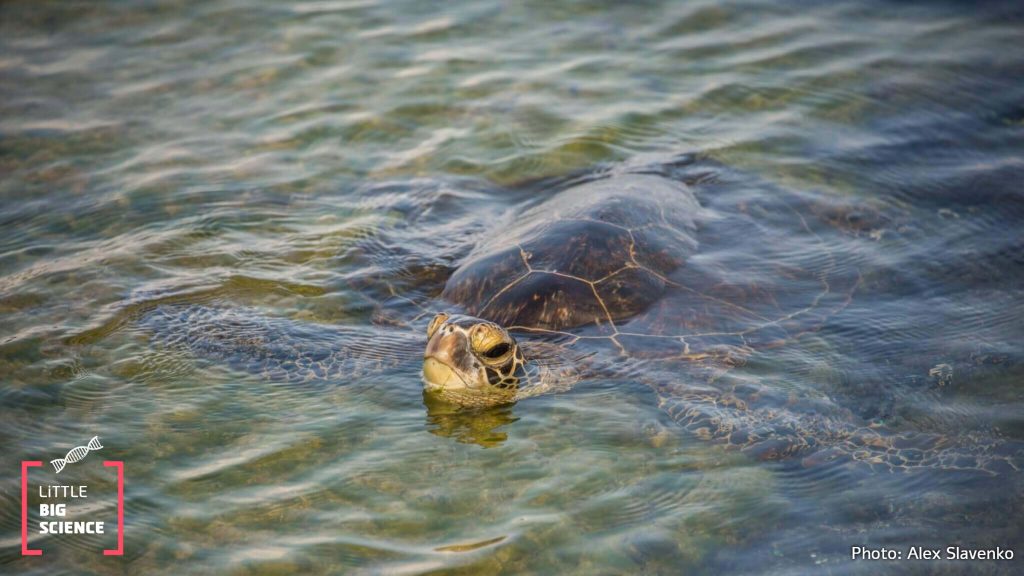
The incubation temperature of sea-turtle eggs determines whether males or females will hatch from them. A new study has shown that among sea turtles nesting in northern Australia, the temperature increase, driven by climate change, has resulted in 99 percent female hatchlings emerging since the 1990s. Earth’s climate is changing rapidly due to human activity, and most notably it is getting warmer. Scientists have long suspected that this rise in temperature would have significant consequences for the animals that share our planet with us, especially for species that are particularly sensitive to temperature changes. One example is sea turtles, and last week a paper published in the journal Current Biology revealed just how severe the impact is.
Advertisement
Sea turtles, like many other reptiles, possess a temperature-dependent sex-determination mechanism. What does that mean? We are mostly familiar with the situation in mammals, where the embryo’s sex (male or female) is determined genetically: the embryo inherits an X chromosome from the mother and either a Y or an X chromosome from the father. If the fertilized egg is XX, it develops into a female; if it is XY, it develops into a male. In sea turtles, by contrast, the embryo’s sex depends on the incubation temperature of the eggs—higher temperatures lead to female hatchlings, while lower temperatures to males. In fact, there is a threshold temperature at which the sex ratio in a clutch (all the eggs laid together in one nest by a single female) is 50-50. Within a narrow temperature range around that threshold the ratio shifts toward females (above the threshold) or males (below it). Outside that range, 100 percent of the hatchlings will be either male or female.
The sea-turtle life cycle creates another problem. The female crawls onto the beach, lays her eggs in a nest she digs in the sand, and then returns to the sea. After the incubation period the tiny hatchlings emerge and imprint on the site where they were born. This is crucial. The hatchlings crawl from the nest to the sea and spend their early years in the open ocean, a stage during which most of them will die. Those that survive return in their juvenile years to coastal areas, where they search for food. After several more years they reach sexual maturity, and males and females return to areas close to their hatching sites, mate, and the females come ashore to lay. Females always return to the beach where they hatched, so if conditions at that site change over time the entire population is at serious risk.
In the study, a team of Australian researchers collected DNA and hormone samples from juvenile green sea turtles (Chelonia mydas) of various ages at a foraging ground on the Great Barrier Reef off Australia’s east coast. The DNA samples were used to determine which population the turtles came from—some from a nesting site in the northern Great Barrier Reef (off Cape York) and some from a site in the southern reef (just north of Brisbane). Hormone samples were used to identify males and females based on testosterone levels in the turtles’ blood.
The researchers found that the overall sex ratio of all turtles was strongly biased toward females—between three and four females for every male. The results are especially alarming when the data are broken down by age and by nesting site. Among the younger turtles from the northern site, born from the 1990s onward, more than 99 percent were female. In other words, since the 1990s almost no males have been born at the northern nesting site, which is one of the most important in the world for this species (about 200,000 nesting females!).
Why? The answer is the rising temperatures. The researchers used recent sea-surface and air-temperature data from Australia to calculate the sand temperature at the northern nesting site. They found that not only has the sand temperature risen in recent years, but since the 1990s it has consistently been nearly one degree Celsius above the threshold temperature. This aligns closely with other troubling data on warming waters, especially in the northern Great Barrier Reef, which is causing massive coral bleaching.
What will be the impact of this skewed sex ratio on the sea-turtle population, and can the situation still be corrected? We do not know. Green sea turtles are highly polygynous, and a single male can mate with many females, but the male-to-female ratio required to maintain a stable population is unknown. For now, mature males are still present, because sea turtles are long-lived. But what will happen when these males die and the generations hatched over the past 30 years reach sexual maturity? Will the few males be enough? Will males arrive from elsewhere? Can the population endure many years without reproduction? These are difficult questions for which we have no answers.
English editing: Elee Shimshoni
References: