
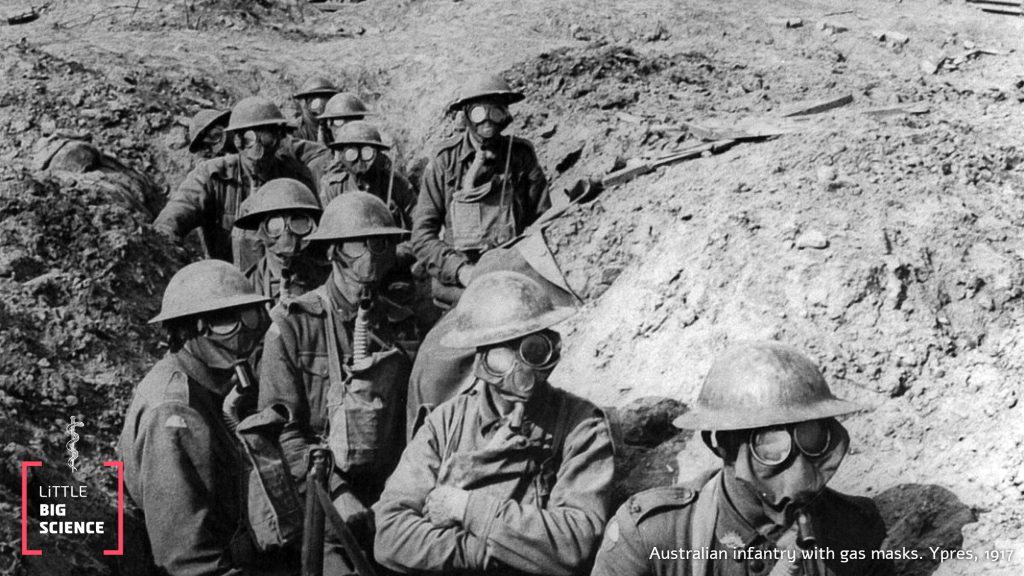
Trench fever is a bacterial disease that was first discovered when it spread among soldiers in World War I. Although it was not lethal, the disease posed a serious problem for the combat forces. Every sick soldier (and there were at least half a million of them) was sidelined for about two months, and for roughly half of that time he occupied a bed in the military hospital. One of them was the officer (and later writer) John Ronald Reuel Tolkien.
Advertisement
Trench fever, also called “five-day fever” (quintan fever), is a bacterial disease transmitted by body lice (Pediculus humanus humanus). The disease was first reported in 1915 by the British medical officer John Graham, who served on the Western Front of World War I, when millions of Allies soldiers (France, Britain and Belgium) were entrenched along 4,000 miles facing enemy lines—the German Empire. Wilhelm His and Heinrich Werner, on the German side, described the disease in 1916. It was later identified on the Eastern Front as well. Estimates indicate that in the armies of the Allies alone, up to the end of 1918, about half a million soldiers contracted the illness [1]. One of them was, as noted, the Briton J. R. R. Tolkien.
Symptoms appeared roughly two weeks after infection and consisted mainly of recurrent bouts of high fever, each lasting about five days. These episodes were accompanied by headaches, eye pain, and muscle aches in the back and legs—especially the calves. Recovery took a month or more. Every infected soldier returned to duty only after about 60–70 days, half of which were spent in the hospital. In very rare cases the disease progressed to heart failure that could be fatal [1, 2].
During the war the infectious agent was unknown, but body lice were suspected [2]. The entomologist Alexander Peacock found in 1916 that 95% of patients were infested with lice [1]. The suspicion was confirmed in 1918, when separate American and British teams investigated the disease in soldiers and civilian volunteers. The British concluded that louse bites caused the illness, whereas the Americans argued that scratching louse bites infected them with louse feces. Both teams were right: the louse bit the host to suck blood; if the host was ill, the bacteria entered the louse’s digestive tract. After the louse moved to a healthy person, scratching the bites introduced louse feces containing the bacteria into the bloodstream. Body lice lay their eggs in the host’s clothing, unlike head lice, which lay eggs at the base of hair shafts. Following these findings, delousing stations were established wherever possible. Soldiers were stripped completely and great effort was made to remove lice from them and their clothes—an approach already known, because since 1909 body lice had been recognized as transmitters of epidemic typhus [2, 3].
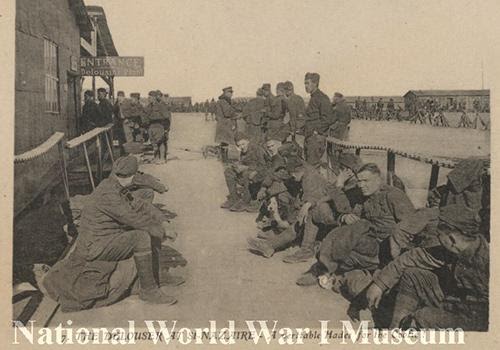
Soldiers standing in a typical queue for delousing treatment. Source: The National World War I Museum, Kansas City, Missouri, United States
The next step, in 1920, was identification of the bacteria in louse feces. Bacteria resembling rickettsiae were found and initially named Rickettsia quintana. About forty years later, in the 1960s, it became clear that unlike rickettsiae—which cannot be cultured in the lab—the trench-fever agents could be grown in the laboratory. They were therefore reassigned to the genus Rochalimaea, which was later merged with Bartonella. They are now known as Bartonella quintana. Other well-known species in the genus include Bartonella henselae, the bacteria that causes cat-scratch disease.
Initially the disease was diagnosed in the blood by detecting antibodies against the bacterium, which appear about a week after symptom onset. Today it is easily identified by PCR. A course of tetracycline antibiotics for about seven to ten days leads to faster recovery [4].
Small outbreaks also occurred during World War II; they were treated rapidly and did not become epidemic. In retrospect, reports of “five-day fever” in early-19th-century Russian medical literature and from the 1877 Russo-Turkish War (Moldavian fever) are thought to have been trench fever as well. Moreover, in 2015 DNA remnants of Bartonella quintana were found in a mass grave of Napoleon’s soldiers in Lithuania from 1812 [1, 5].
In 2005 DNA traces of Bartonella quintana were found in the teeth of a 4,000-year-old skeleton excavated at Roaix in southeastern France [5].
Today the disease is rare, mainly owing to the decline in body-louse infestations resulting from improved hygiene. It is found mostly among people experiencing homelessness, who live in crowded conditions, in refugee camps, as well as, more rarely, among alcoholics and drug users.
Well-known British soldiers who contracted the illness in World War I include C. S. Lewis, author of “The Chronicles of Narnia”; A. A. Milne, creator of “Winnie-the-Pooh”; and John Ronald Reuel Tolkien, author of “The Hobbit” and “The Lord of the Rings.” Trench fever probably saved Tolkien’s life. In October 1916, the 25-year-old officer fell ill with trench fever, and in November he was sent to a rear-area hospital in Birmingham, England. He began writing while still in hospital. During his stay the front-line unit he had served with was almost completely destroyed, and only a few of its men survived. He was hospitalized for about a month and thereafter remained behind the lines, as the disease recurred intermittently. Because of his health he was deemed—fortunately for him and for us—unfit for front-line service [6].
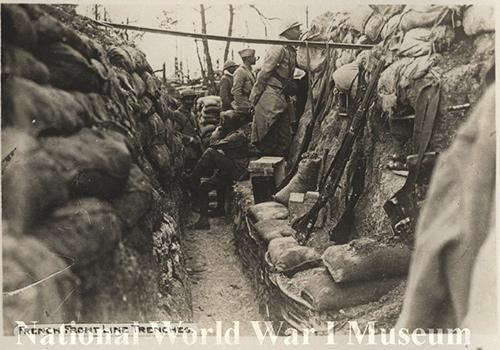
A typical trench on the French front in World War I. Source: The National World War I Museum, Kansas City, Missouri, United States
English editing: Elee Shimshoni
References:
- G. M. Anstead – The centenary of the discovery of trench fever, an emerging infectious disease of World War 1, The Lancet Infectious Diseases 16, 2016
- R. L. Atenstaedt – Trench fever: the British medical response in the Great War
- Frederick Holmes – Trench Fever in the First World War
- Facts about Bartonella quintana infection (‘trench fever’)
- Mai et al. – Five millennia of Bartonella quintana bacteraemia, PLOS ONE
- JRR Tolkien’s wartime narrow escape revealed, The Guardian

Dror is a member of Little, big Science's board of directors. He holds a PhD in Molecular Biology and has authored textbooks and articles for the general public, primarily in microbiology as well as other biological subjects. Dror taught microbiology and cell biology for more than 30 years at the Open University and other institutions.


