Celestial pairs not only attract each other, they also deform each other. Love numbers quantify how strongly a body responds to tides, from Earth’s oceans to pairs of neutron stars. Most amazingly, they can be inferred from gravitational-wave signals, allowing us to learn about some of the densest and most extreme matter in the universe.
Advertisement
Valentine's Day is the perfect time to discuss Love numbers. Yes, that is their actual name, but not for romantic reasons. They are named after Augustus Edward Hough Love (A. E. H. Love), an English mathematician and geophysicist who studied Earth’s response to tidal forces at the beginning of the 20th century. In 1909, Love presented his findings in a paper titled “The Yielding of the Earth to Disturbing Forces” [1].
So while this post isn't about romance, it certainly involves pairs and attraction.
To understand what Love numbers measure, we must first understand tidal forces. Consider the familiar phenomenon of Earth’s tides. Depending on their distance from the Moon, different points on Earth experience slightly different gravitational pulls. This variation gives rise to a tidal field, which produces tidal forces across the planet. In other words, tides arise from differences in gravity, not from the gravitational force at that specific location. This non-uniform pull creates two ocean bulges: on the side facing the Moon and one on the opposite side. This is also why the tides produced by the nearby Moon are stronger than those produced by the distant Sun, despite the Sun’s greater gravitational pull on Earth. For a detailed explanation, see [2]. The same principle applies to other bodies. The gravitational acceleration with which one body pulls on another is not uniform. This non-uniformity generates a tidal field that tries to stretch the bodies along the line connecting them and compress them in the perpendicular directions (see Fig. 1).
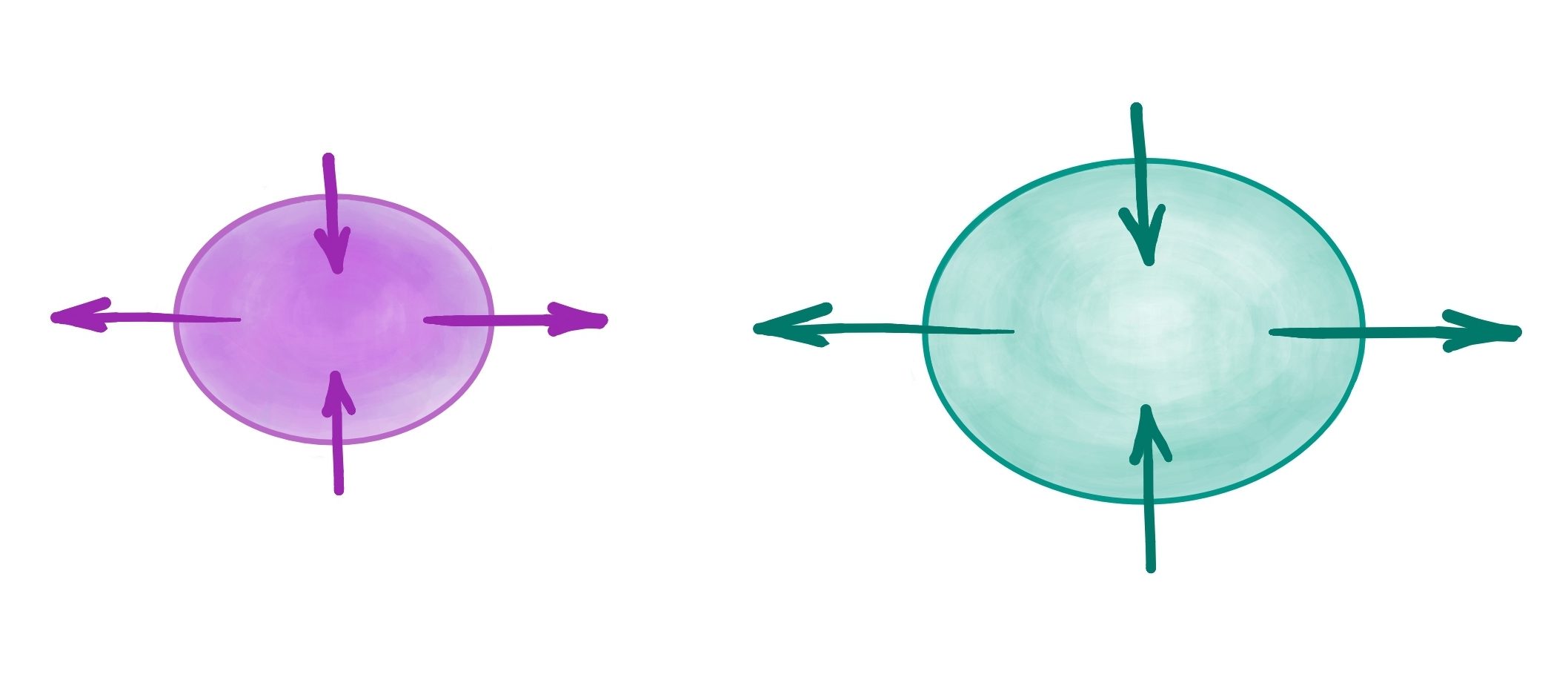
Figure 1: Two bodies, such as astronomical bodies, experience each other's tidal fields. These fields act to stretch the bodies along the line connecting them and compress them in the other directions. The drawing is exaggerated; the effect is usually much smaller. The same mechanism produces Earth’s tides under the influence of the Moon. See additional illustrations in [2].
Love numbers are a set of values that relate the strength of the tidal field applied to a body to the magnitude of its response. More specifically, they are response coefficients: They specify how much tidal deformation results from a given tidal field. A large Love number indicates a stronger tidal response; a small Love number means a weaker response. Why do we need an entire set of numbers rather than a single number? Because deformation is not a single entity, and a body can deform in several distinct ways, each with its own response coefficient. Therefore, each one is telling us how strongly the body responds to tides in a particular way.
The deformation does not stop with a change in shape. It also alters the body’s own gravitational field. In other words, the body not only “feels” a tide, but also reacts to it by producing an additional gravitational signature. This is what makes Love numbers a useful observational tool. For example, the measurement of one of Mars's Love numbers, using precise radio tracking of a spacecraft orbiting the planet, revealed that Mars likely has a partially liquid core and gave rise to an estimation of the core's size [3].
Thus, Love numbers teach us about the physical conditions inside celestial bodies.
Neutron stars, the remnants of massive stars that collapse at the end of their lives, are among the most enigmatic objects in the universe [4]. Unlike the Sun, they no longer “burn” via nuclear fusion. What prevents them from succumbing to gravity is the quantum pressure of neutrons, also called degeneracy pressure, which resists further compression. Neutron stars are composed of the densest stable matter known to science. They are so compact that a teaspoon of their material weighs on the order of ten million tons. We still do not fully understand what happens inside them. This is where Love numbers come in, perhaps we can use them to take a peek inside.
But how can we measure the tidal response of bodies that are hundreds of millions of light-years away that we cannot even see? Today this is possible thanks to gravitational wave detectors. When two compact objects, such as black holes or neutron stars, orbit each other, they emit gravitational waves, which are tiny ripples in spacetime [5]. The signal that reaches detectors such as LIGO and Virgo increases in frequency and amplitude up until the moment of collision and merger. From this signal, we can determine that a merger occurred and identify the participants and their properties.
If both objects are neutron stars, tidal effects begin to deform them even before they collide. This distortion slightly modifies the orbital dynamics, primarily the phase of the gravitational waves, that is, the positions of the “peaks” and “troughs” in the signal [6] (see Fig. 2). The change is small, yet measurable; phase is one of the quantities that the detectors can determine with high precision. Consequently, we can infer how matter behaves at the extreme densities inside a neutron star from the measured gravitational wave signal—something that is essentially impossible to study in a laboratory. In other words, when we measure Love numbers from a binary neutron star system, we are observing the frontier of nuclear physics from across the universe!
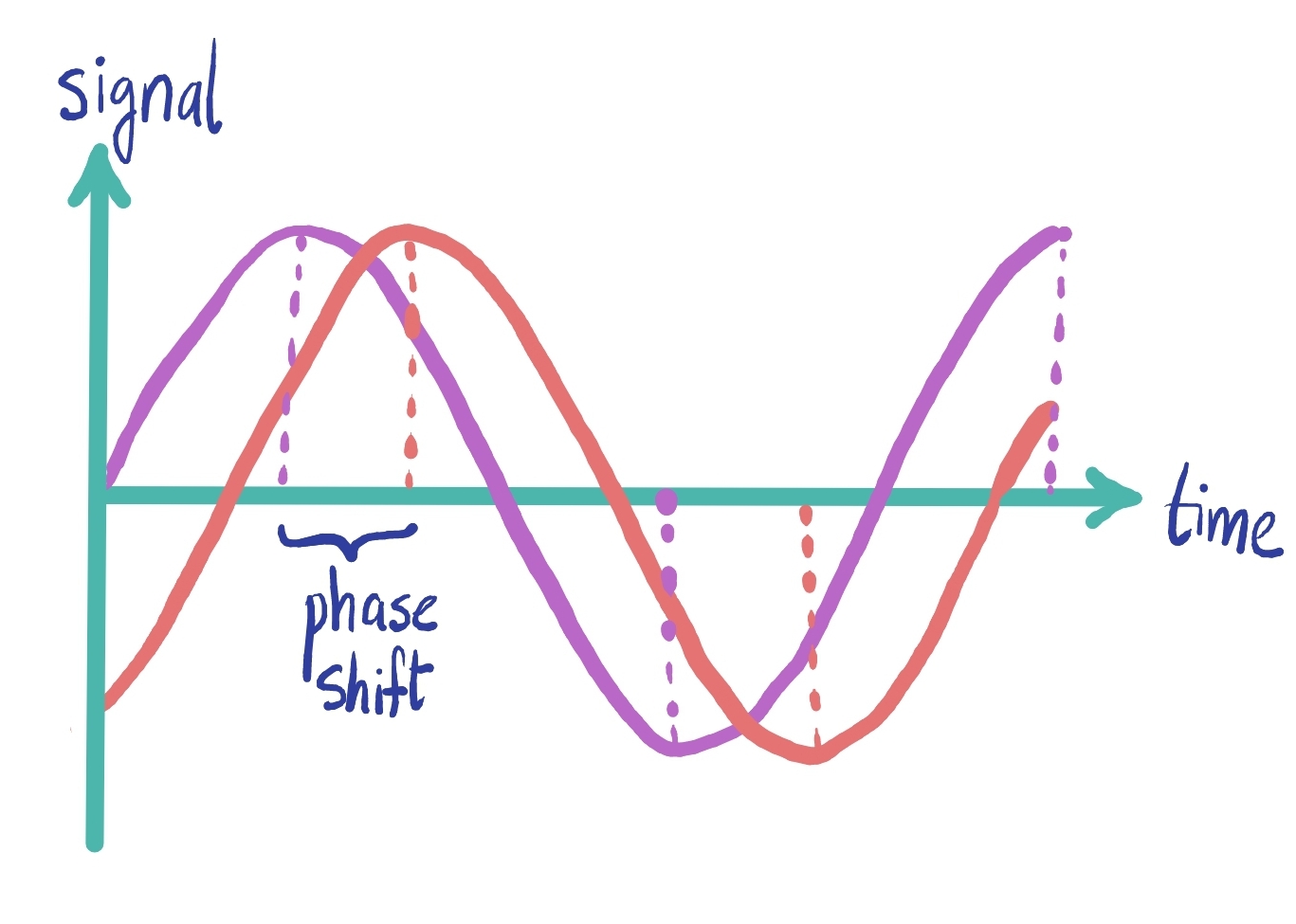
Figure 2: Illustration of a shifted phase. The two signals shown are identical except for a phase shift. In other words, the positions of the peaks and troughs in one signal are shifted relative to those in the other signal. This phase difference can be measured by gravitational wave detectors and thus yields the information about Love numbers. In practice, the relevant phase difference is not a single constant but rather depends on frequency.
In short, if there is anything romantic in physics, it is the fact that “Love” is a number that measures how much a body yields to its partner’s tidal field.
Tag someone with a large Love number and someone with a small one—and don't tell them who is who…
Hebrew editing: Shir Rosenblum-Man
English editing: Gloria Volohonsky
References:
- Love’s original paper: A. E. H. Love, The Yielding of the Earth to Disturbing Forces, Proc. A 82 (551): 73–88 (1909).
- On tides—on the Little, Big Science website
- C. F. Yoder, A. S. Konopliv, D. N. Yuan, E. M. Standish and W. M. Folkner, Fluid core size of Mars from detection of the solar tide, Science 300 (5617): 299-303 (2003).
- Neutron star, Wikipedia
- What are gravitational waves? on LIGO's website
- E. Flanagan and T. Hinderer, Constraining neutron-star tidal Love numbers with gravitational-wave detectors, Phys. Rev. D 77, 021502(R) (2008).

Noa holds a PhD in Physics from the Technion and is currently a postdoctoral researcher at the Princeton Gravity Initiative at Princeton University. Her research focuses on quantum effects on black hole backgrounds. She also serves as a scientific editor at “Little, Big Science".
Noa holds a PhD in Physics from the Technion and is currently a postdoctoral researcher at the Princeton Gravity Initiative at Princeton University. Her research focuses on quantum effects on black hole backgrounds. She also serves as a scientific editor at “Little, Big Science".


