When studying the evolution of a given species, researchers consider its evolutionary history, the environment in which it evolved, the variety of species that evolved alongside it, and more. It is easy to miss the possibility that its evolution was influenced by another species located thousands of kilometers away. In a new study, researchers from the Hebrew University suggest that species whose habitats do not geographically overlap may nonetheless influence each other’s evolution—through the mediation of migratory species.
Advertisement
The black-and-yellow colors of bees and wasps are not dangerous in themselves, yet in the minds of many animals they are associated with the painful sting of their bearers. This is an example of a deterrent signal, a cue that warns potential predators of the danger in eating whoever displays it. In many cases the deterrent signal is not directly linked to the dangerous element. For instance, the warning colors of a bee are not directly connected to its sting. The disconnect between the deterrent signal and the danger it is associated with has important consequences: first, it is often worthwhile to display a deterrent signal that the predators in the system already recognize. Second, an animal can display a deterrent signal and enjoy the protection it confers even if it does not possess the defensive mechanism normally linked to it. This phenomenon is called “mimicry” [1].
There are several different kinds of mimicry: in Batesian mimicry [2], a harmless species (the mimic) displays a signal associated with a dangerous species (the model). In this way it “deceives” potential predators, which avoid the signal. For example, many species of flies, moths and beetles display color patterns resembling those of bees and wasps, thereby gaining protection from many predators even though they themselves lack a stinger. In Müllerian mimicry, by contrast, various dangerous species (co-mimics) converge on a shared signal, thus sharing the “training” of predators and reducing recognition errors [3]. For instance, many species of coral snakes (venomous snakes) show similar color patterns that include red, black and white rings. It has been demonstrated that birds of certain species innately avoid these patterns [4, 5].
Mimicry was first described about 160 years ago, and ever since it was understood that for mimicry to occur there must be geographical overlap among the distribution areas of all the players in the system [6]. The logic is simple: why would one species mimic another that is not present in its surroundings, if the benefit of mimicry lies in confusing predators between them? But could there still be a scenario in which, for example, a snake would gain by copying the warning colors of a snake that lives thousands of kilometers away? We suggest that the answer is yes. Why? Because in mimicry what matters is not the meeting between the mimic and the model or between the co-mimics, but the encounter each of them has with a predator common to all. If that predator is, say, a migratory bird, it may learn a deterrent signal common in one region and apply its avoidance in a completely different region.
This idea has been proposed a few times in the past, but almost always only in passing and without being examined in depth. In our new study [7], just published in PNAS, we provide a theoretical foundation and investigate under which conditions it is likely to materialize. In the study we created a computer simulation that models the evolutionary process of Müllerian mimicry: the simulation consists of two communities, each containing a population of “dangerous” prey and a population of local predators. Each prey population evolves alongside its local predator population, but separately from the other prey and predator populations. In addition, there is a population of migratory predators that moves between the two prey populations. The simulation is divided into generations, in each of which predator-prey encounters are randomly drawn; at the end of the generation, the individuals that survived reproduce. Thus, throughout the simulation an evolutionary process occurs in which the signals displayed by the prey and the predators’ aversion to them can change: prey benefit from displaying a pattern that deters as many predators as possible, whereas predators benefit from avoiding recognition errors that harm them. Consequently, prey and predators that happen to be coordinated so that the prey display a signal the predator avoids survive to the end of the generation with higher probability, and over time their frequency in the population increases. By running the simulations many times, while changing parameters such as the proportion of migratory predators among all predators in the system, the complexity of the signal, etc., we examined how the different factors are expected to influence the dynamics of signal convergence between the two prey populations.
As we anticipated, when the simulation included no migratory predators at all, each community settled on a particular signal that was coordinated between the predators and prey within that community. However, the level of coordination between the two communities did not exceed that expected by chance.
When migratory predators were active in the system from the start of the simulation, increasing their proportion led to a rise in the proportion of simulations that ended with mimicry; the migratory predators served as an evolutionary “bridge” connecting the separate communities.
Yet when predator migration began only after each community had already stabilized on its own signal, convergence of the signals became much more difficult. In each community the predators and prey had already “agreed” on a signal; thus, although the migratory predators applied pressure on both prey populations to converge on a shared signal, each local predator population exerted opposing pressure on its overlapping prey population to maintain the signal that deterred it. In this scenario, the complexity of the signal proved especially important. When the signal comprised a single component, it was almost impossible for the communities to converge. However, when the signal contained two components, a gradual transition between signals became possible: first one component changed, and only afterwards the second. This allowed individuals displaying an intermediate pattern to exist, containing components that deterred both the local predator population and the migratory predator populations.
The scenario in which mimicry evolved most readily in our model occurred when one community began the evolution of its signal before the second community. Thus, when predator migration started, one community already had a consolidated signal, whereas the second community was still “naïve”. In such a case, the migratory predators arriving from the community with the consolidated signal pushed the naïve community towards that specific signal, and the local predator population in the naïve community had not yet fixed on avoidance of any particular signal, making it easy to “tilt” it towards the signal prevalent in the other community.
It is convenient to think of each deterrent signal as having an “evolutionary basin of attraction”: the more common it is in the system and the more predators recognize it, the greater the likelihood that additional species will converge on it. We propose that, mediated by migratory predators, these basins of attraction can cross the geographical boundaries of the signals themselves and draw in very distant species.
Finally, remember that mimicry is only one example of co-evolution, a phenomenon in which two populations mutually influence each other’s evolution. Accordingly, it is natural to extend our proposal even further: there may be many kinds of evolutionary interactions that can occur between geographically distant species, mediated by migratory agents. For example, arms races between pathogens (disease-causing agents such as viruses) and their hosts are very common. Immune systems evolve to cope with various pathogens, which in turn evolve to overcome their hosts’ immune systems, and so on. Moreover, many pathogens, for example various influenza viruses, can move from place to place with the help of migratory agents. Thus, when a pathogen develops adaptations in response to the immune system of a particular host and is then transported by a migratory agent and infects a host in another location, the second host is likely to have to contend with adaptations the pathogen evolved against the first host’s immune system, and vice versa.
Our study does not demonstrate that these phenomena necessarily occur in reality, but it does indicate that such scenarios are entirely possible. The research opens a window onto fascinating possibilities we should look for: perhaps co-evolution need not stop at the geographical boundaries of different species; perhaps it can also take place “by remote control”.
The study described in this article was conducted by Akiva Topper, Yotam Ben-Oren and Oren Kolodny.
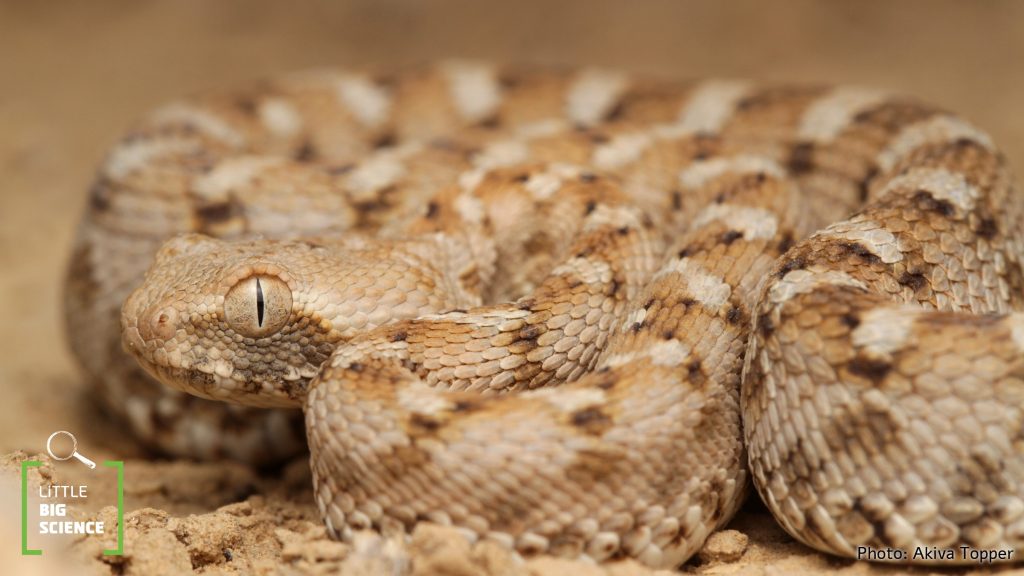
In the main image: a horned viper. And in connection with the article: the horned viper belongs to the group of scale-rubbing vipers, and its distribution in Africa lies only north of the equator. Egg-eating snakes of the genus Dasypeltis are completely harmless, yet they too rub their scales and are considered mimics of the horned viper, and perhaps also of the saw-scaled viper. These egg-eaters are found as far south as the southern tip of South Africa, far from the horned viper’s range. In other words, they rub their scales even though no venomous model that does so is present in their habitat. It is possible that the reason they continue to rub their scales even in areas where they do not overlap with venomous snakes that do so is the presence of migratory birds familiar with the real model from other regions.
Hebrew editing: Smadar Raban
English editing: Elee Shimshoni
References:
- A textbook on the evolutionary ecology of crypsis, aposematism and mimicry
- Henry Walter Bates’s 1862 paper containing the original description of Batesian mimicry
- A theoretical paper proposing that recognition errors by predators are a key driver in the evolution of Müllerian mimicry
- A paper on Müllerian mimicry in coral snakes
- A paper demonstrating the innate avoidance of a tyrant flycatcher towards the colour patterns of coral snakes
- A paper on Müllerian mimicry among pit viper species in Southeast Asia
- The paper described in this article, dealing with mimicry between geographically non-overlapping species

PhD student at the Department of Ecology, Evolution & Behavior at the Hebrew University of Jerusalem.


