
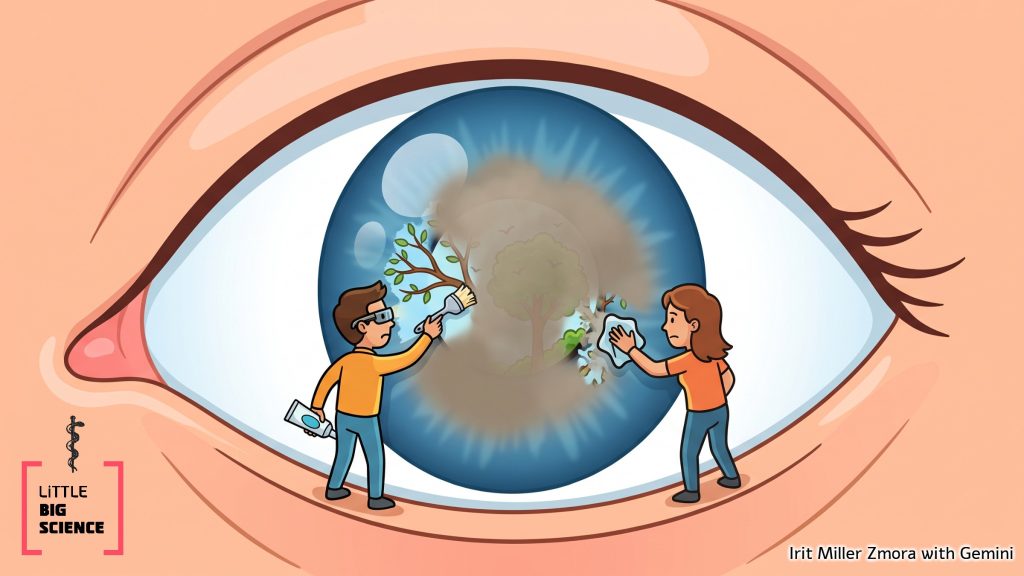
Age-related macular degeneration (AMD) affects millions of people worldwide and is considered one of the leading causes of blindness. Two innovative treatments—a controlled drug-release implant and a chip based on a brain–computer interface—have recently received recommendations and approvals in Europe and are expected to transform patients’ lives.
Advertisement
Imagine trying to read a book, watch your favorite show, or recognize familiar faces, but a blurry spot appears in the center of your visual field and gradually expands. This is the reality for millions of people worldwide who have age-related macular degeneration (AMD), a degenerative retinal disease and the most common cause of vision loss in its advanced stages among older adults [1].
The disease has two stages:
Dry AMD (geographic atrophy, GA) is the more common form, affecting approximately 85–90% of patients. It is characterized by the slow progression of damage to photoreceptor cells in the center of the retina. This process leads to gradual loss of central vision and may ultimately result in blindness. Other than closely monitoring the disease for progression, lifestyle changes are usually recommended at this stage to slow disease progression. These include smoking cessation, since it is a major risk factor, as well as taking supplements such as vitamins and antioxidants.
Wet or neovascular AMD (nAMD) develops in 10–15% of patients. This advanced stage may develop from dry AMD and is more severe and progresses rapidly. In these patients, new blood vessels grow rapidly and abnormally underneath the center of the retina, causing swelling, bleeding, and scarring that lead to vision loss. The main treatment consists of frequent intraocular injections of agents that inhibit new blood-vessel formation (drugs that block the activity of the VEGF protein) [2].
Two innovative treatments that could transform patients’ lives have recently been recommended for approval by the European Medicines Agency.
Roche’s Susvimo treatment offers a new approach to nAMD. As noted above, patients require repeated intraocular injections. This is not a pleasant procedure, and it also requires a skilled, professional medical team. Susvimo is a tiny implant placed in the eye that enables the controlled, continuous release of ranibizumab—a drug that inhibits VEGF and prevents uncontrolled blood-vessel formation. The implant can also be refilled, so patients require only two refills per year and can enjoy a substantial improvement in their quality of life. The treatment has already been approved by the U.S. Food and Drug Administration (FDA) and is also used for diabetes-related eye complications, diabetic retinopathy and diabetic macular edema, which likewise involve damage to blood vessels in the eye [3].
In dry AMD, however, the situation is more complex. What can be done when photoreceptors have been destroyed? Science Corp offers a breakthrough in the form of the PRIMA system, which combines a chip, special glasses, and a pocket processor. The photovoltaic chip is implanted underneath the retina, where it converts light into an electrical signal, much like solar panels used to generate electricity [4]. The glasses in the system capture images of the surroundings, and the information is sent to a “pocket processor” carried by the patient. There, it is processed and then projected by the glasses, using near-infrared light, onto the implanted chip. In this way, the chip functions as an “artificial retina”, stimulating the retinal nerve cells that remain in the retina. These cells transmit the information to the brain, where the signals are translated into shapes the patient can see. PRIMA has a unique focusing capability that allows patients to identify numbers and words, as well as a digital zoom-in function for enlarging letters to make reading easier, which is much like enlarging text on a computer or phone screen. In the company’s clinical trials, 84% of participants reported being able to read letters and words, indicating restoration of central vision, as well as regaining the ability to recognize faces—abilities they had lost before implantation. No decline was observed in the peripheral vision patients had before the implant. The chip has no battery, and the system is designed for continuous use inside the eye thanks to the energy supplied by infrared light. The clinical data presented by the company show that the chip functions for 12 months and is intended for use beyond that period [5, 6]. The PRIMA system may also have the potential to treat other eye diseases involving the destruction of photoreceptors, such as retinitis pigmentosa and Stargardt disease. The company has received CE marking and authorization for commercial launch in Europe, and is also in advanced stages of the FDA approval process.
The two treatments point to significant technological progress in improving quality of life and restoring vision for AMD patients at both stages of the disease. It is important to note that these treatments will initially be introduced in Germany, and approval in additional countries will proceed in stages and take time. Approvals in Europe and elsewhere will make it possible to expand access to advanced treatments for preventing vision loss in older age.
Hebrew editing: Shir Rosenblum-Man
English editing: Elee Shimshoni
Further reading
- What is AMD? An explanation on the World Health Organization website
- About the VEGF protein
- Roche’s press release on the treatment’s anticipated approval in Europe
- About solar panels
- An NEJM publication on the PRIMA clinical trial
- An explanatory video about AMD and the development of PRIMA technology

Irit serves as Scientific Director at “Little, Big Science”. She holds a PhD from Tel Aviv University and has conducted her postdoctoral training at the University of California, San Francisco. Her expertise is in fertility endocrinology, developmental biology, stem cells and tissue regeneration.


