
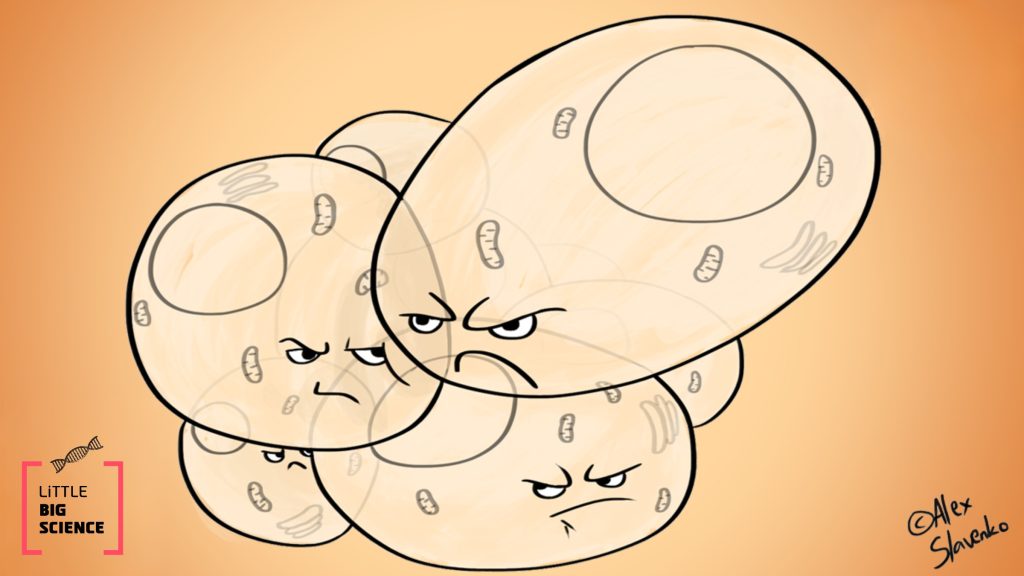
Immune system cells determine where they need to go in the body through chemotaxis, meaning the detection of molecules secreted at the site where an invader has been recognized. One way they migrate is by forming clusters that more efficiently sense the direction from which the secreted substances originate. Physical models of the movement of such clusters have identified several characteristic motion patterns.
Advertisement
Guest post by Prof. Nir Gov, a friend of Little, Big Science and a research collaborator, in collaboration with Shaked Ashkenazi
Imagine you’re out for a walk when the scent of fresh pastries suddenly hits you. It’s hard not to drop everything and follow it. This phenomenon exists in all living creatures. While humans process sensory signals and consciously decide how to respond, single-celled organisms such as bacteria respond automatically. For example, bacteria have receptors for food molecules spread across their surface. When they detect food, they send a signal that causes the cell to move in the direction of the receptors that reacted, i.e, toward the food source. This behavior, in which a single living cell moves toward a chemical in its surroundings, is called chemotaxis.
Most of the cells in our body are stationary. They receive nutrients from the bloodstream so they don’t need to search for them. However, some cells are designed to move. For instance, immune cells must locate and eliminate invaders such as viruses and bacteria. Some immune cells patrol all body tissues and when they encounter an intruder, they engulf it. These cells then trigger a cascade of reactions whose main purpose is to recruit more immune cells to the site. How can one cell summon more cells? You guessed it—through chemotaxis!
How does a cell know from which direction chemicals are arriving? Through a concentration gradient: the closer you are to the source, the higher the concentration. To pinpoint the direction, receptors positioned on the cell surface must detect slight differences in the chemical concentration. However, cells are very small, only a few dozen micrometers long. Within this short distance, they must sense a significant enough difference to know where to move. Sometimes these differences are very small.
One way immune cells overcome this problem is by forming clusters containing dozens of cells. Due to its size, the concentration difference across a cluster is large, even if the gradient over a single cell is small. In vitro experiments on such clusters demonstrate that they can indeed move more efficiently toward the source of the chemicals. Physical models also suggest that clusters effectively detect direction even in weak gradients [1].
For a cell cluster to respond efficiently to a chemical signal, its cells must coordinate their movements. If all cells move in the same direction, their motion is efficient. In contrast, if they move in different directions, their forces cancel each other out, and the cluster stays put. How do the cells coordinate? The answer is unclear and is an active area of research. What is clear is that cells have a coordination ability that strengthens as their speed increases.
In a recent study from the laboratory of Prof. Ajay Gopinathan at the University of California, Merced [2], researchers found that clusters move in a coordinated fashion approximately 40% of the time. About 25% of the time the clusters move in circles, as the group rotates around its axis. The remaining 35 % of the time the clusters move randomly and without coordination. To understand these movement patterns, the researchers built a computer model of a cell cluster that accounts for the natural internal cellular processes. These processes can cause cells to move slightly in one direction or another. When the simulation included only a few such fluctuations in response to secreted chemicals, the cells moved in an orderly fashion along the concentration gradient. In contrast, when there were many fluctuations, the cells failed to coordinate and moved randomly. Yet the model did not predict the circular motion.
Next, the researchers examined a more realistic model in which the cluster is non-uniform. A cell’s ability to move depends on its position: peripheral cells can move more easily than those trapped in the center. This model revealed a new movement pattern. At fluctuation levels where the internal processes caused cells to move slightly, the peripheral cells coordinated their movement and attempted to advance, while the central cells failed to synchronize. This situation created frustration in the cells, much like you would feel if someone tried to drag you somewhere against your will. Neither side gets exactly what it wants, and the result is circular motion.
The benefits of circular motion, if any exit, are still unclear. It may serve as a transition state between movement patterns, or it may prevent cells on one side from being constantly exposed to high chemical concentrations. Large clusters spend more time rotating, suggesting that there is a size limit for a cell clusters. It appears the cells are programmed to reach this limit. The reason for this remains unknown, although it is clear that clusters spend a significant amount of time in circular motion. Follow-up studies are needed to determine why this occurs.
This study focused on immune cells, but similar group movement patterns exist in many other systems, including fish schools and bird flocks. Despite the substantial differences in complexity between fish and cells, the same three movement patterns appear in both. Therefore, studying the simpler system may help us understand more complex ones.
English editing: Gloria Volohonsky
References:
- Article on cluster movement in response to concentration gradients
- Original paper – modeling collective cell movement patterns