Advertisement
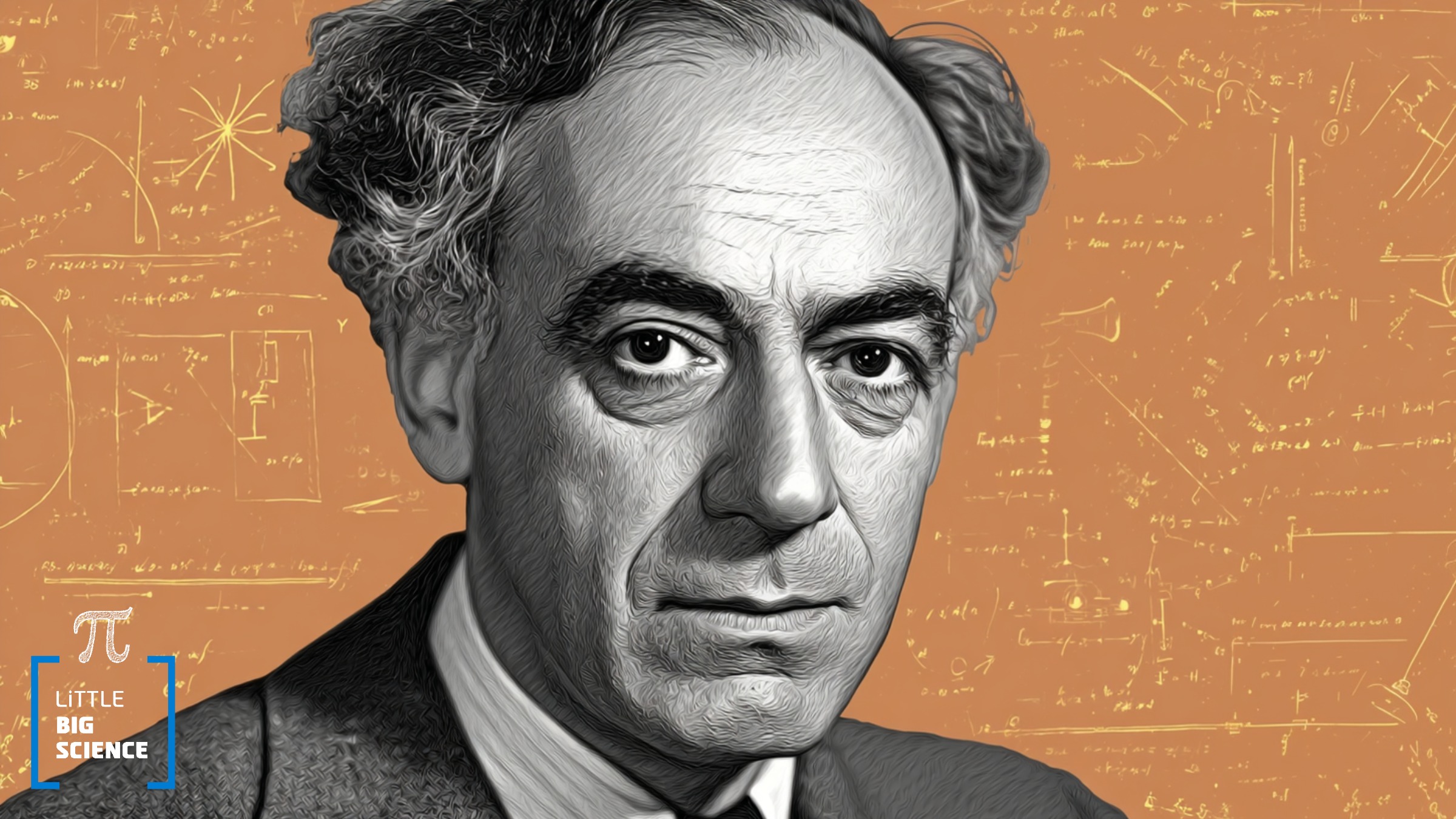
Today, January 22, is the birthday of the Jewish-Soviet physicist Lev Davidovich Landau.
Born in 1908, Landau was one of the most prominent figures in 20th-century theoretical physics. In 1962, he was awarded the Nobel Prize “for his pioneering theories for condensed matter, especially liquid helium” [1]. Yet his work was by no means confined to condensed-matter physics, and it is hard to overstate his contribution to the entire field of theoretical physics. He studied an extraordinary range of topics, including quantum mechanics, fluid dynamics, magnetism, superconductivity and cosmic radiation.
One of Landau’s most surprising ideas emerged from his work in plasma physics. He demonstrated that electric waves in a plasma can weaken and even disappear without friction or collisions between particles, a phenomenon now known as Landau damping. Intuitively, plasma always contains electrons whose velocities are close to the wave’s phase velocity. These slower electrons can “ride” the wave, like a surfer on an ocean wave, and gain energy from it, causing the wave to lose energy. If the majority of electrons are moving more slowly than the wave, the wave weakens and “stabilizes.” Landau predicted this mechanism in a 1946 paper on oscillations in an electronic plasma [2]. This paper became a cornerstone of plasma physics and has implications in many fields, including nuclear fusion laboratories and particle accelerators [3], nanomaterials, the solar wind [4], and the heating of the interstellar medium [5].
Landau did not retreat into an academic ivory tower. Alongside his scientific advances, he made significant contributions to physics education. The Landau–Lifshitz series, “Course of Theoretical Physics,” provides a comprehensive summary of the physics known at the time. It has become a classic and is still widely used today, as any physics student will confirm. In 1962 Landau and Lifshitz were awarded the Lenin Prize for this series.
Landau was known for his sharp tongue. A humorous warning sign for students hung on his office door: Beware, he bites! [6].
His life in the Soviet Union was turbulent: in April 1938, during Stalin’s Great Purge, he was imprisoned for a year for publishing a protest leaflet that compared Stalinism to fascism and Nazism [7]. In January 1962, he was seriously injured in a car accident and remained in a deep coma for around two months. He unexpectedly regained consciousness during a medical conference convened to discuss his case. The Nobel Prize awarded to him that year was delivered by the Swedish ambassador to Moscow.
Landau died a few years after the accident, on April 1, 1968.
Landau expressed his boundless passion for science in a letter to his niece:
“It is important to do everything with passion, it embellishes life enormously.” [6].
Hebrew editing: Smadar Raban
English editing: Gloria Volohonsky
References:
- The announcement of Landau’s Nobel Prize on the Nobel Prize website
- Landau, L. D. On the Vibrations of the Electronic Plasma. Journal of Physics (USSR), 10, 25–34 (1946)
- Buffat, X. Landau Damping. CERN Accelerator School Proceedings – Advanced Accelerator Physics – Spa, Belgium, (2024)
- Chen, C. H. K., Klein, K. G. & Howes, G. G. Evidence for electron Landau damping in space plasma turbulence. Nat. Commun. 10, 740 (2019)
- Lerche, I., Schlickeiser, R. Linear Landau damping and wave energy dissipation in the interstellar medium. Astronomy & Astrophysics 366, 1008–1015 (2001)
- Source of quotations, Wikiquote
- Korets–Landau leaflet on English Wikipedia

Noa holds a PhD in Physics from the Technion and is currently a postdoctoral researcher at the Princeton Gravity Initiative at Princeton University. Her research focuses on quantum effects on black hole backgrounds. She also serves as a scientific editor at “Little, Big Science".


