
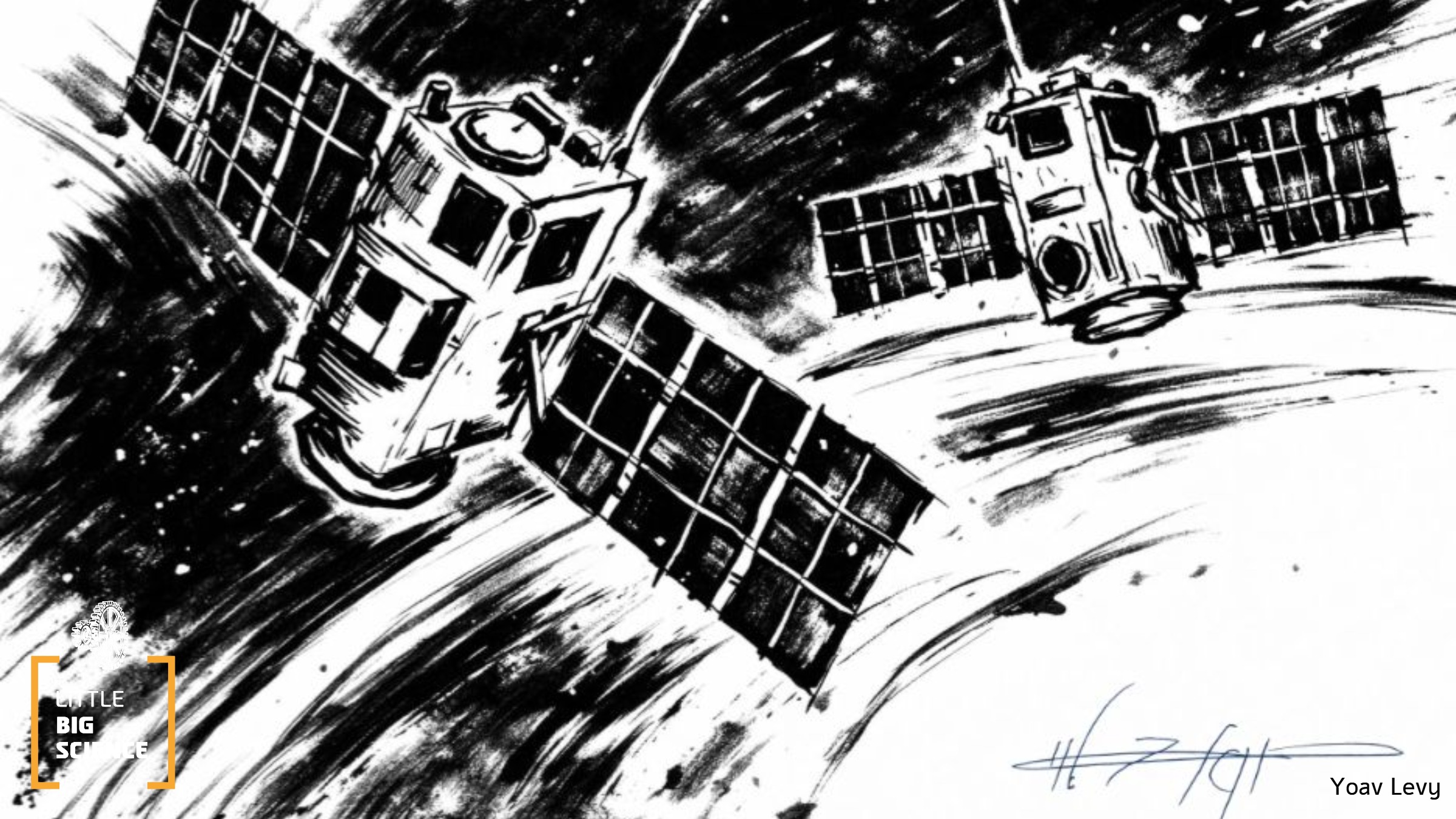
A pair of miniature satellites are on their way to Mars, but not via the usual route. They will perform complex maneuvers and investigate a four-billion-year-old mystery. How did Mars become a wasteland? How will they observe in stereo, and what is the relevance to the vision of settling the Red Planet?
Advertisement
Launched on November 13th 2025, the ESCAPADE mission aims to answer the historic question: What turned Mars into the red wasteland we know today? [1] The prevailing hypothesis is that the solar wind, combined with the disappearance of the Martian magnetic field, stripped away the atmosphere. Wow, that’s a complicated sentence, let’s break it down.
We can compare the solar wind to a sea breeze, but in space. It is a stream of particles emitted by the Sun and dispersed throughout space. When these particles reach a planet, they are deflected by the planet’s magnetic field. On Earth, for example, the magnetic field is generated by the rotational motion of the core of the planet. The region around a planet that is influenced by its magnetic field is called the magnetosphere.
However, unlike Earth which is protected by a vast internal magnetic field generated in its core, Mars has no such magnetic field. Instead, it has an irregular “hybrid magnetic field,” which is formed by the interaction of the solar wind with the atmosphere and ancient local magnetic remnants embedded in its rocky crust. It is thought that Mars’ original magnetic field disappeared around four billion years ago.
Without a magnetic field to protect it, the solar wind disperses the atmosphere, resulting in a very thin atmosphere, much thinner than Earth’s. The Sun emits particles that directly hit the upper atmosphere of Mars, and over billions of years, this has slowly “peeled off” the atmosphere.
It is widely accepted that the solar wind not only prevents gases from accumulating by scattering the atmosphere, but also causes water to evaporate from the planet’s surface [2]. The mission led by the University of California, Berkeley, under NASA’s SIMPLEx program aims to study this phenomenon [3].
The mission was launched on a Blue Origin New Glenn launcher [4] at the end of 2025 travelling on a unique, indirect trajectory to Mars. The satellites will remain in space until Mars reaches a suitable position, at which point they will begin their journey towards the planet. The satellites are expected to reach Mars and begin their mission in two years. The mission will be conducted using two small satellites (SmallSats) named Blue and Gold [4].
During the initial phase of the mission, the satellites will orbit Mars one after the other. The first satellite will take a measurement, after which the second satellite, travelling behind it, will repeat the measurement at the same position. This will enable scientists to distinguish between changes over time and changes in space. For example, if the first satellite detects a plasma wave, the second satellite will measure the same area a few minutes later. This will allow researchers to calculate the wave’s propagation speed and its temporal evolution. This is fascinating, because such a calculation would be impossible for a single spacecraft, since space and time are interdependent. Let’s illustrate this with an analogy. Imagine you are paddling a kayak down a murky river and cannot see the bottom. Suddenly, the kayak rocks violently up and down. Did you just pass over a large rock fixed to the riverbed (space)? Or was it a passing wave (time)? We can solve this by using two kayaks: another kayak follows exactly ten seconds behind you on the same path. If the second kayak rocks in exactly the same spot, then it must be a rock (a fixed spatial structure). If it passes smoothly, then it must have been a wave (a transient event in time that has already moved on).
In the second phase, the satellites will travel through different regions of the magnetosphere, taking simultaneous measurements from two distinct points. Imagine the solar wind as a stream of water. One satellite will measure the conditions before the stream hits Mars, while the other will measure the condition afterward, i.e., the particles lost or deflected after the encounter. Combining these two measurements will enable us to understand how a sudden changes in the solar wind affect atmospheric escape in real time. In other words, for the first time we will obtain a simultaneous, stereoscopic view of the solar wind’s interaction with the Martian environment.
Each satellite will be equipped with four identical scientific instruments for performing measurements: a magnetometer for measuring the magnetic field; an electrostatic analyzer for quantifying the energy and currents of charged ions and electrons; a probe for measuring the density and temperature of plasma (ionized gas) in the upper atmosphere; and a visible and infrared imaging system comprising a dual camera built by students.
In summary, the success of this mission will demonstrate that significant achievements can be made with small tools, paving the way for a whole fleet of inexpensive, efficient spacecrafts. The information gathered about radiation storms will impact our strategy for protecting the first astronauts to walk one day on the surface of the Red Planet[5]. Fingers crossed for success!
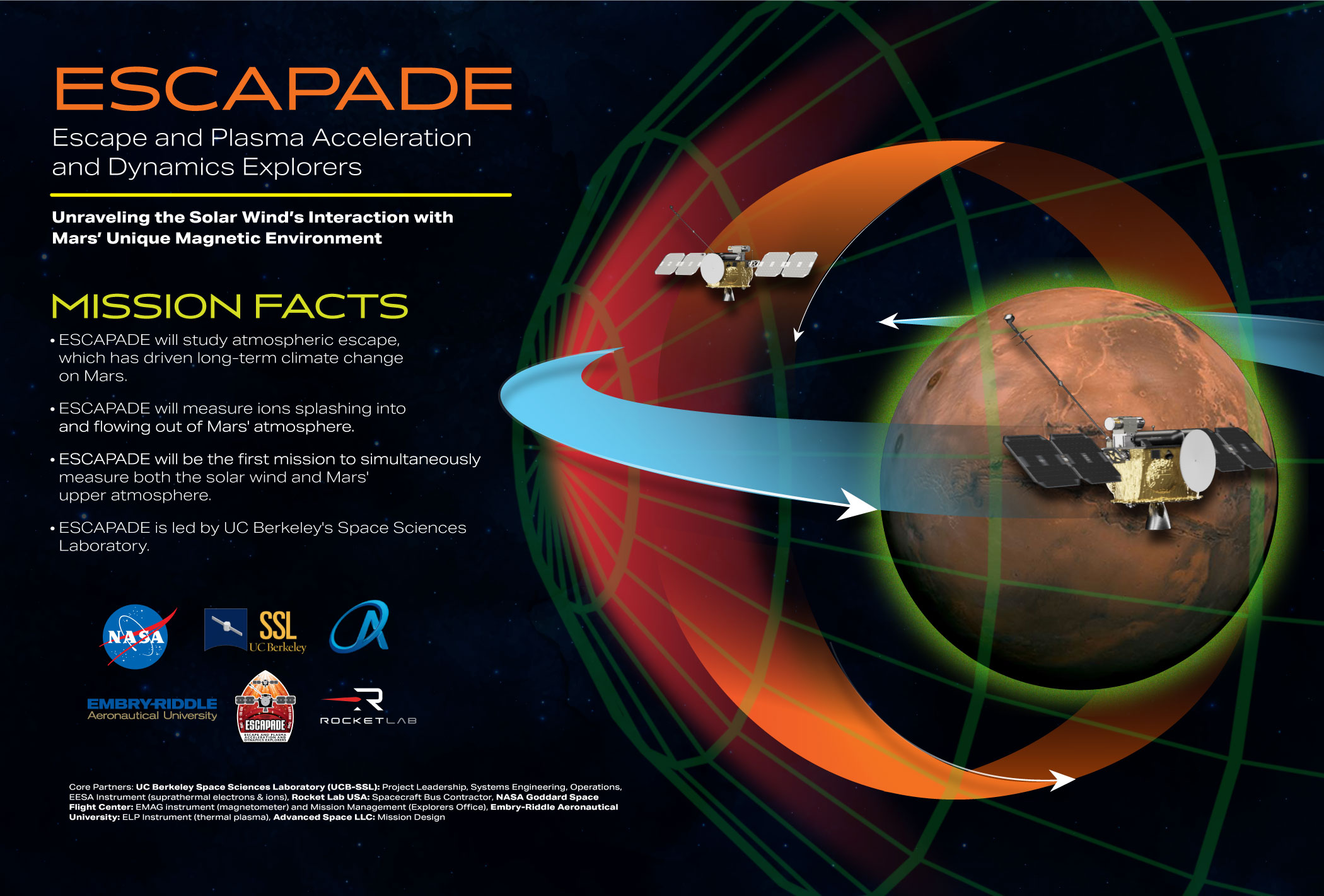
ESCAPADE mission (Credit: NASA).
Hebrew editing: Shir Rosenblum-Man
English editing: Gloria Volohonsky
References:

Michael is the Vice President of New Media department at "Little, Big Science" and holds a bachelor's degree in Mechanical Engineering as well as a master's degree in Systems Engineering, both from the Technion.

Yoav is 15 years old, he loves drawing, participating in scout activities, and surfing the sea.


