Swift, NASA’s space telescope for monitoring gamma-ray bursts, is losing altitude at a far faster rate than expected. To buy time, NASA has shut down almost all of its instruments, and now, in a race against the clock, a rescue spacecraft is attempting to grab a satellite that was never designed to be captured. What exactly went wrong, and why did no one see it coming?
Advertisement
For over two decades, NASA’s Swift space telescope has been tracking one of the most violent phenomena in the universe: gamma-ray bursts [1]. These are powerful flashes of energy that suddenly appear somewhere in the sky and fade within minutes to hours. What makes Swift so special is its ability to autonomously detect a burst and turn its three telescopes towards the source in under one minute, without waiting for instructions from Earth. This response speed is unmatched by ground-based telescopes.
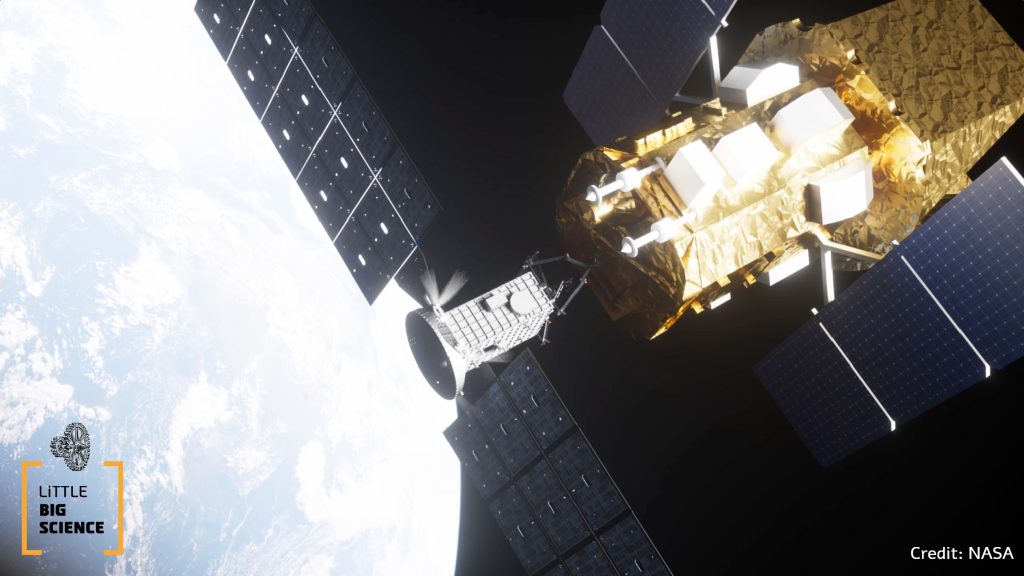
When Swift was launched in 2004, its official scientific mission was scheduled to last only two years. However, it was designed to remain safely in orbit far beyond that, until the 2030s according to estimates. Yet over the past year, Swift’s mission has changed: from observing the sky to simply trying to remain in orbit. Its orbit began to decay faster than expected, and by early 2026 NASA was faced with a real deadline that forced a decision: keep Swift operational, or lose it permanently. In February, most of its scientific instruments were switched off, and the last remaining one was shut down in April. On July 3rd this year, a commercial spacecraft called LINK was launched in a race against time. It had to catch up with Swift, capture the satellite that was never designed to be captured, and push it back to a safe altitude before it was too late [2]. If the mission is not completed in time and Swift descends too low, it will fall and burn up on re-entry to the atmosphere. However, if LINK succeeds in boosting Swift and restoring it to a safe altitude, it can be reactivated.
But why would an orbit change on its own? And why does a satellite that is “in space” fall at all?
The problem is that “space” has no sharp physical boundary. The Kármán line, located at an altitude of 100 km, is widely accepted as the point at which space begins. However, this is merely a convention, not a clear boundary that separates the atmosphere from space. Even far above this line, gas particles are present, though they are extremely sparse. Each gas particle that strikes a satellite slows it down very slightly, but this has a significant cumulative effect over time.
This deceleration results in a loss of altitude. Why? A satellite remains in orbit because it moves at a high horizontal speed while gravity constantly pulls it toward Earth. If the Earth were flat, the satellite would hit the ground. However, because the Earth's surface is curved, the ground “drops away” beneath the satellite’s path. At the appropriate speed, the curvature of the satellite’s path matches the curvature of the Earth, so it continues to “fall” around the planet without ever reaching its surface [3]. When drag slows the satellite’s motion, the curvature of its path no longer matches that of the Earth, and the satellite loses altitude. At lower altitudes, the atmosphere is denser, so drag increases and the loss of speed accelerates, causing a more rapid decline in altitude. This is a gradual but unavoidable process.
For this reason, most satellites, especially those in low Earth orbit such as the International Space Station, are equipped with station-keeping engines. These engines are activated from time to time to push the satellite back up. However, Swift has no such engine because it was designed to fall and burn up in the atmosphere at the end of its mission.
If NASA has been aware of this all along, why has it been unable to accurately predict when Swift will reach the critical altitude and crash?
The answer is related to the Sun. The Sun is not a constant source of energy, but rather it has an 11-year cycle of activity. This includes quiet periods known as solar minimums and turbulent periods known as solar maximums. During periods of peak activity, the Sun emits more ultraviolet radiation and charged particles. This heats the upper layers of the atmosphere and, because hot gas expands, the atmosphere “swells” upwards. Therefore, at any given altitude, there is more gas than during a quiet period and, consequently, more drag.
The original projections for Swift’s orbit were based on an assumption of average solar activity. However, solar activity in 2024–2025 was particularly strong. While the physical calculations themselves were accurate, the Sun’s heightened activity caused Swift to lose altitude faster than predicted. Throughout 2025–2026, the estimated date on which it would reach the critical altitude of approximately 300 kilometers was brought forward repeatedly.
When NASA personnel noticed the rapid loss of altitude, they had one option to buy time: to reduce Swift’s cross-sectional area facing the direction of travel to minimize drag, much like a cyclist leaning forward into the wind. However, this comes at a cost: when Swift is oriented this way, it cannot point its telescopes towards the sky to search for bursts. Nor can it position its solar panels to maximize exposure to the Sun. In February 2026, it happened. Most instruments were switched off, and the final instrument was shut down in April.
This is where the major challenge arises: Swift was never designed to be serviced in space and does not have any docking points. So how can LINK, the spacecraft sent to rescue it, grip it? Katalyst, the startup company that built LINK on an exceptionally tight schedule, devised a solution. LINK will target the small metal rings that held Swift while it was being transported on the ground in preparation for launch. As these were never intended for use as docking points in space, Katalyst’s engineers had to examine old photographs to identify them.
If the rescue attempt is successful, Swift will be able to reactivate its telescopes and continue operating. This could be an achievement that would pave the way for a whole industry of satellite servicing and rescue.
Ultimately, Swift’s story is not just a tale of bad luck. Swift was designed according to the best knowledge available at the time. However, the problem is that its actual orbit depends on solar activity, a factor that is difficult to predict accurately years in advance. When solar activity is higher than expected, even the most careful forecast can be inaccurate.
By the time it becomes clear that the forecast is wrong, it is too late to correct it. The only option left is to buy time by any possible means, and ultimately launch a bold rescue mission to achieve something that no one expected would ever be necessary.
Hebrew Editing: Smadar Raban
English Editing: Gloria Volohonsky
References:
Elad is a lecturer in the Mechanical Engineering Department at Brauda Academic College of Engineering in Karmiel. He holds a PhD in Autonomous Systems and Robotics and is actively engaged in research in artificial intelligence and optimization.


