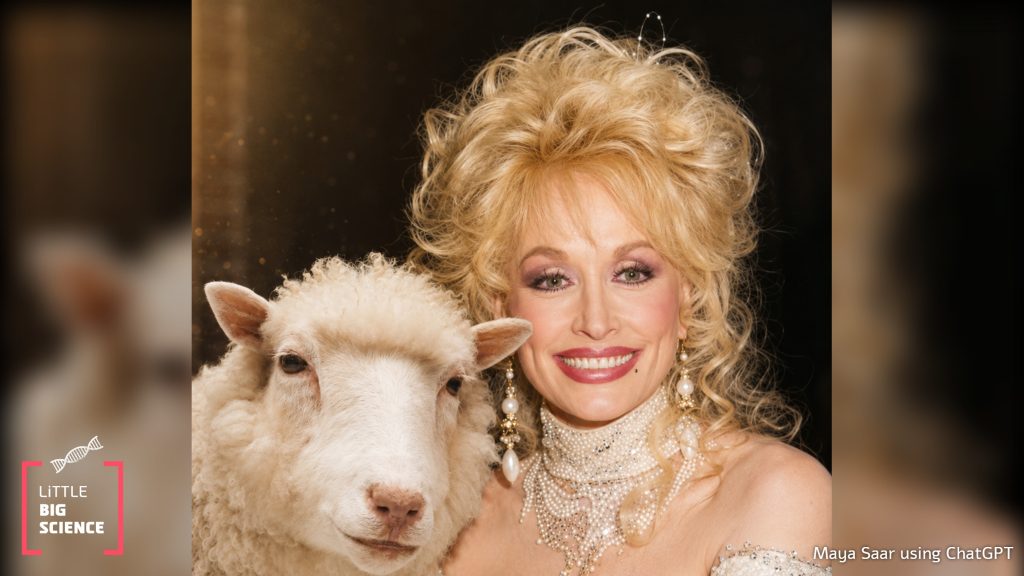
Dolly Parton, one of the most prominent figures in country music in the United States, died at the age of eighty. The musical legend contributed money, as well as her fame and image, to the advancement of science. About three decades before Dolly Parton’s death, a cloned sheep named after her was born and became one of the most famous animals in the history of science. Dolly the sheep revolutionized our understanding of the ability to reprogram cells.
Advertisement
On 25 August 2026, we mourned the death of Dolly Parton, who died of cancer at the age of eighty. Over her decades-long career, Parton has written, produced and sung hundreds of songs. Alongside her musical career, Parton engaged in extensive philanthropic work, including promoting literacy among children in many countries through continuous donations of reading books, as well as advancing medical research. One of Parton’s long-term contributions to science is connected to the development of one of the key vaccines against SARS-CoV-2, the virus that causes COVID-19. In March 2020, Parton donated one million dollars to Vanderbilt University Medical Center (VUMC) in Nashville, Tennessee. The donation helped establish the Dolly Parton COVID-19 Research Fund. An analysis by the journal Nature found that at least 37 scientific papers cite the Dolly Parton Research Fund as a source of support.
According to Mark Denison, a pediatrician and infectious-disease researcher at Vanderbilt University, Parton’s donation helped fund the early stages of research into an experimental mRNA vaccine, which later became Moderna’s vaccine. The fund is mentioned in the first paper on the vaccine’s Phase I clinical trial, published in the New England Journal of Medicine in July 2020 [1]. In March 2021, Parton was photographed receiving a COVID-19 vaccine at Vanderbilt University Medical Center and encouraged others to do the same—her contribution to the fight against COVID-19 was not limited to funding alone [2].
For many scientists, however, the name Dolly is at least as strongly associated with a sheep born in Scotland in July 1996. Dolly the sheep was the first mammal created by cloning a cell taken from an adult animal [3]. This achievement demonstrated for the first time that it is possible to take the nucleus of a cell that is already specialized to perform a particular function, such as a muscle cell or nerve cell, and reprogram it so that it can initiate the process leading to the formation of a fertilized egg that develops into a complete animal.
Dolly was created using a method called somatic cell nuclear transfer. The researchers, led by Ian Wilmut, removed the nucleus from an egg cell taken from one sheep and replaced it with the nucleus of a cell taken from the mammary gland of another sheep. After the egg began to develop, it was implanted into the uterus of a third sheep. Thus, three sheep took part in creating Dolly: one donated the cell nucleus, the second donated the egg cell, and the third was the surrogate that carried the pregnancy. Genetically, Dolly was almost completely identical to the sheep that donated the cell nucleus, but they were not perfectly identical, because mitochondrial DNA was also inherited from the egg cell [4].
The fact that the nucleus of an adult cell can be “reset” and return to a state capable of producing an embryo was a dramatic discovery. It showed that adult cells do not lose the genetic information needed to create an entire organism, even after they have become specialized to perform a particular role.
Dolly was named after the source of the cell used to clone her: the mammary gland in the sheep’s udder. The researchers decided to name her after singer Dolly Parton, as a humorous nod to a prominent physical feature associated with her. Parton was not offended by the joke—quite the opposite: she had the rare ability not to take herself too seriously [5]. But there were always those who objected to the “tribute”. For example, Jens Foell, a neuropsychologist and science editor from Germany, wrote on Bluesky after her death: “Scientific breakthroughs should be named after her, but for another reason; for decades, she was a significant force in advancing science and knowledge” [6].
Dolly the sheep lived for only six and a half years. At age five, she developed arthritis, and later died of lung disease. The fact that she lived shorter than expected for sheep of her breed raised suspicions that she had aged rapidly because of cloning. However, a later study that examined 13 cloned sheep aged seven to nine, including four created from the same cells used to produce Dolly, found no evidence of premature aging or unusual health damage. It therefore appears that Dolly’s death at a young age was not necessarily a result of cloning, and may have been related to the unusual living conditions in research laboratories where the famous sheep spent her life [7].
The scientific legacy of Dolly the sheep is far greater than her individual fate. The experiment that led to her creation provided proof of principle that the nucleus of an adult cell can be reprogrammed and returned to an embryonic state. Research conducted about a decade later showed that cells can also be reprogrammed without an egg cell, using four transcription factors—proteins that activate gene expression—to create induced pluripotent stem cells (iPSCs) [8], i.e., stem cells that can differentiate into any type of cell as needed. Such cells are now used in medical research, disease modeling, and the development of applications in regenerative medicine.
Dolly Parton and Dolly the sheep share only a name, but both connect it to a valuable legacy: Dolly Parton is primarily known as a groundbreaking artist, but her legacy also includes a unique contribution to advancing scientific research and literacy, while Dolly the sheep is associated with the question of how far a cell can be reprogrammed and restored to its capacity for development—in other words, with reprogramming life.
Hebrew editing: Smadar Raban
English editing: Elee Shimshoni
References:
- Phase I clinical trial of the COVID-19 vaccine
- Nature’s tribute to Dolly Parton
- The first mammal cloned—the sheep Dolly
- About mitochondrial DNA
- Interview with Dolly Parton, in which she says she was happy that Dolly the sheep was named after her
- Jens Foell on Bluesky
- Paper: Dolly’s death does not appear to have resulted from accelerated aging
- Reprogramming cells without an egg cell, using four transcription factors
Maya serves as Scientific Director at "Little Big Science". Maya is a zoologist and an entomologist with a PhD from Tel-Aviv University, currently working as a postdoctoral researcher in the Florida Museum of Natural History, at the University of Florida. Her research focuses on social insects - especially ants - and covers topics such as ecology and invasive biology.


