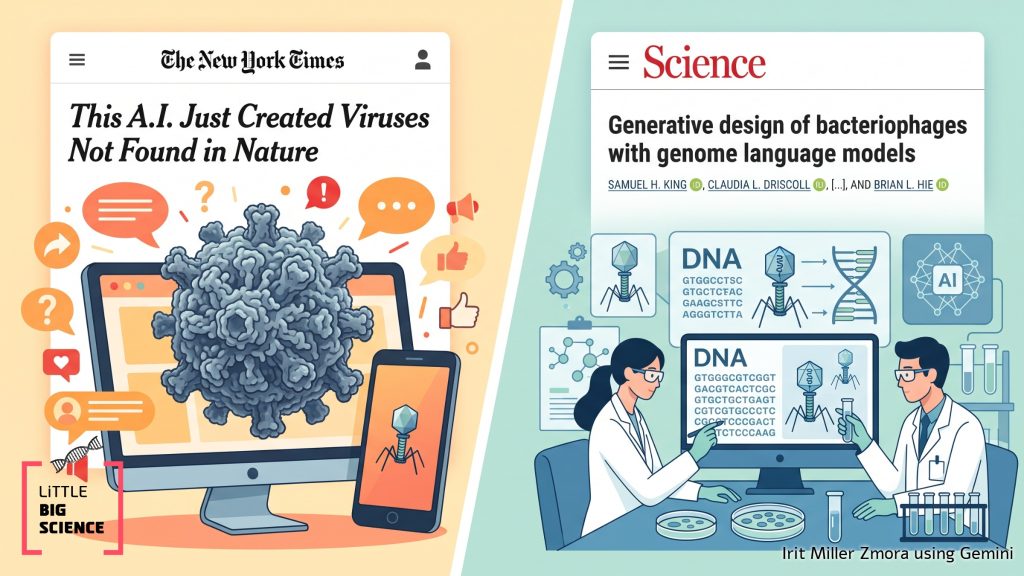
If you happened to encounter, sometime in August, media coverage with headlines claiming that artificial intelligence had created viruses “that do not exist in nature”, you likely wondered whether the world as we know it is coming to an end, and unfamiliar life forms would soon attack us. Let us compare the headlines with the actual study: a groundbreaking study by researchers at the Arc Institute and Stanford University was recently published in the journal Science. This research is indeed a significant milestone in synthetic biology, but the gap between the scientific findings and the clickbait-driven media coverage requires some clarification.
Advertisement
The published science:
The researchers used genomic language models, language models that specialize in genetic material, called Evo 1 and Evo 2, which were trained on enormous quantities of DNA sequences. For the experiment, they specifically adapted the models to a particular family of bacteriophages (viruses that infect bacteria) and used a well-known, extensively studied bacteriophage (or phage) as a template for designing new genomes. The models did not merely alter a few letters in an existing sequence; they generated entire genomic sequences. Some contained different genes, changes in genome length, and even changes in the order and organization of genes along the genome. However, the design process was highly constrained: the researchers imposed restrictions on genome structure, host range (the range of organisms and cells that could potentially be infected), and the degree of difference from known natural sequences.
From thousands of generated sequences, the researchers selected 302 candidates for testing. They were able to synthesize and assemble 285 of them, and only 16 produced functional phages—about 5.6% of the genomes tested.
The researchers then generated, in the laboratory, two strains of E. coli bacteria that had developed resistance to the phage used as the template. At the beginning of the experiment, none of the phages could infect the resistant bacteria. The researchers allowed different phage cocktails to undergo several rounds of propagation in the presence of the bacteria. After one or two rounds, a cocktail of the model-designed phages succeeded in overcoming the resistance. In contrast, the template phage alone, and a cocktail containing the template phage alongside closely related natural phages, failed to do so even after five rounds. Importantly, the phages that overcame resistance also underwent further recombination and mutations during the experiment—in other words, the AI provided a genetic foundation on which evolution continued to act.
The gaps between the headline and the research:
The AI model did not “generate a virus from scratch”. On the one hand, the researchers used a known phage as a template, trained the models on thousands of its relatives, and applied numerous biological filters to select the most plausible sequences. On the other hand, it would also be inaccurate to say that the model merely edited an existing phage: it did generate complete new genomes, some of which differed substantially from every known natural sequence. The genomic sequences of the 16 functional phages showed 93%–99% similarity to the sequences of their closest natural phage relatives.
This leads to another important point: “not known from nature” is not the same as “does not exist in nature”. Even if a particular sequence does not appear in our databases, a similar phage may exist somewhere in the natural world.
The success rate is also important for keeping things in proportion. Only about 5.6% of the assembled genomes produced active phages. The researchers were unable to fully explain why those particular genomes were functional, but they found that the likelihood of success increased as a sequence more closely resembled a known natural phage. The bacterial strain also matters: the phages were tested on several E. coli strains and succeeded in infecting only some of them. Therefore, 5.6% is not a general success rate applicable to other phages or bacteria. Generative AI is a powerful and important research tool, but moving from a DNA sequence on a computer to a functioning biological system still requires DNA synthesis, substantial resources, time, and a skilled, professional wet-lab team.
In addition, as part of Evo 2’s safety measures, the researchers excluded from the training dataset sequences of viruses that infect eukaryotic cells (cells with internal, distinct sub-cellular structures), including human viruses. They also tested the effect of this exclusion and found that the model struggled to predict and generate sequences of human viruses. The experiment itself focused on phages and on a laboratory bacterium that does not cause disease in humans. However, one potential future application of this approach is the development of phage therapies against bacteria that cause disease, particularly antibiotic-resistant bacteria.
The bottom line: the shift from designing proteins, genes, and limited genetic systems to designing an entire viral genome capable of producing a functional phage is a significant leap forward for biological research in general, and for synthetic biology in particular. In the future, this capability may contribute, among other things, to the development of phage therapies against antibiotic-resistant bacteria. The success rate remains low, and the process requires extensive laboratory work, but this study demonstrates for the first time that genomic language models can generate complete, functional genomes and provide genetic diversity that can also be used to address bacterial resistance. Coverage of studies such as this should present both the advances and the potential, as well as the limitations and risks—without sacrificing scientific credibility and informed discussion for a bunch of likes and shares.
Hebrew editing: Smadar Raban
English editing: Elee Shimshoni
References:
Yomiran is the General Manager of the NGO "Little, big Science". He is a doctoral candidate in the Department of Zoology at Tel Aviv University, where he researches bats' genetics, he holds a master's degree in Biology from the Technion.

Irit serves as Scientific Director at “Little, Big Science”. She holds a PhD from Tel Aviv University and has conducted her postdoctoral training at the University of California, San Francisco. Her expertise is in fertility endocrinology, developmental biology, stem cells and tissue regeneration.


