*Approximately. But don't take our word for—test it out yourselves
Advertisement
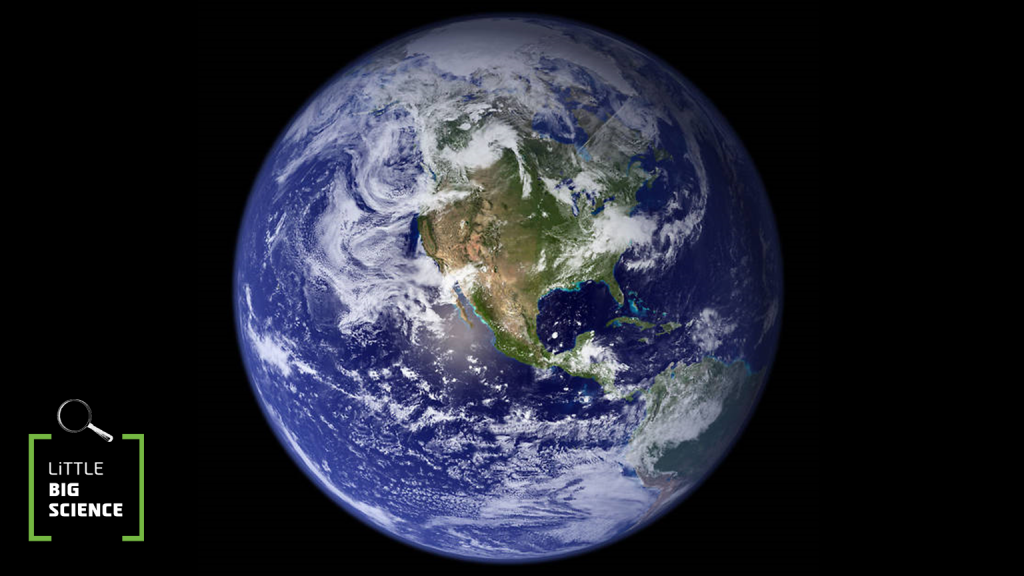
Determining the shape of the Earth has occupied researchers and scientists long before the first satellites were launched into space. As early as ancient Greece, many philosophers—among them Pythagoras, Aristotle, Plato and Eratosthenes—claimed that the Earth is a sphere: ships and clouds disappeared below the sea horizon. On southbound voyages to Africa, sailors discovered that the Sun changes the azimuth in which it rises during the journey [1]. Eratosthenes even used geometry and the angular difference between the Sun’s rays and the ground in two different Egyptian cities to calculate the Earth’s circumference with an accuracy of about 15 percent—not too shabby! By contrast, other prominent scholars and philosophers, including the ancient Egyptians, Homer and the rapper B.o.B, argued that the Earth is flat, a disk surrounded by an abyss or an ice wall [2–3].
Let us, for a moment, apply Descartes's approach [4] and assume that we believe nothing: not the satellite images [5], not the astronauts’ testimonies [6] nor the theories developed by physicists over the years that show why the Earth must be a sphere rather than a cube, pyramid or plane [7]. What experiments can you conduct yourself to decide whether the Earth is spherical or flat?
First experiment: watch the shadow the Earth casts on the Moon during a lunar eclipse, and see that it is round.
A lunar eclipse occurs when the Earth, in its orbit, comes between the Sun and the Moon and casts its shadow on the Moon. Two conclusions follow from this experiment: first, that the Earth is sometimes between the Sun and the Moon. Second, that the Earth’s cross-section (its shadow) is circular; in other words, it is a sphere or a disk—but not a triangle or a square. Okay, that's progress; but we still cannot determine from this which of the two options is correct. If you wish to see for yourself, wait until for a partial lunar eclipse.
Second experiment: along different longitudes—for example, Israel and the United States—the Sun rises at different hours. To run this experiment, simply call (or video-call) relatives or friends you trust who are in the United States or in the Far East. Ask them to photograph the sky when it is night for them and day for you. Using the location and timestamp, you can verify that the photo was taken exactly where and when you asked, and that while it is night for them—it is day for you—or vice versa. One interpretation is that the Earth is a sphere: one side of the sphere faces the Sun and is lit, while the other faces the darkness of space. Another possibility is that the Earth is a disk with a Sun above it that projects a precise beam of light illuminating only part of it at any given time. A problem with the latter interpretation is that the Sun appears at different heights in the sky in different places on Earth. For instance, while the Sun is high in the sky over Tel Aviv, it is lower in the sky above the heads of Parisian residents. Such a situation cannot occur if the Earth were a disk lit from above by a narrow beam. It seems that the spherical-Earth theory explains the results better.
Third experiment: this one will require some effort, but if you are very precise you will obtain interesting results. Here we try to refute the claim that the Earth is a sphere with a specific radius. If the Earth is a sphere, shadows cast by objects of identical length (such as a stick or ruler) placed along different latitudes will differ in length. If the Earth is a disk, the shadows will be identical.
To perform the experiment, you will need two rulers of equal length and the help of a friend. First, place the two rulers side by side and verify they are the same length. Now give one ruler to your partner, who will travel with it to another city—for example, one ruler in Tel Aviv and the other in Jerusalem. It is preferable that the cities be far apart to maximize the effect. Stick the ruler into flat ground up to the five-centimeter mark and measure the length of its shadow on the ground. Then compare the result with your partner, who is in another city conducting the experiment at the same time. The different shadow lengths indicate that the Earth is a sphere rather than a flat disk. You can also examine similar experiments by great thinkers such as the Greek philosopher Eratosthenes [8] and the American YouTuber Curtiss Baute [9], showing that the Earth is a sphere with a radius of about 6,300 km.
*Oh—yes. We almost forgot. Hello to the nitpickers who read to the end of the post to check whether we remembered to write that the Earth is not a perfect sphere but an oblate one. Indeed—that is true. The Earth is not perfectly spherical; it is more like an orange. The polar diameter, or the distance from the North Pole to the South Pole, is roughly 40 km shorter than the equatorial diameter, the distance between two opposite points on the circle circumventing the Equator. But hey, what are 40 km between friends?
English editing: Elee Shimshoni
References:
- https://www.aps.org/publications/apsnews/200606/history.cfm.
- http://adsabs.harvard.edu/full/1916PA.....24..358M
- http://time.com/4193114/neil-degrasse-tyson-bob-earth-flat/
- Discourse on the Method, wikipedia
- https://www.livescience.com/20369-earth-pictures-space.html
- https://www.space.com/38305-flat-earth-bob-nasa-astronauts.html
- Ask Smithsonian: Why Are Planets Round?
- How Eratosthenes to calculated Earth's circumference 2300 years ago
- How I Proved the Earth is Round (with my Bike and Two Sticks)