
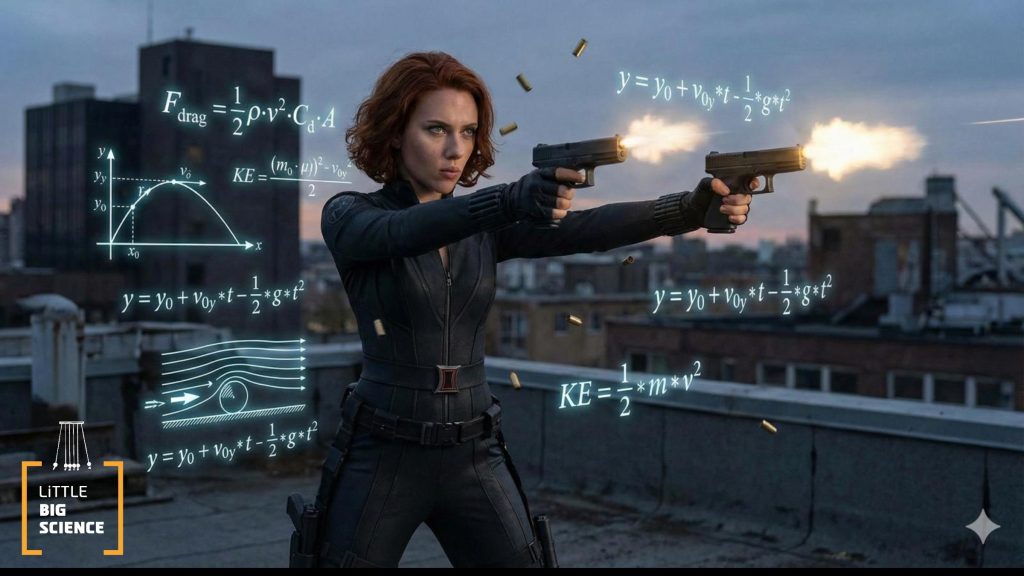
Natasha Romanoff is a masterful gunwoman, and is even able to shoot two guns simultaneously. What is the science behind the maneuver? Would the Black Widow succeed in hitting her target in real life?
Advertisement
The Black Widow is Natasha Romanoff, a skilled assassin, a member of S.H.I.E.L.D. and one of the Avengers [1]. We will analyze a scene from the film “Captain America: The Winter Soldier", during which a gunfight breaks out between Black Widow and the Winter Soldier and his gang. During the fight she jumps off a bridge, then stands beneath it and fires at him with two guns, one in each hand.
Let us analyze the scene scientifically.
The ammunition, pistol parts and firing mechanism:
Ammunition:
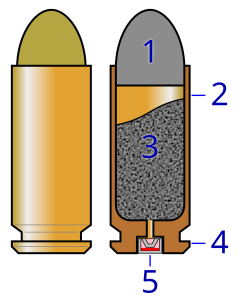
Diagram of a typical cartridge: 1. bullet; 2. case; 3. gunpowder; 4. rim; 5. primer.
A cartridge consists of four main components: the bullet, the casing, the propellant (gunpowder) and the primer. The casing contains the primer and the gunpowder and is usually made of brass (an alloy of copper and zinc). The bullet, the part propelled toward the target, is typically a lead core coated with a soft metal, most often copper. There are also dedicated bullets that differ in structure and composition.

Pistol parts and firing mechanism.
In the scene in question, our friend Natasha uses a semi-automatic Glock26 9mm, which has unique features—a trigger mechanism with safeties, a barrel different from other pistols, and more [2]—but we shall describe the general mechanism.
So what happens inside the pistol when it fires? Pulling the trigger drives the firing pin rapidly toward the cartridge, striking the primer. The primer contains a sensitive compound, such as mercury fulminate, which reacts quickly with the gunpowder. The reaction raises the temperature and pressure (up to about 34,000 psi, which is more than 2,000 atmospheres, equivalent to a depth of 200 meters underwater, and beyond) [3], releasing a large volume of gas. The pressure rise causes the gas to expand. Because the chamber is sealed, the gas, having nowhere else to go, “pushes” the bullet out as it escapes through the barrel into the lower-pressure surroundings.
The barrel of the gun is a cylinder whose interior usually contains spiral grooves that impart “spin angular momentum about the flight axis,” i.e., they make the bullet spin as it leaves the barrel. This rotation stabilizes the bullet’s flight and helps keep its trajectory straight. In the pistol Natasha uses in the film, the bullet’s spin is generated by casting the barrel steel in different orientations, reducing wear and increasing muzzle velocity.
What affects the shot?
- Barrel length → acceleration and accuracy: the bullet accelerates along the barrel. The longer the barrel, the longer the gunpowder burns before the bullet exits, the greater the bullet’s acceleration and the better the accuracy (up to a point, of course; an infinite barrel will not accelerate a bullet to infinity).
- Amount of gunpowder → explosion strength: pistol cartridges are usually 9×19 millimeters. The numbers indicate the barrel’s internal diameter (9 mm) and the cartridge case length (19 mm). Rifle cartridges are generally larger, and the difference in case volume affects the amount of gunpowder [4]. Not all of the powder burns during a shot, so at close-range fire or in indoor ranges unburned grains accumulate on the floor or in the gunshot wound.
- Bullet mass → acceleration: according to Newton’s second law of motion (force equals mass times acceleration), the heavier the bullet, the lower its acceleration. If the same firearm fires bullets of different masses while the gunpowder charge remains identical—i.e., the explosion strength is the same—the heavier bullet, the lower its acceleration, and therefore its muzzle velocity.
- Environmental barometric conditions → bullet “behavior”: the conditions through which the bullet travels, such as temperature, barometric pressure, humidity and wind, will influence the bullet's range, drift, etc.
Back to the movies, where villains always miss, weapons never jam, magazines are bottomless, and the hero always hits the target with a gun from far away. In reality, the effective range for accurate handgun fire is only a few tens of meters, usually up to 100 meters, compared with a rifle, whose range can reach hundreds of meters [5]. The main reason is muzzle velocity: an ordinary pistol bullet leaves the barrel at 300–340m/s, whereas a rifle bullet leaves at 700–900m/s.
And in our scene? Because she is a skilled markswoman and the distance between her and the Winter Soldier and his companions is not very large, the odds are that she will indeed hit her target.
Scientific accuracy: 9/10
Firing two pistols simultaneously:
Accurate shooting with two pistols may look implausible, but a skilled shooter can manage it. True, “point shooting” works only at short ranges, whereas longer-range fire requires sight alignment; it is preferable to hold the pistol with both hands; and one cannot aim at and hit two separate targets at once—but it is not impossible.
First, the pistol’s design suits both right- and left-handed shooters. Second, Natasha fires with both eyes open, so the dominant-eye issue is largely irrelevant. Third, one can hit from about 50 meters away by focusing only on the front aim. Fourth, while you cannot aim at two targets simultaneously, alternating fire is certainly possible, effectively doubling the rate of fire. And most importantly—it looks terrific on screen and makes Black Widow cooler than Hawkeye: after all, he cannot shoot two bows at once.
Scientific accuracy: 7/10
Thanks to Roee Bergman, Eran Zellner and Assaf Green for their assistance.
Design: Michael Levy
Hebrew editing: Haggai Gelernter
English editing: Elee Shimshoni
References:
- Black Widow
- How does the Glock 26 work?
- Bullet pressure
- 9 mm vs .223 caliber (5.56 mm NATO) as a Primary SWAT Team
- Firearm ranges

Michael is the Vice President of New Media department at "Little, Big Science" and holds a bachelor's degree in Mechanical Engineering as well as a master's degree in Systems Engineering, both from the Technion.


