
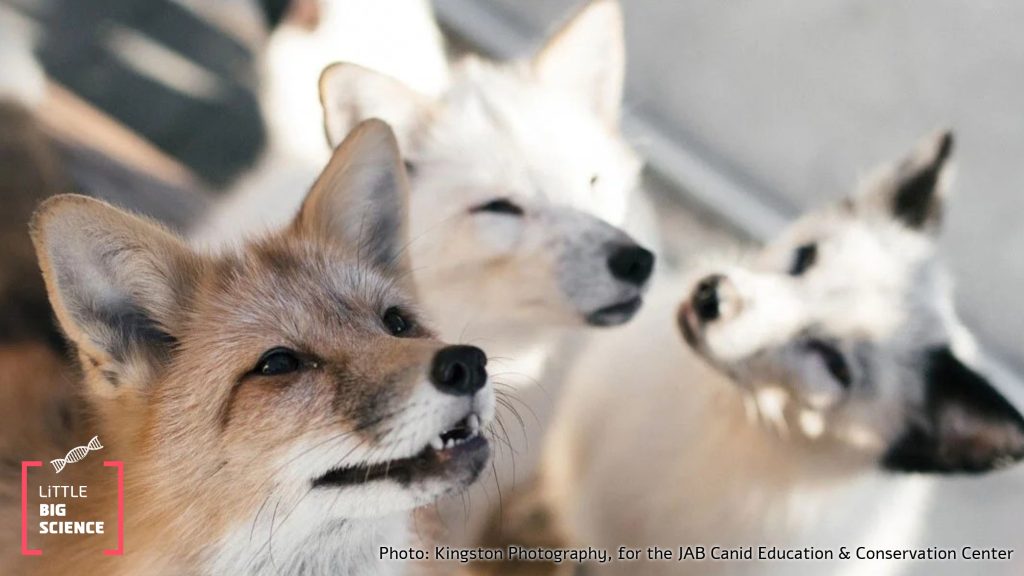
For several decades, a research institute in Russia has been domesticating foxes to investigate the domestication process and the genes underlying it. By selecting for a single trait in foxes—sociability—across multiple generations and mapping the DNA of these foxes, the researchers identified the DNA regions linked to this trait.
Advertisement
Anyone who has raised a dog knows how hard it is to imagine that our shoe-eating, ball-chasing companions share any genetic connection with wild wolves. Yet not only do they share such a connection, they actually originate from wolves. For thousands of years, humans selected the traits they wanted in wolves and bred only the individuals that displayed them. By selecting for desired traits and behaviors, humans also selected the genes responsible for those traits, bringing about changes not only in the wolves’ behavior but also in their DNA. In this way, humans domesticated wolves into the dogs we know today.
But what exactly happened during domestication? Which genes were selected? To answer these questions, researchers at the Institute of Cytology and Genetics of the Siberian Branch of the Russian Academy of Sciences in Novosibirsk, Russia, began an unprecedented experiment in 1959—the domestication of the red fox. The red fox is a close relative of the wolf; their last common ancestor lived only about 10 million years ago—a very short time on the evolutionary scale—so foxes are considered highly similar to wolves. Unlike wolves, which were selected for a wide range of traits, the foxes in this study were selected solely for their sociability toward humans. One group consisted only of the friendliest foxes, a second of the most aggressive foxes, and a third served as an unselected control group. By focusing on a single trait, the researchers could most efficiently isolate the DNA regions associated with it.
In a paper published recently, the researchers mapped the DNA sequences of foxes from the three groups and identified 103 DNA segments that differed among them. Some segments contained genes known from earlier studies, such as genes linked to the immune system or to bipolar disorder and the autism spectrum in humans. They also found genes associated with Williams syndrome in humans, which is characterized in part by heightened sociability. Surprisingly, the genetic profile of Williams syndrome more closely resembled that of the aggressive foxes than the friendly ones. Williams syndrome is often accompanied by anxiety, which could also explain the foxes’ aggressive behavior. This finding underscores how complex the relationship between genes and behavior can be. Additional DNA regions that differed among the groups have also been implicated in dog domestication.
One notable gene examined was SorCS1, which plays an important role in neurons. To assess its influence on fox behavior, the researchers measured how the animals responded to humans in several situations. They found a link between behavior and the gene variant each fox carried: the friendlier foxes had a different version of the gene than the others. SorCS1 therefore affects the degree of sociability in foxes.
A dramatic behavioral change was observed in the domesticated friendly foxes compared with the undomesticated ones. They stopped fearing humans, sought human contact, and even wagged their tails at people. Yet not only their behavior changed: their coat color shifted, their tails curled like those of dogs, and their reproduction was affected as well. Although only one trait was selected, additional traits changed thanks to the complex workings of genetics, in which a single gene can influence several characteristics. This means that not all changes result from intentional selection; some are by-products of domestication.
This research is an important milestone in understanding domestication processes and demonstrates how artificial selection can have an impact within just a few generations. Moreover, it helps identify the DNA regions associated with social behavior. Determining the function of all the DNA regions found in the study will take more time, but there is definitely much to look forward to. The institute continues to domesticate foxes and learn from them, and more fascinating discoveries undoubtedly lie ahead. Until then, we can keep wondering whether a new contender for man's best friend has emerged—and whether foxes will one day lounge on our sofas.
English editing: Elee Shimshoni
References: