
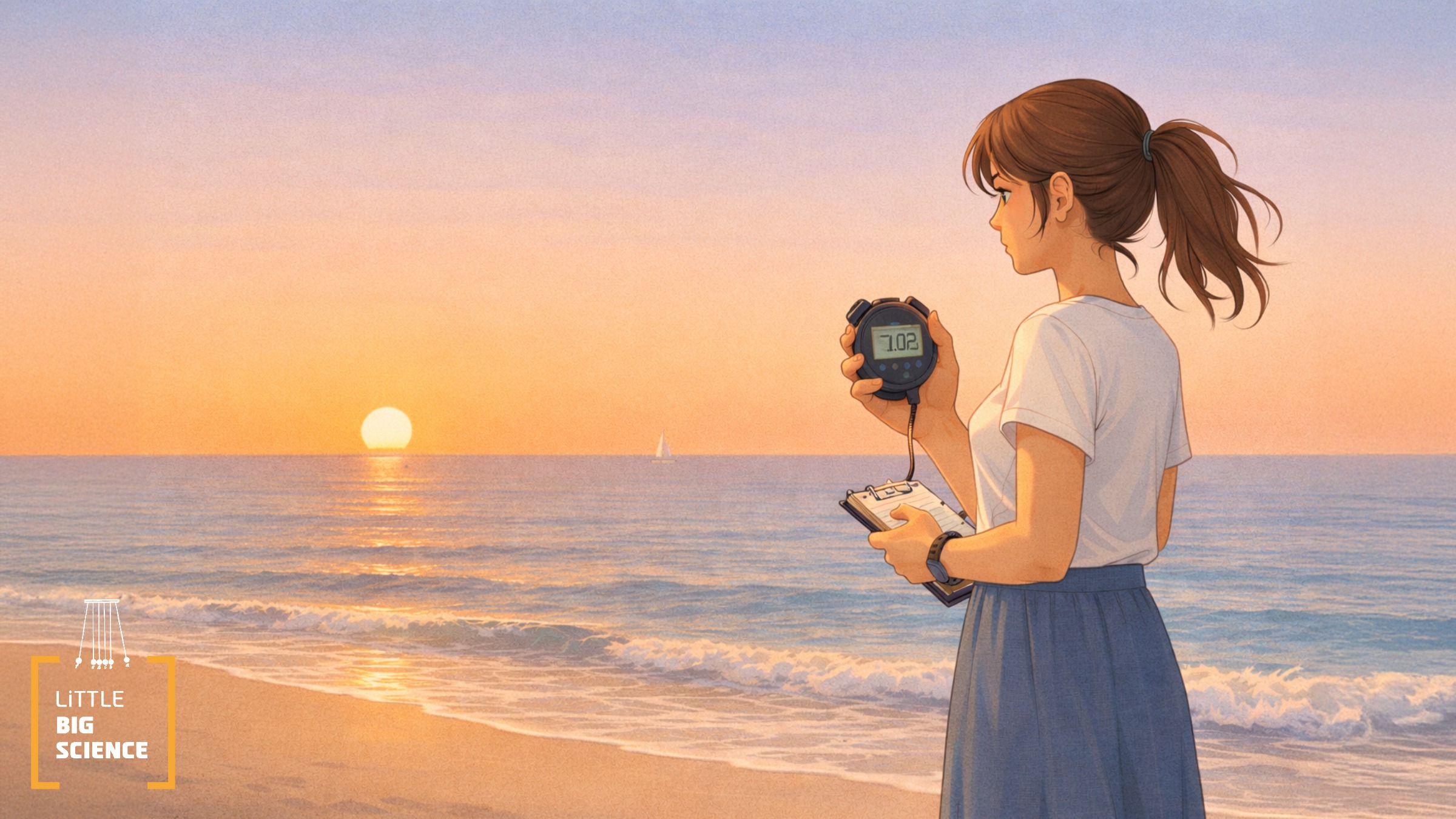
Watching the sunset is a pleasant and romantic experience by all accounts, but did you know that it is also a wonderful opportunity to roughly estimate Earth’s radius? All you need is a stopwatch, a calculator, and a bit of trigonometry.
Advertisement
In a previous article [1], we explained how Eratosthenes measured Earth’s radius 2,300 years ago with impressive accuracy using just two sticks, a shadow, and basic geometry. But Eratosthenes’ method involved two different locations on Earth—the Egyptian cities of Aswan and Alexandria. Could you achieve a good estimate of Earth’s radius, without traveling to another city?
The method we present is simple and relies on Earth’s rotation.
- Go to the beach, or any other place from which you can watch the sunset.
- Lie down, facing the horizon. The moment you see the Sun’s last ray slip behind the horizon, start your stopwatch (see Illustration 1).
- Quickly stand up. Lo and behold—the Sun reappears above the horizon! Enjoy a second sunset, and when the last ray disappears, stop the stopwatch (see Illustration 2).
- Now use the measurements to estimate Earth’s radius. In the approximation we will use, the only pieces of information you need are the time you measured between the two sunsets, your height, and the duration of one full rotation of Earth on its axis (preferably in seconds).
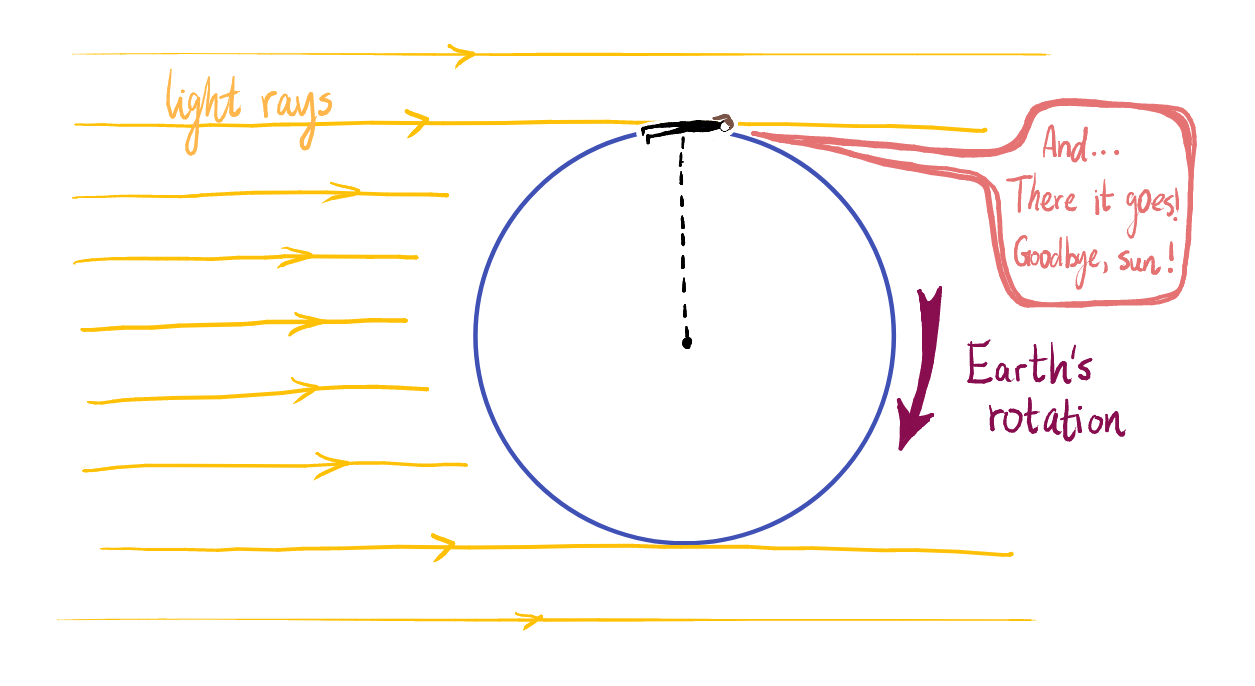
Illustration 1: Watch the sunset while lying down, and when the Sun disappears behind the horizon, start the stopwatch and stand up.
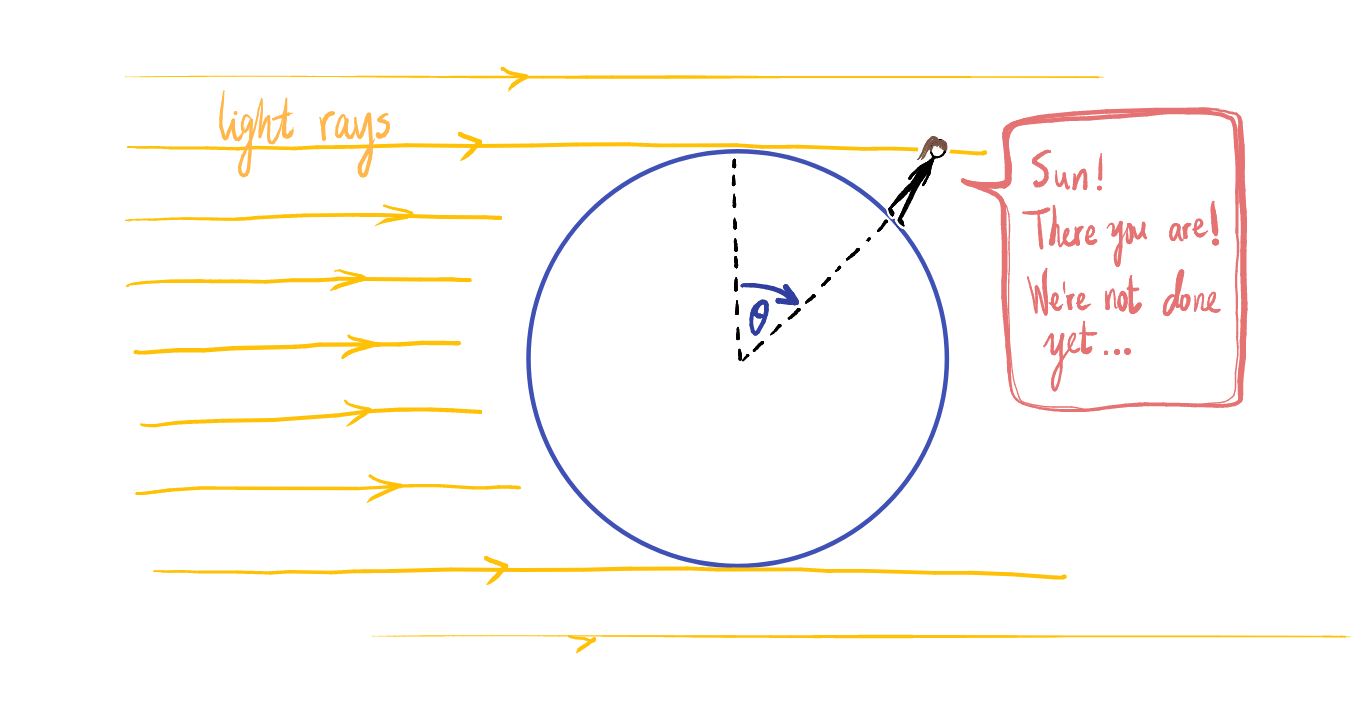
Illustration 2: After you stand up, you will get to see another sunset. When the Sun vanishes a second time, stop the timer.
Let us start with the fact that the ratio of different time intervals (in our case: the time you measured and one day) equals the ratio of the angles Earth turns during those intervals. The angle Earth rotates in a day is, of course, 360 degrees, giving the simple ratio: the time you measured divided by one day equals the angle Earth turned divided by 360 degrees. We will call this angle θ (theta).
From this you can calculate the angle (in degrees): 360 times the time you measured (in seconds) divided by the length of a day (86,400 seconds). For example, if you measured 10 seconds—then the angle Earth turned in that time interval is θ = 0.0417 degrees.
Now, assume the Sun crosses the horizon vertically (imagine it moving straight down, not at an angle). Under this assumption, the angle produced by Earth’s rotation during the measured time approximates how far the Sun has dropped below the horizon in that period of time. In reality, the Sun does not always cross the horizon vertically: its rate of descent depends on latitude and on the season. Therefore, the result of our experiment will be more accurate near the equator and around the equinoxes (in March and September), and less accurate closer to the poles or near the winter or summer solstices.
For simplicity, we will continue with this assumption and relate the angle we calculated to the two lengths in the problem (Earth’s radius and your height) using basic trigonometry (see Illustration 3).
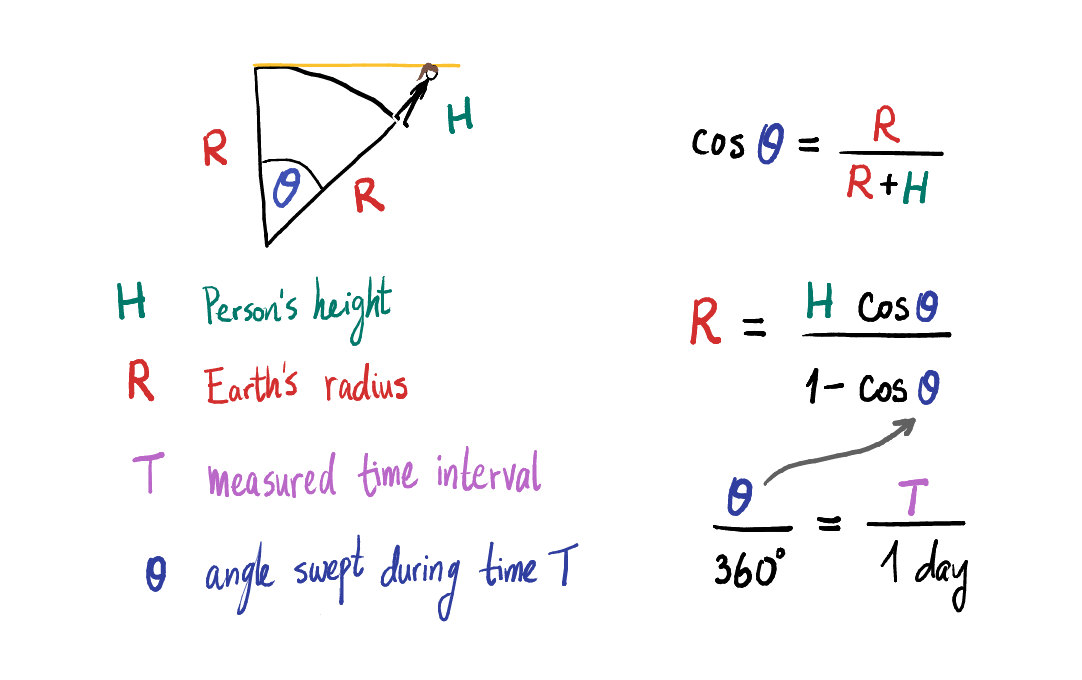
Illustration 3: The right triangle obtained in the experiment and the relations among the parameters. Insert the relation between the angle θ and the measured time T into the expression to obtain the radius R.
If we look at the diagram of our experiment, we can identify a right triangle in which one leg is Earth’s radius (corresponding to the moment you started the timer) and the hypotenuse is Earth’s radius plus your height (corresponding to the moment you stopped the timer). The angle we want lies between these two lines, so the ratio of the two equals the cosine of the angle.
cos θ = R / (R + H)
Solving for Earth’s radius gives:
R = H · cos θ / (1 − cos θ)
Insert the angle you calculated and your height, and you have an estimate of Earth’s radius straight from the shoreline! Continuing the previous example, suppose your height is 160 cm and you measured 10 seconds between the two sunsets—then the radius you calculate is 6,050 km. Not bad compared with the average radius of 6,370 km!
Note that atmospheric conditions during the measurement can slightly distort the result—there are atmospheric effects that bend the Sun’s rays at sunset (ever seen a flattened Sun hovering above the horizon? That’s an illusion, of course [2]), and this will affect the accuracy of your timing. Still, even a result that deviates by, say, ten percent from the known radius is very impressive for something calculated in a few minutes on the beach!
To conclude, here are some variations on the simple method presented here:
For better precision in timing, you can use a tower of known height (ideally one with an elevator!). Start as close as possible to the tower’s base (e.g., lying down on the ground outside—for science!). When you see the Sun’s last ray disappear, start the stopwatch and quickly climb to the top of the tower. Stop the timer when you see the last ray vanish again, this time from the top. Using the same calculation as before, with the tower height replacing your height, you can achieve higher accuracy. You can also do this experiment with a friend stationed at the top who reports when they see the last ray disappear.
Another variation: if you are more of a sunrise person than a sunset person, fear not! You can measure Earth’s radius in exactly the same way at dawn. The difference is that this time you start standing, and when the first ray of light appears, lie down quickly—the Sun will disappear again—and measure the time until the first ray reappears. Use this time difference exactly as you did at sunset.
And one more advanced option: use a drone so you can observe multiple sunsets at different times and altitudes. The more data you collect, the more accurate your measurement will be [4].
Either way, we hope you enjoy the experiment and invite you to share your results!
Hebrew editing: Shir Rosenblum-Man
English editing: Elee Shimshoni
References:

Noa holds a PhD in Physics from the Technion and is currently a postdoctoral researcher at the Princeton Gravity Initiative at Princeton University. Her research focuses on quantum effects on black hole backgrounds. She also serves as a scientific editor at “Little, Big Science".
Noa holds a PhD in Physics from the Technion and is currently a postdoctoral researcher at the Princeton Gravity Initiative at Princeton University. Her research focuses on quantum effects on black hole backgrounds. She also serves as a scientific editor at “Little, Big Science".


